Over the past decade, farmers, communities, researchers, policymakers, and international organizations have increasingly taken up agroecology. Yet higher education has struggled to keep pace.
While more colleges and universities now offer agroecology-related courses and programs, many still fail to embrace agroecology's full transformative potential, particularly its radical holism, transdisciplinarity, and its rootedness in political change.
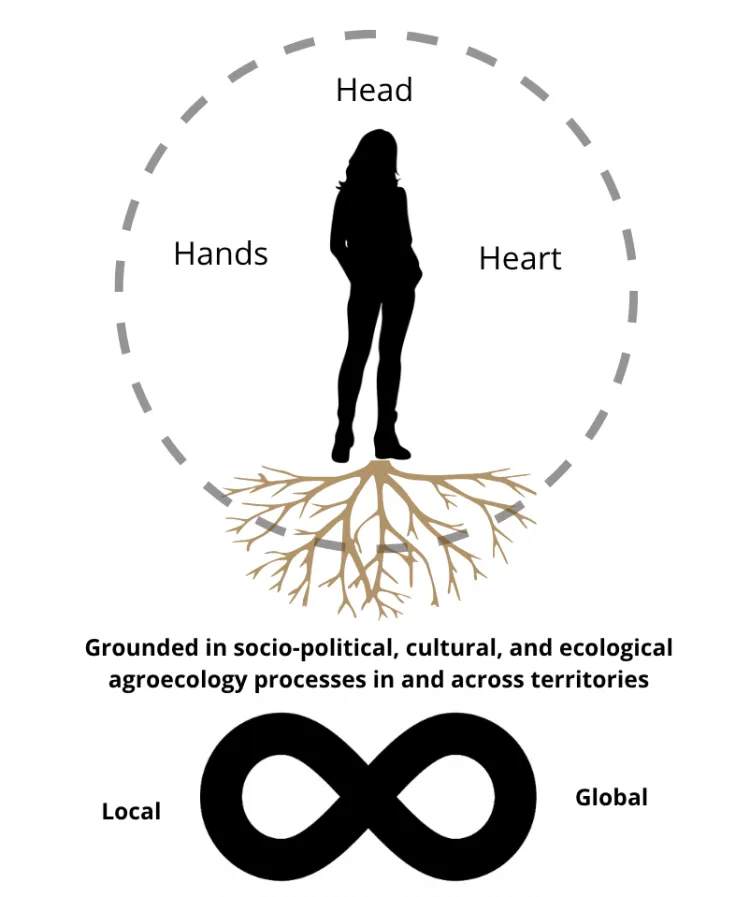
In a recently published paper - Pedagogical foundations for agroecological transformation in higher education - we argue that teaching to transform means moving beyond conventional models of instruction that focus on top-down knowledge transfer and narrow technical training. We make the case that Education for Agroecological Transformations requires cultivating three interconnected dimensions of education and intentionally rooting education in local and global processes of agroecological transformation.
This will require moving beyond the narrow focus of education as only a cognitive exercise focused on acquiring knowledge. We explain that teaching to transform engages not only the head but also the hands and the heart in a deeply committed and engaged form of education.
In this blog, we explain the Let’s Educate for Agroecological Transformations approach. We encourage you to click through to view the paper where we go into deeper detail and provide five inspiring case studies of programs that engage in these educational practices.
Three Methods of Teaching to Transform in Agroecology
The Head: Thinking Across Boundaries
Addressing complex food system challenges requires understanding food systems through ecological, social, cultural, economic, and political lenses simultaneously. Yet higher education has long been organized around disciplines, creating barriers to the integrative thinking agroecology demands.
Transdisciplinary education bridges the natural sciences, social sciences, humanities, and, crucially, Indigenous and local knowledge systems. At the heart of this approach is diálogo de saberes (dialogue of knowledges) and interscienctific dialogue which recognizes diverse forms of knowledge as equally valuable, relevant, and crucially important.
In practice, this means creating educational experiences that encourage students to cross boundaries: between disciplines, between academic and community-based knowledge, and between many ways of knowing. Students learn not only to integrate different perspectives but also to engage respectfully with communities where much of this knowledge is generated and sustained.
Building meaningful transdisciplinary education environments requires intentional design. Students need opportunities, mentorship, and collaborative spaces that support knowledge co-creation and systems thinking. They must develop skills and competencies that are rarely prioritized in conventional agricultural education but are essential for navigating complexity and fostering transformation. These capacities remain underdeveloped in many agroecology programs, limiting their transformative potential.
The Hands: Educating Through Practice
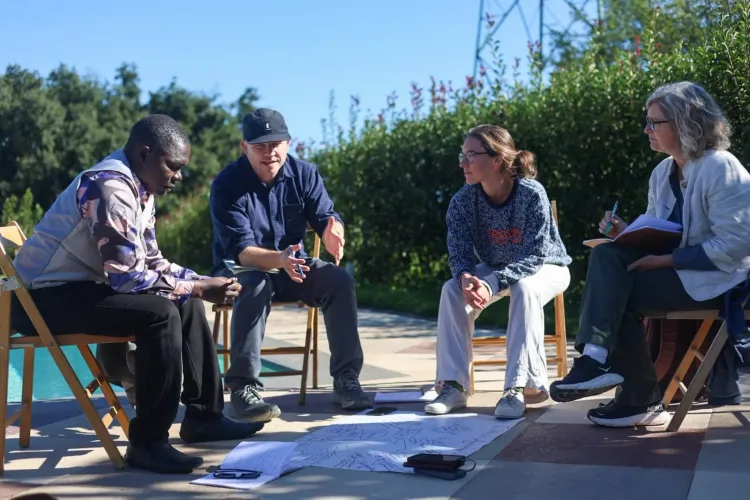
Experiential education is a cornerstone of agroecology education. It invites students to engage directly with farms, food systems initiatives, and community-based projects, where they encounter the practical realities and material dimensions of food production and food-system change. Such experiences go far beyond technical skill development or simply "getting one's hands in the soil" (though that is crucial too). They are intentionally structured around cycles of action, reflection, and adaptation that deepen understanding and strengthen practice and making meaning.
Experiential education also highlights the relational nature of knowledge. Through collaboration with farmers, community organizations, and peers, students participate in collective education processes and contribute to the co-creation of knowledge. Participatory approaches connect academic learning with lived experience and practical expertise while building relationships rooted in reciprocity and trust.
Importantly, experiential education can also bridge practical action and broader social and political change. Through direct engagement with communities, students come to understand how local knowledge and everyday practices connect to larger questions of justice, sustainability, and transformation.
Yet neither the head nor the hands alone can cultivate the emancipatory vision at the core of agroecology.
The Heart: Cultivating Justice, Agency, and Commitment
The heart represents the ethical and political dimensions of education. It invites students to ask not only what works and how systems function, but also why conditions exist as they do and who benefits or bears the consequences.
Critical pedagogy brings this dimension into focus. It draws from traditions of popular education and social struggle that emphasize dialogue, horizontal learning, and collective knowledge creation.
Rooted in traditions of social justice and liberation, critical pedagogy fosters critical consciousness: the ability to recognize, question, and challenge the power structures that shape food systems. Students learn to see food systems as arenas of contestation and possibility, where issues of land, labor, knowledge, wealth, and decision-making are deeply political.
Through this process, learners develop the capacity to identify systemic inequities, imagine alternatives, and become active agents of change. Rather than emphasizing individual achievement alone, critical pedagogy fosters collective action and a shared political purpose. Education becomes not merely a means of acquiring knowledge but a practice of transformation.
In the article, critical pedagogy is therefore understood as an aspirational horizon for agroecology education in higher education, recognizing that institutionalized educational settings may reproduce hierarchies and practices that contradict its political, territorial, and epistemological foundations.
Drawing on the diverse experiences represented in the Let’s E.A.T. community of practice, we aim to reclaim transformative educational practices, learn from social movements, and foster change within university settings.

The Spatial Dimensions of Teaching to Transform: Rooting in Territory and Global Movements
Transformative agroecology education requires not only ongoing integration of all three dimensions, but also a commitment to grounding these processes in territorial and global processes of transformation.
Territorial Rootedness
Educational praxis must be rooted in place and relationships and in agroecological transformation processes in territories. Place-based education emphasizes learning deeply connected to the ecological, cultural, historical, and social realities of specific places, and to the struggles to realize agroecological futures in territories. Within agroecology, this means understanding land not simply as a productive resource, but as a site of identity, memory, relationship, learning, and struggle. It requires engaging with the historical and ongoing connections that Indigenous peoples, peasants, farmers, and local communities maintain with landscapes, foodways, and the more-than-human world of soils, plants, animals, and waterways.
Rooting agroecological education in territory creates opportunities for learners to engage with diverse ways of knowing and being that colonial and industrial agricultural systems have often marginalized. Territorial approaches foreground the biocultural diversity of places and highlight how local knowledge, cultural traditions, and ecological conditions shape agroecological practice. Developing agroecologists who are deeply embedded in and accountable to places is critical for fostering meaningful and lasting transformations. In contrast, educational models that present agroecology as a universal set of techniques divorced from territorial realities risk reproducing top-down and colonial approaches that overlook local complexity and context.
At the same time, territorial rootedness should not be romanticized. Places and territories are not inherently harmonious or homogeneous; histories of power, conflict, exclusion, and inequality shape them. Agroecological territories can also reflect tensions related to race, class, gender, colonialism, and other forms of oppression. Place-based education must therefore foster critical engagement with the politics of difference and the contradictions within local communities. It should help learners understand how dispossession, imperialism, displacement, and the ecological violence of industrial agriculture have shaped territories. Through deep community engagement, solidarity learning, and reflection, territorial rootedness enables learners to navigate these complexities and grounds agroecological transformation in the realities, relationships, and histories of place.
Global Solidarity
Education grounded in global solidarity complements place-based learning by helping students understand how broader economic, political, and ecological processes shape local agroecological transitions and how students can connect to global movements for transformation.
While agroecology is rooted in specific territories and communities, it also requires awareness of the global forces that influence food systems, including trade regimes, geopolitics, corporate power, climate change, and migration. A global solidarity approach therefore encourages learners to examine the connections between local realities and wider structures while developing the critical skills needed to navigate misinformation, political polarization, and competing narratives about food system change.
Solidarity education offers a pathway to operationalize agroecology’s internationalist vision by cultivating empathy, mutual responsibility, and cross-border collaboration. It creates opportunities for learners to connect local agroecological practices with national and global challenges, while critically examining power relations, colonial histories, and uneven forms of responsibility across scales.
Drawing on postcolonial approaches to international education, this perspective emphasizes understanding the enduring influence of colonial relations and the importance of decolonial commitments in education. Such an approach holds local and global realities in productive tension, enabling students to think and act simultaneously within their communities and within broader movements for transformation.
The Let’s E.A.T. framework emphasizes cultural pluralism, cosmopolitanism, and planetary kinship, fostering learners who can respect political and cultural differences while working toward collective action. This orientation is increasingly important in contexts marked by rising nationalism, xenophobia, and other forms of exclusionary politics.
Moving Forward
The transformative power of agroecology education emerges when the head, hands, and heart are cultivated together. Transdisciplinary thinking without practical engagement can remain abstract. Intellectual and experiential education without political analysis may overlook, or even reinforce, existing inequalities. Likewise, political commitment without grounding in lived experience and dialogue can become rigid or dogmatic, replacing critical inquiry with new forms of orthodoxy.
This raises an important question: how can we make this holistic approach to education the norm rather than the exception? How do we prepare more students, practitioners, scholars, and activists to engage in food system transformation with their full selves: head, hands, and heart?
These are not merely theoretical questions. They are at the center of the work of Let's Educate for Agroecology Transformations (Let's EAT), an international community of educators committed to transformative education in higher education. We aim to provide a platform for educators to share experiences, learn from one another's teaching practices and challenges, and explore ways to expand transformative agroecology education across colleges and universities worldwide.
By integrating head, hands, and heart and imagining education as a process of rooting in transformation that links the local and the global, agroecology education can help cultivate the knowledge, skills, values, and agency needed to transform food systems.