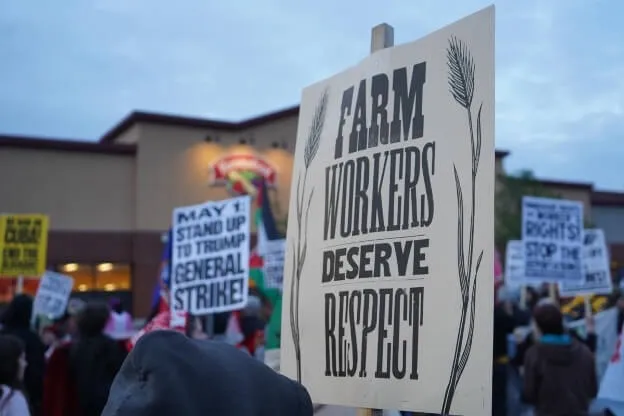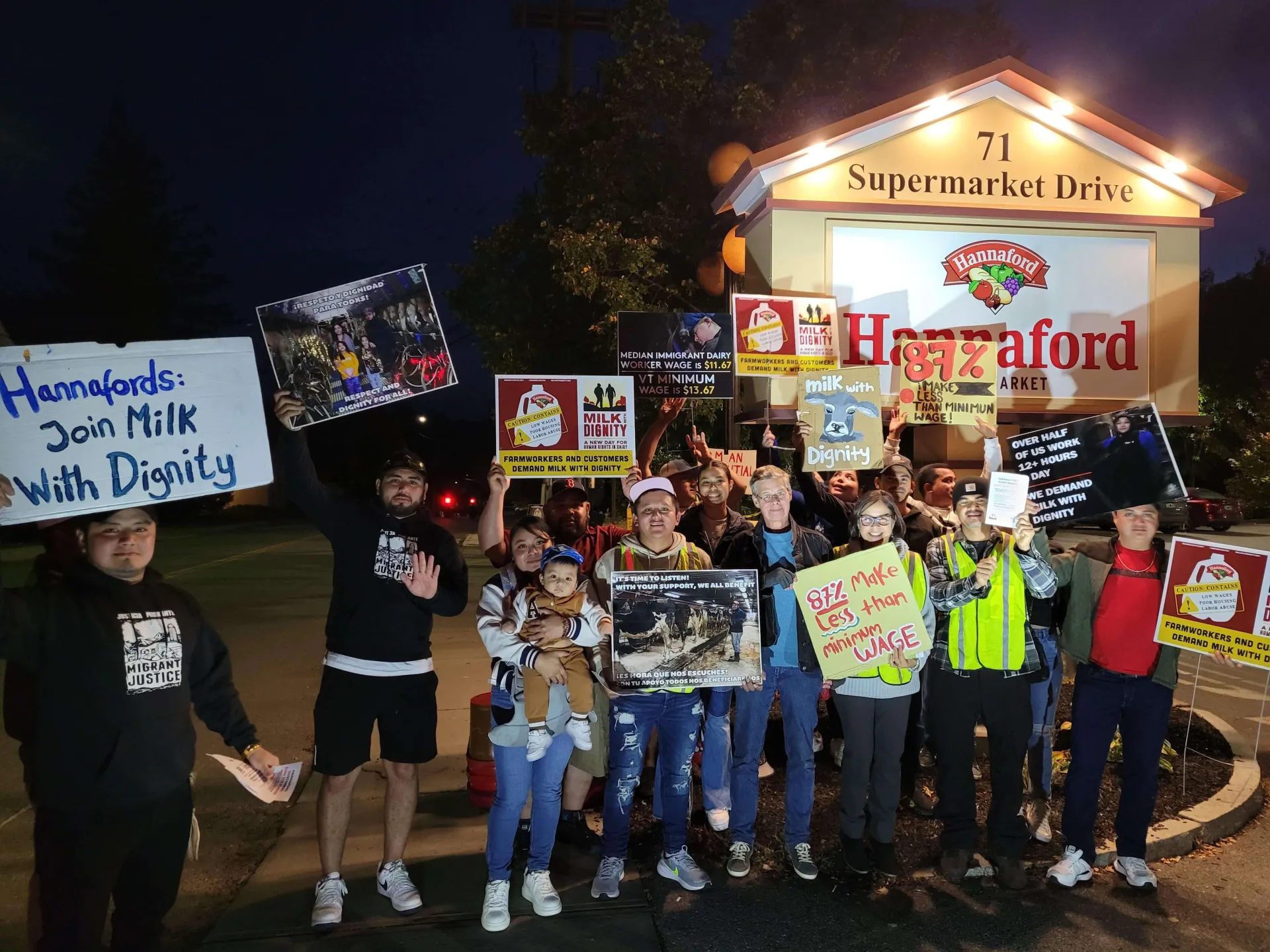
In April 2025, Vermont-based organization Migrant Justice filed an international human rights complaint with the Dutch National Contact Point for Responsible Business Conduct (NCP), claiming that Ahold Delhaize–owner of New England supermarket chain Hannaford–was violating guidelines for multinational enterprises by failing to exercise due diligence and ensure human rights in the dairy supply chains of their subsidiary. The complaint is exhaustive – over 75 pages of documentation of abuses on dairy farms in Hannaford’s supply chain.
Last month, the NCP issued its initial assessment of the complaint: that it meets the criteria for further examination. This decision follows five years of consistent refusals from Hannaford, one of the largest buyers of Vermont dairy, to source their store brand milk from farms enrolled in Migrant Justice’s Milk with Dignity program.
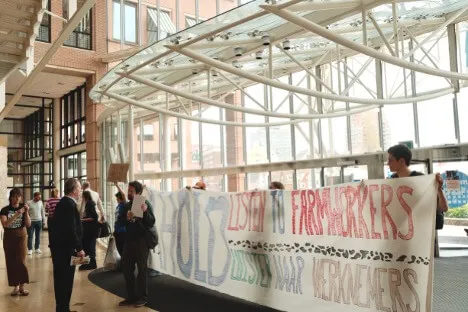
Due to their noncooperation, farmworkers have been compelled to get their foot in the door with Hannaford’s parent company, Ahold Delhaize. For the past few years, dairy workers have traveled to the Netherlands to campaign for Milk with Dignity.
“By building support among investors, [Migrant Justice] has been able to gain entry into [shareholder] meetings and directly address Ahold's executives and board of directors and inform them of the issues that are happening in Hannaford's dairy supply chain,” explains Will Lambek, Migrant Justice organizer.
What happens next is a “sustained dialogue” between Migrant Justice and Ahold Delhaize, mediated by the NCP. If the parties successfully reach a resolution, the complaint ends there. If not, the NCP moves forward with its investigation as to whether Ahold Delhaize has violated guidelines.
“Our expectation is certainly that when Ahold learns about the conditions in Hannaford's supply chain, and when Ahold learns about the solution, of Milk with Dignity, that they will join the program,” says Lambek. “That's what workers are demanding and that's what farmworkers expect."
The Origins
Migrant Justice was created after the 2009 preventable workplace death of José Obeth Santiz Cruz on a Vermont dairy farm. The tragic event catalyzed workers to start the arduous and dangerous organizing, farm-by-farm, for fair and humane working conditions. In the fifteen years since, farmworkers have built collective power to hold corporations accountable and demand what they deserve, despite the system’s failures to make this process easy.
“Migrant Justice pulled back the curtain to reveal that behind the postcard image of Vermont dairy, there's a community of immigrant workers who are on farms around the state, sustaining the state's dairy industry,” says Lambek. “And that they are organizing together to fight for their human rights."
In those early days, Migrant Justice leaned on the work of the Coalition of Immokalee Workers (CIW) in Immokalee, Fla. – a group of farmworkers who successfully negotiated agreements with fourteen major corporations over their tomato sourcing. The CIW utilized a model of Worker-driven Social Responsibility(WSR), and a core insight of this model is that “it's not enough to organize farm-by-farm or to put pressure on employers,” says Lambek. “You actually need to go to the corporations at the top of supply chains, because those are the actors in the industry that have the power and the resources to make those sorts of investments to ensure protection for workers' rights.”
It distinguishes itself from corporate social responsibility, where decisions are made by corporate boardmen who have rarely been on the frontlines of farm labor. Instead, it means that decisions are guided by the needs, priorities, and visions of workers themselves.
Teresa Mares, associate professor of anthropology at the University of Vermont, long-time labor researcher, and collaborator of Migrant Justice, has watched the organization take shape since she moved to Vermont fifteen years ago. The WSR model stands out to her as both unique and a key factor in Migrant Justice’s success.
“Workers know what dignified work will look like, right?,” she says. “Workers know firsthand what will make their lives easier, better, and more sustainable.”
Vermont dairy workers adapted the principles of the CIW’s model of Worker-driven Social Responsibility and the Fair Food Program to the Northeast dairy industry, launching the Milk with Dignity program in 2018 following an initial contract with Ben & Jerry’s. “That itself came on the heels of a multi-year public campaign,” says Lambek. This brought about 20% of Vermont’s dairy industry by volume into the program, covering over 250 dairy workers.
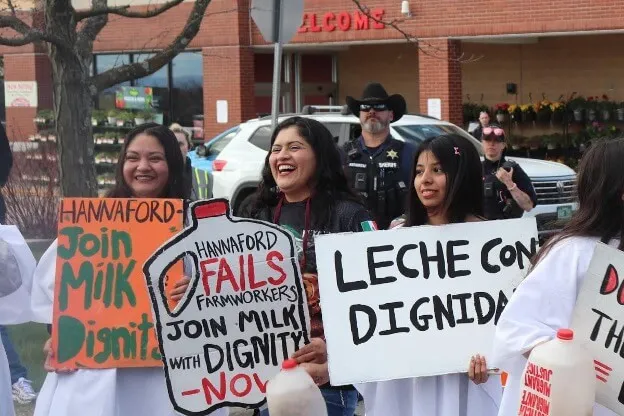
Lambek describes the program as a win-win-win. Farmworker rights are protected by a farmworker-authored code of conduct, and workers receive regular education on what those rights are – standards on wages, hours, housing, safety, sexual harassment, child labor, retaliation, and more. Farms in the program are audited through site and housing inspections that include interviews with workers and management and receive a premium on the price of milk from participating companies, which covers the cost of compliance. As for the companies, it provides them an “independently verifiable claim that their milk is being produced on farms where workers are protected from human rights violations.”
“Now we have close to a decade of data showing us the difference between farms in the program and farms outside the program, and it’s really a tale of two dairy industries,” Lambek says. Since 2018, the Milk with Dignity Standards Council has released four reports detailing the unprecedented improvements to living and working conditions on farms enrolled in the program.
Moving Beyond Vermont
After securing the win for farmworkers in the Ben and Jerry’s supply chain in 2018, Migrant Justice pivoted their energy to Hannaford. The shift in focus from Ben & Jerry’s, largely a food processor, to Hannaford, a retail chain, posed a slew of challenges. As increasing consolidation impacts both the dairy industry and the supermarket industry, the resulting power dynamics affect the entire supply chain, making the Milk with Dignity organizing more of a labyrinth.
“A smaller number of buyers at the top are exerting a downward pressure on the price of milk, and that creates a downward pressure on wages and working conditions on the farms themselves,” Lambek shares.
Despite these differences and difficulties, Migrant Justice has successfully adjusted their organizing efforts to target the corporation that sits on top, which to Mares is “very exciting.”
“It has the potential to really scale up the impacts of the Milk with Dignity program beyond Vermont, into the Northeast, and now, as we're seeing, into global relationships,” Mares adds.
For years, Migrant Justice has explicitly brought labor into conversations surrounding our food system, which Mares claims there has “never been enough attention” on. This has shown up in all scales of their organizing – like state efforts to allow workers to obtain a Driver’s Privilege Card or municipal efforts to push for bias-free policing. This strength has proved vital in their work in the Northeast, and now, globally.
Beyond these efforts, they've excelled in building coalitions with other labor groups in the community, answering the question of, as Mares puts it, “how can there be greater solidarity across labor lines for people who are doing very different kinds of work?”
Among everything, Migrant Justice has made noise. What started as a movement of farmworkers has attracted the support of Vermonters from all lines of work, because the state depends on a functioning – dignified, worker-driven, equitable – labor system.
“Whether it is our purchasing behavior or our organizing behavior or our voting behavior () we all have some culpability,” Mares concludes.
What's Next?
With both Migrant Justice and Ahold Delhaize accepting the offer for mediation, Ahold Delhaize finds itself in the position of having to sit down with farmworkers for the first time – and that, to Lambek, is “certainly a victory.”
Where hope and celebration exist, so does caution and vigilance. The NCP does not hold judicial authority, so the final ruling does not impose a binding obligation on Ahold Delhaize or Hannaford. This moment is simply an opportunity for the company to do the right thing – an opportunity that farmworkers will not let slip out of their hands.
“It's not enough just to have a dialogue – farmworkers want and deserve real action from the company to take responsibility for the abuses in their dairy supply chain and to stop those abuses by joining the Milk with Dignity program,” Lambek concludes.