Globally, agroecology has gained traction as a way to transform the food system into one that is more ecological and just. Yet in the United States, a full embrace of agroecology has not been as extensive due to a long history of industrial agriculture. Despite this, farmers, grassroots organizations, and academics continue to work hard to establish agroecology in the U.S. and as the movement builds more momentum, academic institutions have an important role to play.
“At the Institute for Agroecology, we define transformative agroecology as a movement and practice that tackles the root causes of injustices in food systems, carries out research with-and-for people, and centers equity,” says Ernesto Mendéz, co-director of the UVM Institute for Agroecology (IFA). “In order to advance and deepen the commitment to transformative agroecology in academia in the United States, it is necessary for institutions working in the field to engage in a more cohesive and collective approach.”
Recognizing this need, the IFA launched a national agroecology network in 2025. It is made up of 11 academic institutions and two advocacy organizations that are working across natural and social sciences, policy, advocacy, and strategic communications in pursuit of transformative agroecology. Supported by the WK Kellog Foundation and McKnight Foundation, the U.S. National Agroecology Network is emerging from a shared understanding that, while agroecology work in U.S. academic institutions is growing , it remains fragmented and structured, supported infrastructure is needed to advance agroecological research, practice, and advocacy across the nation.
“Our job as academic institutions is to generate intellectual capital, that’s what we’re good at,” says Alexis Racelis, Houston Endowed Chair for Science and Technology at the University of Texas Rio Grande Valley, where he serves as an associate professor in the School for Earth, Environmental, and Marine Science, and director of the Agroecology and Resilient Food Systems Program, and one of the participants of the network. “It could be through teaching, it could be through research, but that extra step of informing action is where we need some work.”
According to the IFA, the ultimate aspiration of the network is to build “nets-that-work.” These will go beyond connecting and information sharing to bringing together researchers, advocates, and educators to coordinate work that complements and supports agroecological efforts led by farmers, grassroots organizations, and other food system advocates.
“I think there is still some work we need to do as academic agroecologists to be able to better embrace the movement and connect with folks looking to practice agroecology,” adds Racelis. “Because in the end, those are the people who are making the change that we aspire to.”
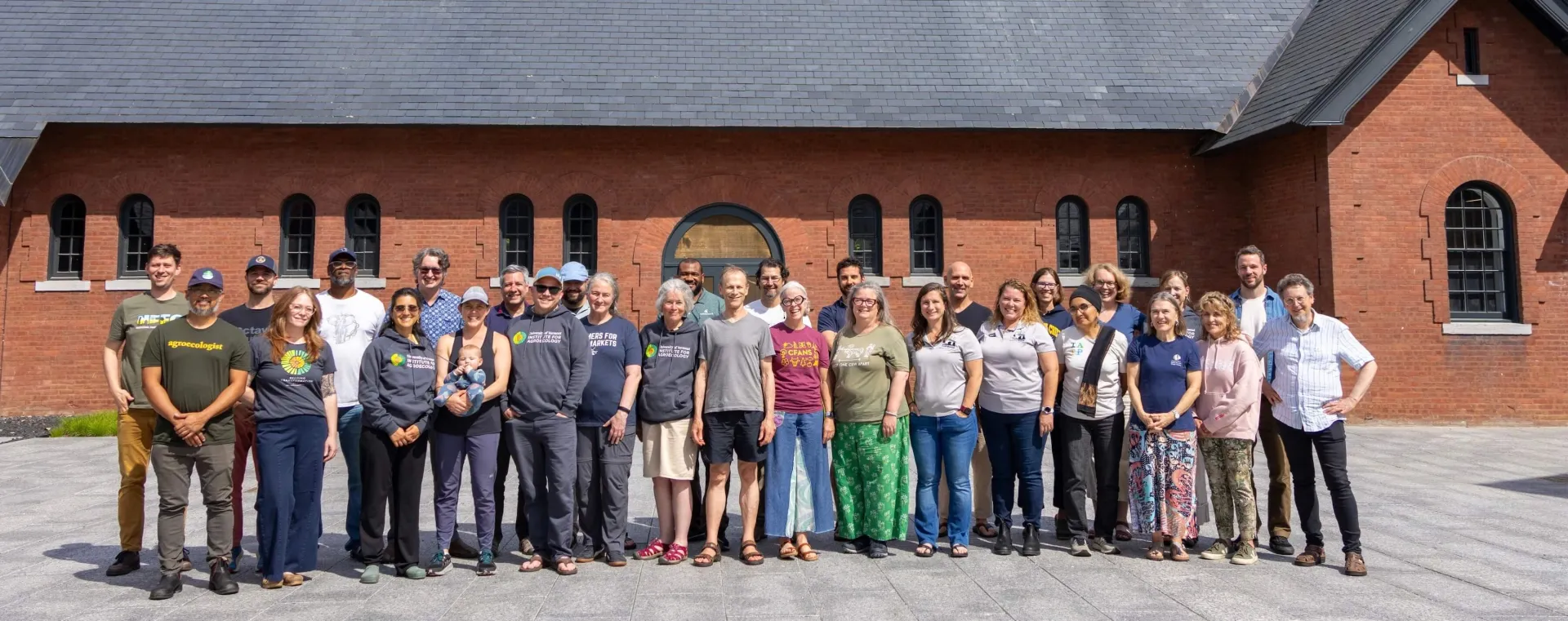
The network has been meeting remotely to identify and prioritize shared areas of interest in research, learning programs, institutionalization, and advocacy. In June 2026, network members came together in-person at Shelburne Farms, an renowned educational farm in Vermont. Hosted by the UVM Institute for Agroecology, 28 people from the 13 institutional members of the network and three funders attended the convening for two days of strategizing, breaking bread, and deepening relationships.
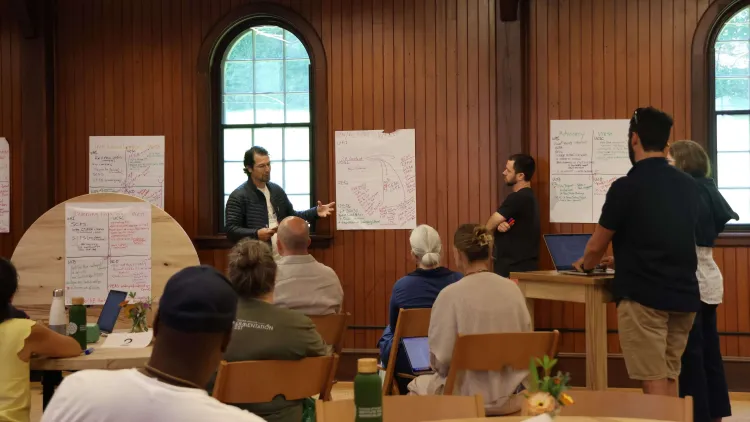
“Together, we were able to strengthen the network, take stock of the work already carried out across the network, and begin to define next steps,” says Mendéz. “We are in the process of analyzing all the ideas that emerged but are excited for what’s to come in second phase of the network.”
Some preliminary emerging projects for the next phase of the network, include:
Research- Identifying and examining successful “Agroecology Bright Spots” in the different regions where network members are present. Focus on why they have been successful, the challenges that they face, and what can be learned to apply in other regions.
Learning Programs- Developing a national community of practice around education and learning for transformative of agroecology, building off efforts in the U.S. based Sustainable Agriculture Education Association (SAEA) and IFA’s Let’s EAT global Community of Practice.
Building Thick Legitimacy – Taking a coordinated approach to developing and broadly disseminating the work of the network through collective communications approaches in owned, earned, and social media.
In the coming months, the IFA team will synthesize the findings and work with the network to propose collaborative projects in the three areas outlined above.
The U.S. National Agroecology Network includes members from:
Florida Agricultural & Mechanical University; Michigan State University; North Carolina State University; University of Wisconsin, Madison; University of California, Berkeley; University of California, Davis; University of California, Santa Cruz; University of Hawaii – Manoa; University of Hawaii – West Oahu; University of Minnesota; University of Texas, Rio Grand Valley; University of Vermont; National Family Farm Coalition; Institute for Trade and Agriculture Policy