Which is why University of Vermont researchers in the College of Agriculture and Life Sciences are approaching these problems at the community level.
In the Community Development and Applied Economics Department (CDAE), Master of Public Administration and Graduate Certificate in Community Resilience and Planning Director Christina Barsky recently co-published an all-of-society project in the International Journal of Emergency Services examining how rural areas weather natural disasters.
And in the Ecological Planning Laboratory led by UVM Extension and the Field Naturalist graduate program, faculty, students and Extension staff are entering their third year of partnering with Vermont officials and organizations to build watershed-scale resilience for future flooding.
Examining how rural communities manage natural disasters
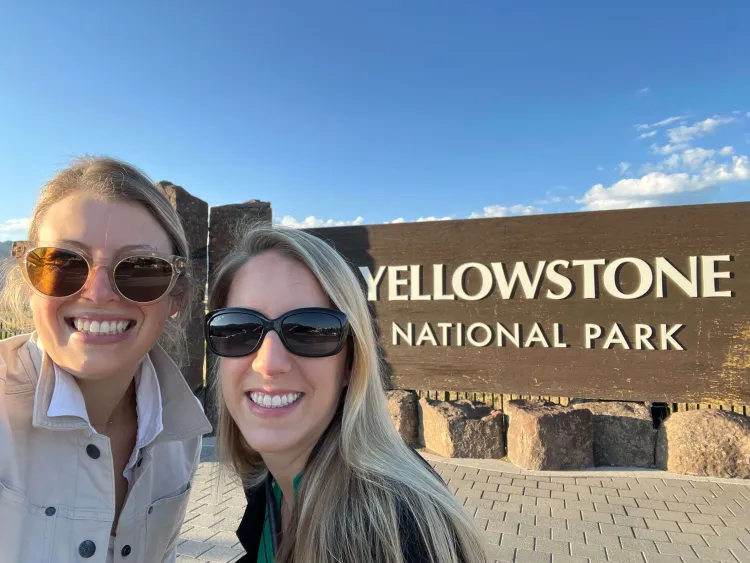
In June 2022, rapid snowmelt combined with heavy rains created a one-in-500-year flooding event in the Yellowstone region of Montana. Christina Barsky, who is currently an Associate Professor in UVM CDAE, was then an assistant professor at the University of Montana (UM), and she happened to already be in touch with an alum who was also the federal recovery officer that FEMA assigned to the area.
That's how Barksy got invited to a recovery meeting with emergency management officials that fall — where she said she was totally out of her element.
"I studied poetry composition in college," Barsky said. "I do not think of myself as being an emergency manager."
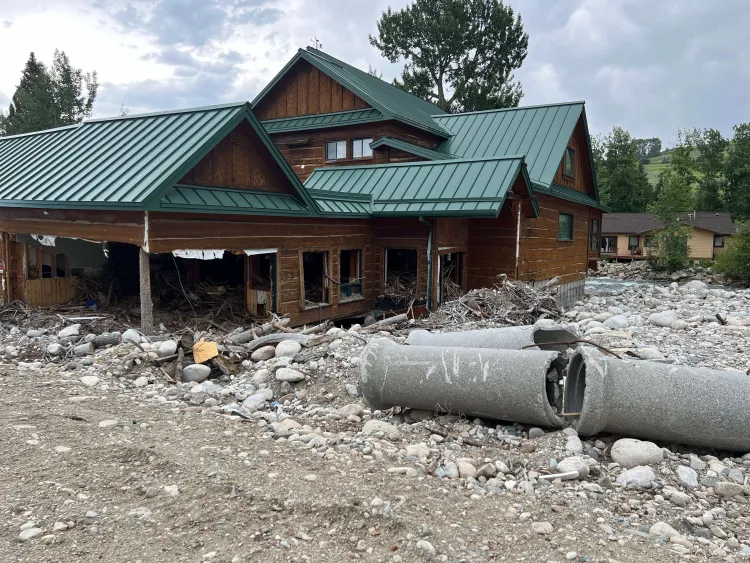
And yet, during the meeting, she realized she had something federal officials didn't have: local, rural context. Before her academic career at UM and eventually UVM, Barsky worked for nearly two decades in community economic development and policy advocacy in the American West. (She also spent her childhood in a tiny town in Michigan's Upper Peninsula.)
“In the conversations we were having, it became apparent to me that our isolation and rurality was unfamiliar," Barsky said. "FEMA was talking about the number of bulldozers we need to put back riprap along the river and the amounts of heavy machinery needed for reconstruction of all these other things, and I thought, we don't even have that many bulldozers in the state of Montana, let alone in the Yellowstone region. It was a total disconnect."
This disconnect, she added, often arises when people more used to urban areas try to apply the same resources to less-populated, more-isolated places. And Barsky saw an opportunity to better understand the specific ways that rural communities build natural disaster resilience.
"There are some unique practices that are going on here that other places could learn from," she said.
Together with co-author Lauren McKeague, Barsky spent two years surveying, interviewing and engaging local government officials, small business owners and residents in the flood-impacted areas of Montana's Yellowstone region. In one vein of the project, Barsky and McKeague synthesized that data and applied the community capitals framework (CCF) to identify which supports community members said they needed for future resilience.
In February 2026, their findings were published in the International Journal of Emergency Services. Among the seven community capitals — built, cultural, financial, human, natural, political and social — the study notes that while respondents considered nearly all capitals valuable for disaster resilience, residents identified physical infrastructure (built capital) and relationships within the community (social capital) as most important. Local governments and small businesses prioritized the legal authority to acquire and distribute resources, outreach with safety information and the trust of local citizens (political capital).
In the course of their work, Barsky and McKeague heard 2022 flood stories like a church congregation making a good-faith effort to sandbag a levee but creating a traffic hazard, and a resident with a ham radio telling his neighbors flooding information because they didn't have cell service or smartphones to receive emergency notifications. And from examples like these, the researchers noted something that didn't fit neatly into the existing community capitals framework, but that emerged as vital for resilience: planning and policy at the local governance level to lessen natural disaster impact.
"A mayor of a town told us, 'I didn't even know I had a role in disaster recovery,' and it was like, 'If you don't, who does,' right?" Barsky said.
Her perspective is that everyone has a role, and that it's important to for leaders to think through ahead of time all the skills, tools, knowledge and abilities community members can offer.
"I don't think it's just lights and sirens," she said. "It's all of the other pieces that go into preparedness, response, recovery and resilience."
To that end, Barsky is now the director of UVM's graduate Certificate in Community Resilience and Planning program, which prepares students to lead and assist communities through times of crisis and transition. And she hopes the knowledge and skills provided by the program can be directly applied right here in Vermont and across more rural areas.
"I'm working on bringing in some [local governance] practitioners across the state to talk about, what are our needs and how can we design class offerings or programming that can better address those," Barsky said.
The program is also moving toward offering online certification so it's more accessible.
Partnering with Vermont communities on flood resilience
Similar to the UVM graduate Certificate in Community Resilience and Planning program, the Ecological Planning Laboratory (EPL) is collaborating with local communities on the tools they need to develop resilience.
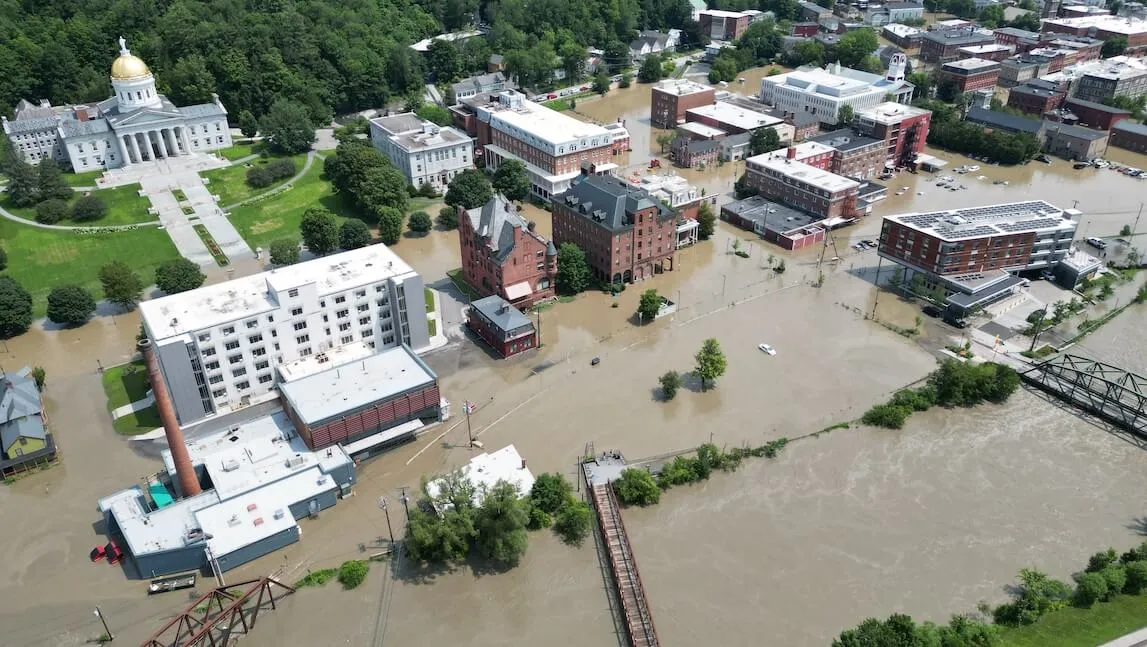
The EPL started in response to historic flooding across the state in 2023 and 2024 (more flooding would come in 2025). Given that the impacts of these natural disasters are a repeated and long-term challenge, the EPL wants to provide Vermonters with repeated and long-term support.
The program does this through finding funding, offering scientific expertise and student interns and elevating the narratives that emerge from the work communities are already undertaking in response to flooding. The overall goal: help people concretely grasp what it means to steward their local watershed.
"The whole land-grant mission is about connecting the university, the expertise, the resources, the people out in the community," said Hans Estrin, with UVM Extension, in an introductory video made about the EPL. "This is really a bottom-up approach."
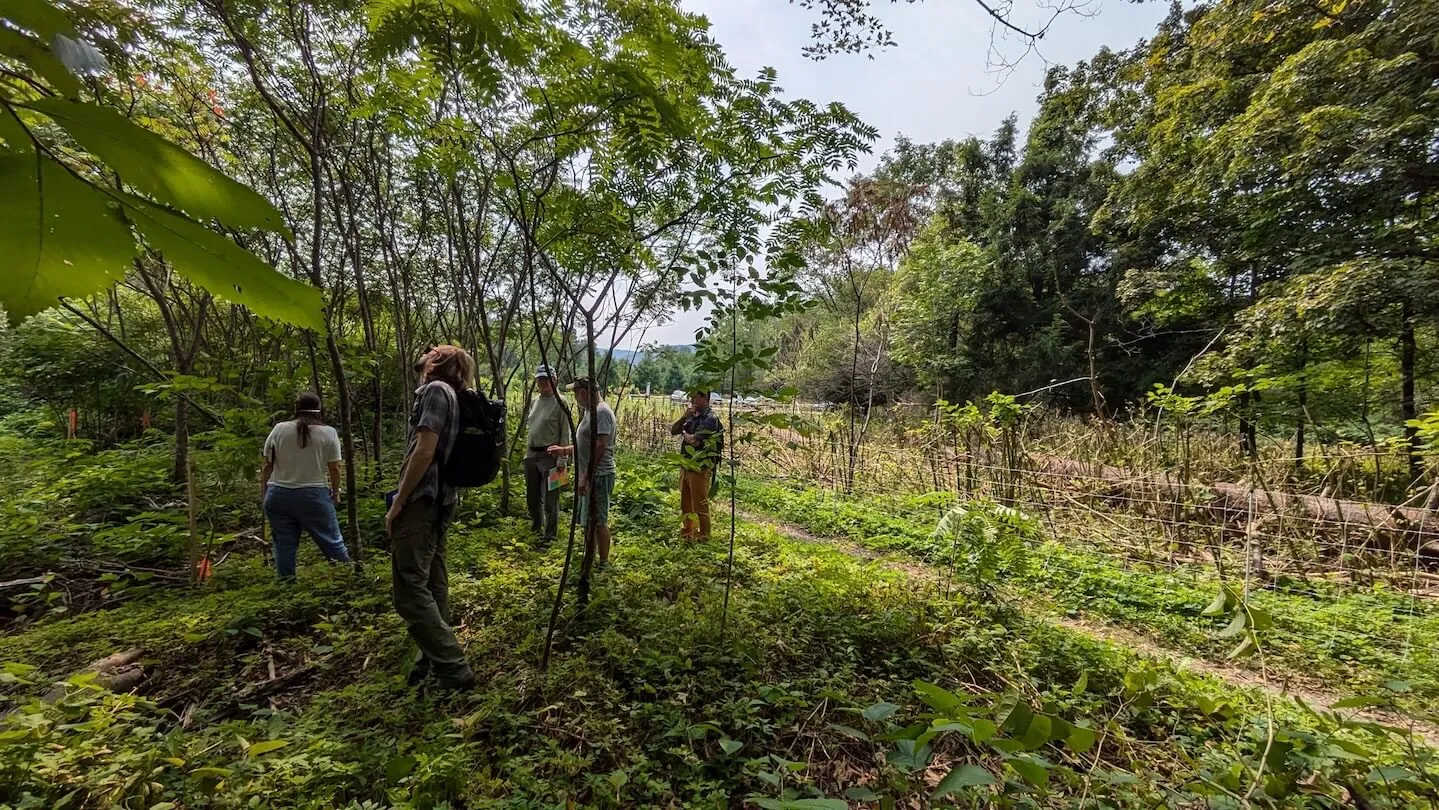
Estrin is the Extension staffer overseeing the EPL alongside UVM Field Naturalist graduate program director Walter Poleman. And he said this coming summer, the EPL will continue the work it began during 2024 and 2025, partnering with Waitsfield, Warren, and Fayston to:
- expand a coordinated research protocol to measure the effectiveness of mechanical knotweed control methods
- build cultivation and monitoring protocols to reestablish native plant communities in existing knotweed control sites
- employ six UVM summer interns to lead and energize more than 50 volunteers to manage knotweed and plant over 800 native trees
- develop a robust GIS system and web dashboard to track progress on 243 knotweed locations
- hire a digital media production company to document and communicate the impact of the work
"Another round of funding from the Lake Champlain Basin Program will employ more interns in the Mad River Valley," Estrin said. Those funds will also pay for a Field Naturalist graduate student to look into knotweed management's long-term impacts on riparian ecosystems.
"It's not just about pulling out plants," Estrin said. "It's really about helping to set the stage for the emergence of new plants, and this sets the stage for reinvigorating the dynamic natural systems that have been there for thousands of years."
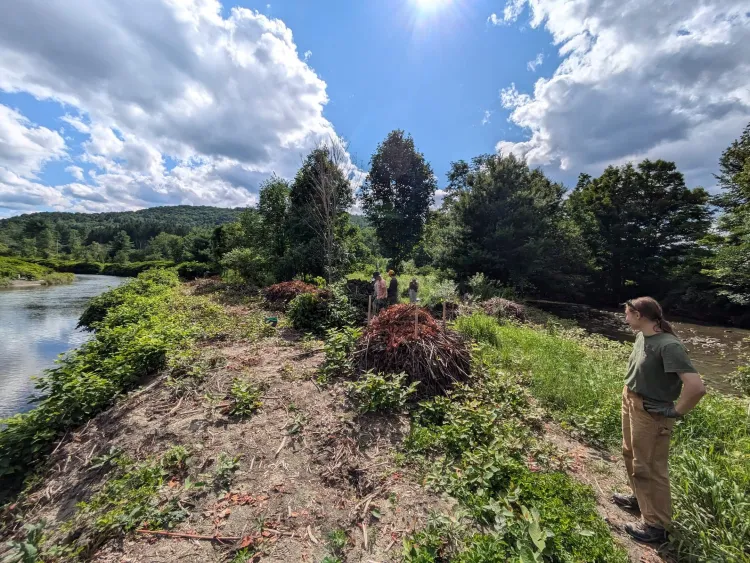
How the EPL and Mad River Valley communities have prepared for this kind of long-term work, is by building relationships first.
"We've taken a very emergent approach to the development of this community effort," said Curt Lindberg, chair of the Waitsfield Conservation Commission, in an interview for the EPL introductory video. "We didn't try to plan it all out in advance and then march along implementing that plan... we're just confident that by bringing in different people and different perspectives and voices, that will inform what we do next."
Another important approach for building long-term resilience in Vermont communities, Estrin said, is story. Because to bring in different people and perspectives and voices — they need to be able to somehow digest the vastness that is climate change and flood resilience and watershed stewardship.
"Our brains can't actually comprehend this scale of complexity, they're not designed to handle it," Estrin said. "But when we collect the stories of people and projects caring for their homes, this integrated narrative connects the dots."
For example: everyone can understand what it means to support your home sports team. So what about supporting your home watershed? And what about doing it by coordinating volunteers to manage knotweed — like in the Mad River Valley?
"It involves norming and norm-spreading between communities," Estrin said. "It's a much bigger project."