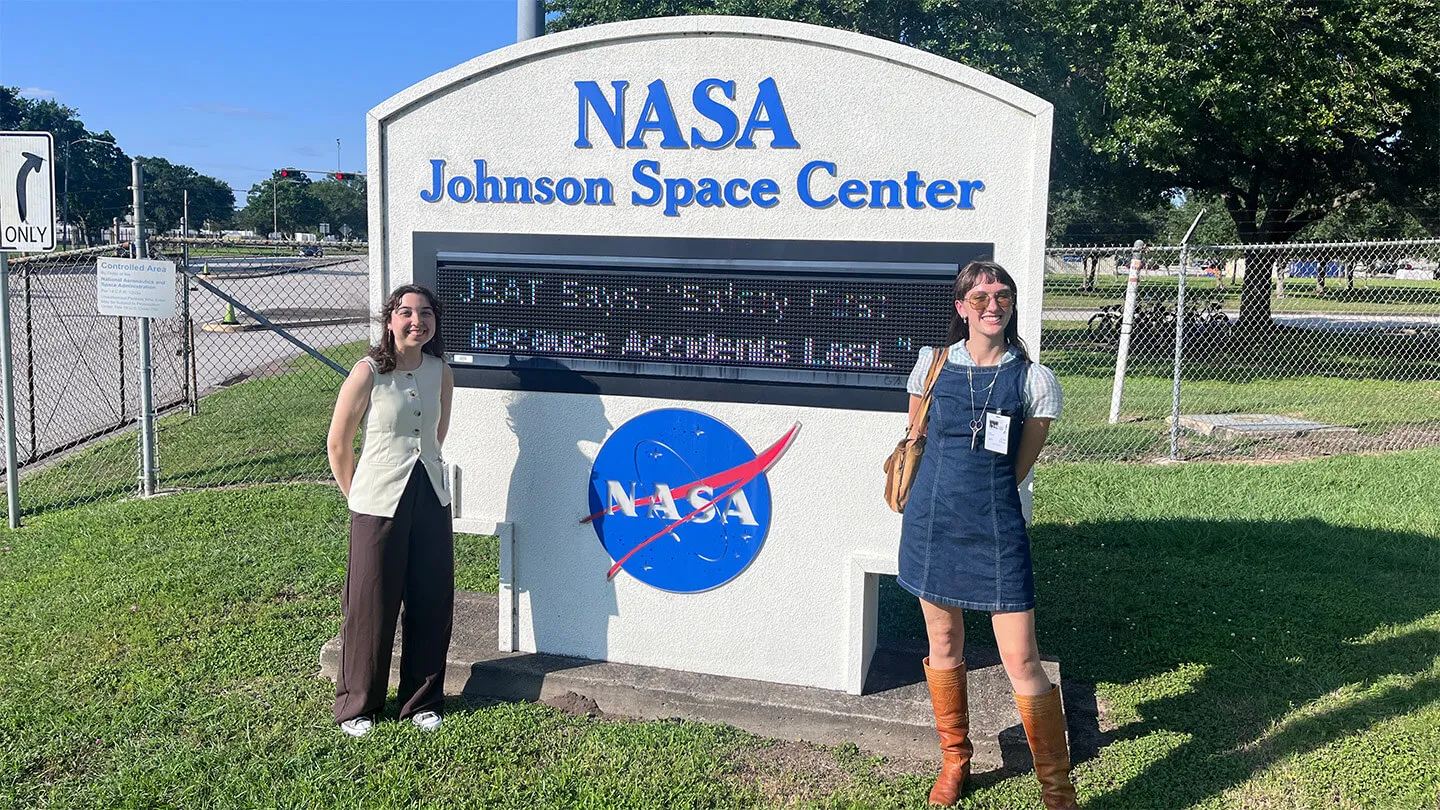
NASA’s Lyndon B. Johnson Space Center is a massive place, covering over two and a half square miles in Houston, TX. Home to both space flight mission control and astronaut training, it’s one of the agency’s largest research and development facilities. So, when two UVM College of Arts and Sciences undergrads walked through the entrance gate with their faculty supervisor this past May to meet with a team of NASA Mars experts, they were understandably a bit nervous.
“We were there to meet Liz Rampe, who is an exploration mission scientist and the deputy principal investigator of the CheMin Instrument on the Curiosity rover, one of the two major data sources I used in my research,” says Mia Jane “MJ” Moline ’26. “But she turned out to be really down to earth, if you’ll forgive the pun. We also had time to decompress and notice that all the people who were coming in and out looked, well, normal.”
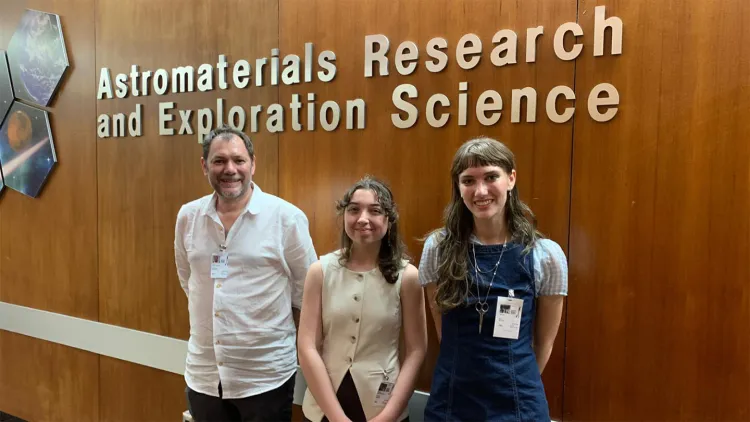
Soon afterward, the group began walking across the Space Center campus. Moline and fellow student Sky Boiros ’27, who had joined the project just three months before, were about to do something remarkable: present their research to a team of scientists (including Rampe) from NASA’s Astromaterials Research and Exploration Science (ARES) Division, which studies minerals found on Mars.
It all began during Moline’s sophomore year, when she approached Nico Perdrial, associate professor in the Department of Geography and Geosciences, about starting her own research project that would use machine learning to study the mineral makeup of the Martian surface. “I was blown away by the creativity of her idea,” Perdrial says. “I thought it was incredibly brilliant and that we could leverage some initial research funds to pursue it.”
Perdrial and Moline submitted her initial data analysis to the Vermont NASA Established Program to Stimulate Competitive Research (EPSCoR) and were awarded a $45,000 grant to pursue the research and travel to the Johnson Space Center. Two years and a whole lot of hard work later, the time had come to make that trip.
Now that they were at the Space Center, the magnitude of the students’ opportunity became increasingly clear. As they walked across campus to meet the ARES team, the UVM cohort was told their destination had been changed. The reason? Astronauts involved with the upcoming Artemis III mission were using the original room for training purposes. Moline, for one, saw the change of plan as a positive sign. “Our new meeting room was called Innovation, and I thought, hey, we have one of those at UVM,” she says.
The trio gave their presentation to a dozen or so eager and engaged ARES team members, some in the room and some online. After an introduction from Perdrial, Moline took over. She talked about how she had developed a machine-learning protocol to look at satellite imagery of the Gale Crater on Mars and classify different areas of the planet surface into distinct groups based on their composition. The Gale Crater is of keen interest to scientists—including the ARES team—because it’s an area that shows signs that the planet once may have hosted life. (See the spring 2026 article “Powered by Curiosity: Meet 8 CAS Student Researchers” for more details on Moline’s research.)
“It went so much better than I could have imagined,” says Moline. “I’ve been working on this project for the past two years and have explained it so many times at so many conferences that I just knew how to do it and what to say.”
Once she finished, Boiros wrapped things up with slides explaining the next steps. Finally, the floor was opened for questions.
“Watching MJ and Sky present our research to the NASA scientists was incredibly rewarding,” Perdrial says. “They impressed our colleagues and made me proud with the quality of their work and command of the topic.”
That quality and command elicited a flood of positive feedback from the NASA scientists in attendance. “They asked a lot of really awesome questions and seemed very into the methodology we presented,” Moline says. “They recommended a few other data packages to try and suggested some interesting things we could look at.” The ARES team also mentioned they had recently sent some satellites to Europa, one of Jupiter’s moons, and noted that the methodology could potentially be applied to a project like that.
“Mars is a good testing ground for the methodology I came up with because we have both the satellite data and the surface data to compare it with,” Moline says. “The cool thing about this research is that it’s making a tool that can be used to extract information from other parts of the solar system.”
The biggest takeaway for Perdrial is the value of the experience itself for both Moline and Boiros. “I am convinced that, for an undergraduate student, there is no better way to learn and make an impact than by carrying a research project and presenting the results in front of peers and professionals in the field,” he says.
“Right now, I’m writing the paper that goes along with this whole project,” say Moline, who received her undergraduate degree from UVM less than a week after traveling to Houston. “This fall, I’m moving to Iceland to start my master’s degree in geology. NASA happens to do a lot of comparative planetology field work there, and they’ve given me the names of several scientists to reach out to and share what I’ve been working on.” There’s an excellent chance that one day she’ll take her place among them. “I’ve loved both geology and planets since I was in eighth grade,” Moline says. “I kind of feel it was meant to be that I ended up doing this.”
Boiros, a rising senior whose job has been to work on consolidating three key data sets into one, is eager to take on a broader role next year as the project wraps up. “I’ll continue to work on merging the data, plus I’ll work on integrating data from one of the Mars rovers,” they say. “I’m going to do what it takes to keep our research moving toward publication.”
While this is Boiros’s first full-scale research project, they’ve already begun to consider research academia as a potential career path—and they credit Moline and Perdrial with planting that seed. “They’re both super passionate and knowledgeable people. They’ve been working on this for a couple of years and it’s clear that a lot of love went into the project for them,” they say. “Honestly, that’s what made me fall in love with both the project and with research in general. It feels like we’re sort of paving the way to something new.”
For Moline, the trip to Johnson Space Center provided some clarity about what’s next. “After two years on this project, logging on to my computer and working with data from NASA had begun to feel very normal. But then I discovered that what I’ve been doing seems new and innovative to the ARES scientists who do this kind of work professionally,” Moline says, “and I thought, okay, yeah, let’s keep doing this.”