
Innovation E336
82 University Pl
Burlington, VT 05405
United States
- B.A., Hamilton College, Clinton, NY, 2003
- Ph.D., University of Wisconsin, Madison, WI, 2008
- NIH NRSA Postdoctoral Research Fellow, University of Rochester, Rochester, NY, 2008–2011
Areas of expertise
Bioinorganic chemistry, magneto-optical spectroscopy, computational chemistry.
Courses
- CHEM 1400 and 1450 - General Chemistry I and II
- CHEM 1410 and 1460 - Exploring Chemistry I and II
- CHEM 2400 - Inorganic Chemistry
- CHEM 3400/5400 - Advanced Inorganic Chemistry
- CHEM 6010 - Intro to Graduate Research
- CHEM 6460 - Physical Inorganic Chemistry
Publications
Publications (from the Liptak Group webpage)
Awards and Achievements
- UVM CAS Dean’s Teacher-Scholar Award
- Election to VASE (Vermont Academy of Science and Engineering)
- New Talent: Americas, 2016
- Paul Saltman Award, 2015
- Ruth Kirschstein-NRSA, 2009
- Barry M. Goldwater Scholarship, 2002
Courses
- CHEM 1400 and 1450 - General Chemistry I and II
- CHEM 1410 and 1460 - Exploring Chemistry I and II
- CHEM 2400 - Inorganic Chemistry
- CHEM 3400/5400 - Advanced Inorganic Chemistry
- CHEM 6010 - Intro to Graduate Research
- CHEM 6460 - Physical Inorganic Chemistry
Publications
Awards and Achievements
- UVM CAS Dean’s Teacher-Scholar Award
- Election to VASE (Vermont Academy of Science and Engineering)
- New Talent: Americas, 2016
- Paul Saltman Award, 2015
- Ruth Kirschstein-NRSA, 2009
- Barry M. Goldwater Scholarship, 2002
Research and/or Creative Works
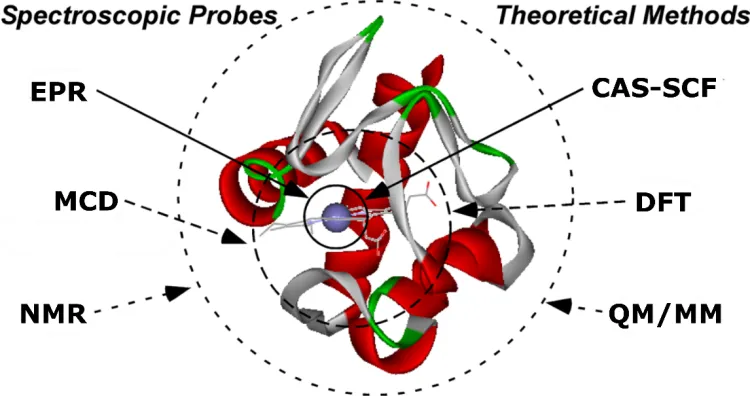
Current thinking is that over a quarter of all proteins require a metal. These metalloproteins have diverse biological functions, including: oxygen transport, electron transfer, and enzyme catalysis. The Liptak group is particularly interested in elucidating the mechanisms of metalloenzymes that rely upon transition metals such as iron, cobalt, and nickel. Currently, the major thrust of the research group is unravelling the mechanisms of heme iron acquisition by pathogenic bacteria to lay the foundation for future antibiotic development. A second research focus of the group is revealing the mechanisms of metal tetrapyrrole biosynthesis with the long-term goal of designing synthetic enzymes for production of catalysts with alternative energy applications.