Take a Tour
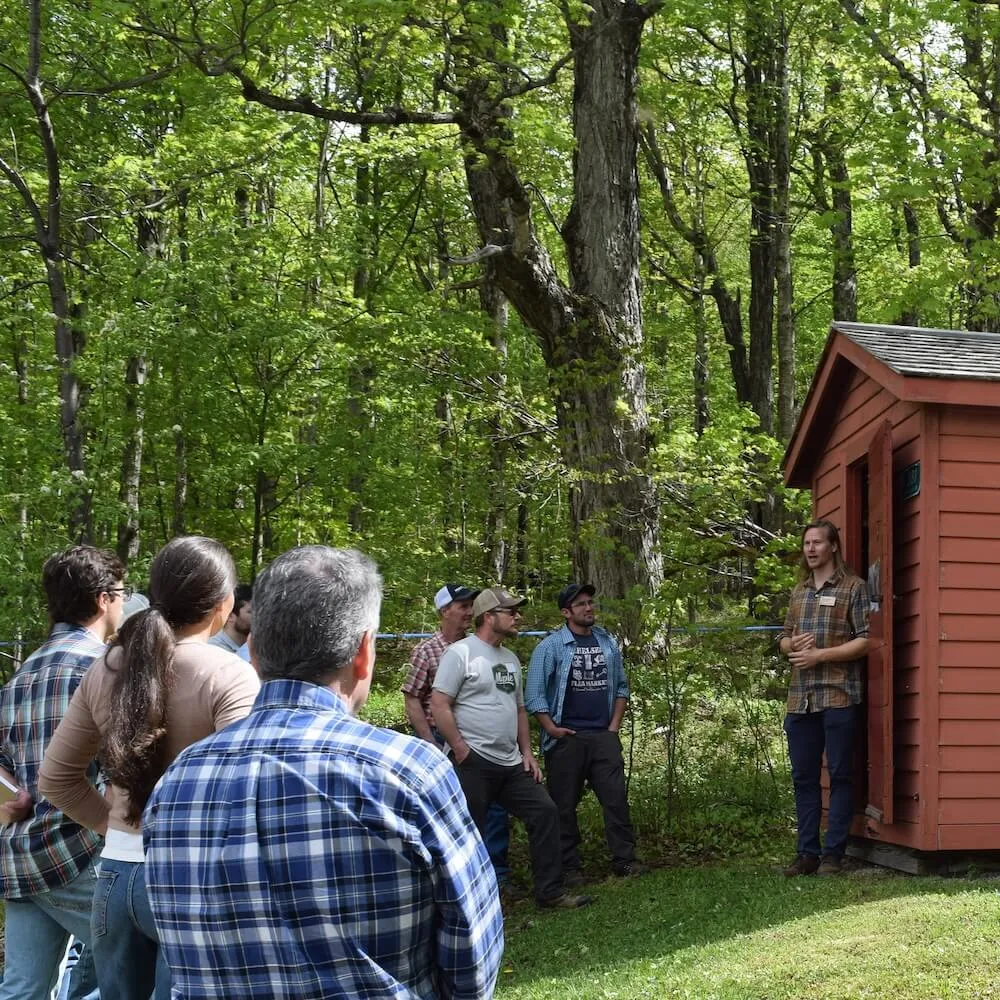
We currently offer tours for academic and maple producer groups. Tours are coordinated on a first-come, first-served basis. Our calendar fills up quickly, so we recommend submitting your requests early.
Contact Phoebe Plank to bookProctor Maple Research Center FAQs
How was the Proctor Maple Research Center founded?
The land now home to the Proctor Maple Research Center sits on what was originally the Harvey Farm, a typical Vermont hill farm where maple syrup has been produced for over a century. The original Proctor Maple Research Farm (now Center) was established in 1946 when Governor Mortimer Proctor purchased the former Harvey Farm and deeded it to The University of Vermont for $1(National Park Service, 2023). With the support of Governor Mortimer Proctor, the two co-founders, Dr. James Marvin and Dr. Fred Taylor, wanted to create a center for the research and study of maple with the goal of supporting producers and enhancing maple production internationally. The Proctor Maple Research Center is the oldest research center dedicated to the study of maple in the world.
Why is Vermont the number one producer of maple syrup in the country?
Vermont is the number one producer of maple syrup in the United States, producing 53% of the maple syrup for the country (UVM Extension, 2026). This is because Vermont has a strong heritage related to maple sugaring and its environmental conditions such as climate and soil that are extremely favorable for maple production (Barred Woods Maple, 2026). Vermont's heritage of families producing maple syrup for generations have built a rich tradition and expertise that continues to support Vermont’s dominance in maple sugaring. As for climate, Vermont has ideal conditions for tapping maples with its cold winters and moderate spring temperatures. This type of climate is vital to supporting a period of freezing and thawing in the early spring (freezing at night and warmer temperatures during the day) that allows sap flow. As for soil, maples need well-drained soil that is rich in organic matter which is abundant throughout the forests of Vermont (Caledonia Maple Association, 2025).
What does the forest look like at the Proctor Maple Research Center? How old are the trees and how diverse is the forest?
The Proctor Maple Research Center has about 200 acres of mixed hardwood forest dominated by sugar and red maple trees. About 160 of those acres are used for production, and about 7,000 maples of trees are tapped. The forest is considered to be re-growth from the early 1900s, so it is a little over 100 years old. Some sections did not begin to revert to forest until the original Harvey Farm ceased operation in the early 1940s. Other than maple trees, our forest is also made of about 25% other species such as yellow birch, American beech, black cherry, and white pine.
Other than sugar and red maples, are there any other species you can tap and make syrup from?
Yes! Maple syrup can legally be made from any species in the genus Acer such as silver maple, black maple, boxelder, bigtooth maple, and bigleaf maple. Sugar and red maples are just the most common and most abundant in northeastern North America. Despite all being the same genus, not all syrup is equal; they can greatly vary in flavor.
When is sap harvested from maple trees and for how long?
Maple trees require a pattern of below freezing temperatures at night followed by above freezing temperatures around 40-45°F during the day to produce sap (Vermont Maple Sugar Makers' Association, 2026). Sap can run in maple trees whenever these conditions that promote positive pressure in the stem occur. There have been periods where sap flows after leaf drop in the fall and before the onset of winter weather. In the early spring we see the highest concentration of days with ideal weather conditions which is why the sugaring season in Vermont typically starts in late February and runs through April, lasting for about 6-8 weeks (National Geographic, 2025). Larger fluctuations in temperature generally result in more sap flow. This is all true if vacuum technology isn’t used. There have been years of relatively few freeze-thaw cycles where syrup was still produced mostly due to vacuum-induced flow.
Why does syrup get darker later in the season?
In the beginning of the maple sugaring season trees tend to produce lighter, golden colored sweet syrup whereas at the end the season trees produce darker syrup with a more complex flavor (Adirondack Explorer, 2016). As temperatures warm later in the sugaring season, microbes start converting the sucrose in the sap to invert sugars (namely glucose and fructose). Additionally, other components in the sap increase, such as certain amino acids and minerals. When heat is added during evaporation, combinations of these compounds undergo caramelization and the Maillard reaction, resulting in darker syrup with a more robust flavor.
How does using vacuum with tubing affect sap yield?
Other than tubing systems that solely rely on gravity, vacuum pumps can be utilized to apply negative pressure through the tubing system to support greater sap flow from the trees (Republic Manufacturing, 2025). The tubing has a dual purpose of transporting sap from the tree to the sugarhouse and the vacuum from the sugarhouse to the trees. Originally, tubing was invented to reduce the labor needed to harvest sap by eliminating the need to visit each tree each time the sap flows. Proctor Maple Research Center’s long-term tree health study has shown that high-level vacuum roughly doubles our yields compared to gravity alone.
Why is reverse osmosis often used before boiling sap to make maple syrup?
Reverse osmosis is a process that sap goes through to separate water from the sap concentrating the remaining sugar before the boiling process in the evaporators. During reverse osmosis, pumps push the maple sap through semi-permeable membranes. The pours in the membranes are engineered to allow water molecules to pass through while the larger sugar molecules are rejected, thereby concentrating the remaining liquid (North American Maple Syrup Producers Manual, 3rd Ed, 2022). The reverse osmosis machine at the Proctor Maple Research Center has eight membranes and produces a concentrate that is about 35% sugar content from the sap’s original 2% sugar content. In general, using reverse osmosis can concentrate sap between approximately 4° and 40° Brix (between 8° and 20° Brix is most common). This means that reverse osmosis can be used to cut boiling time and fuel use by over 90% before evaporation (North American Maple Syrup Producers Manual, 3rd Ed, 2022).
How long does the boiling process take at the Proctor Maple Research Center?
At the Proctor Maple Research Center boiling time can vary day to day depending on the sap flow. On a day with large sap flow, we can produce up to 400 gallons of maple syrup from about 16,000 gallons of sap (approximately 40 gallons of sap = 1 gallon of syrup). This means that about one hour of boiling in our evaporator produces 40 gallons of maple syrup.
Why and how is maple syrup filtered after boiling it?
After the boiling process in the evaporator, maple syrup is not considered to be clear until it has gone through the filtering process. Filtering removes “sugar sand,” also known as niter. Niter is a collection of natural minerals (primarily calcium malate) in the sap that have condensed in the boiling process, but it can cause the syrup to look cloudy or have a gritty texture. When the syrup first comes out of the evaporator, it is mixed with a filtering aid called diatomaceous earth which is a food grade, powdery substance made from fossilized diatoms, or algae. At the Proctor Maple Research Center, we use a filter press which pushes the syrup mixed with diatomaceous earth through a pressurized system. The diatomaceous earth traps impurities from the syrup on its surface and allows the pure syrup to flow through. The filtered syrup that comes out of the press should be clean and clear. (UVM Proctor Maple Research Center,2021).
How long is maple syrup good for?
At the Proctor Maple Research Center, we cold and hot pack our maple syrup. Generally, most syrup must be hot packed to avoid spoilage. In the food industry, most pre-packaged food has some sort of heat treatment. The syrup that gets sold in jugs at the University of Vermont's Bookstore is hot packed. This means the syrup is reheated to at least 180° Fahrenheit, bottled in a sterilized container, inverted and held for at least 3 minutes to reduce the risk of harmful bacteria and microorganism contamination. After this process it can be stored in a cool, dry place for up to two years. Then after opening it must be refrigerated for up to one year (MSU Extension, 2023). Cold packing syrup at the Proctor Maple Research Center is only possible because we keep it frozen before delivery.
Can maple syrup change after packaging it?
While not a food safety concern, lighter maple syrups may change color over time, especially if packaged in a porous, uncoated plastic container (Perkins et al., 2020). Changes in color can impact the maple syrup grade. Some syrups stored in metal containers (for example cans) may develop a metallic flavor over a couple of months, which is considered a defect (Marckres, 2017).
How does the Bird Friendly Maple Program work and what are the priority species?
Bird Friendly Maple is a program through the Audubon Vermont that supports producers who manage their sugarbush with nesting and migratory birds in mind. Maple producers can enroll in this program and receive Audubon's recognition when they agree to implement practices that improve the forest ecosystem for birds and biodiversity. The Proctor Maple Research Center participates in the Bird Friendly Maple Program, and Audubon Vermont has recognized priority bird species at Proctor such as the Yellow-bellied Sapsucker, Wood Thrush, Eastern Wood-Pewee, Black-throated Blue Warbler, Scarlet Tanager (National Audubon Society, 2026). In order for Proctor Maple Research Center to be recognized for the program we must ensure that at least 25% of our forest consists of species other than maple trees (Maine Audubon, 2026). Since we have upheld this standard we are currently part of the Bird friendly Maple Program and our seal of approval can be seen on our sugarhouse.
Does tapping maple trees harm them in any way?
Modern tapping guidelines have been designed to balance internal wounding and sap yield in maples, but it is still important to recognize that sap collection does remove a portion of the tree's energy reserves. There are limited studies that compare tree health and growth in trees that have been tapped versus those that have not been. Overall, the studies that do exist show mixed results. Some suggest that there is a possible impact of sugar extraction on growth, and other studies show no impact. If there is an impact of sugar removal, it’s likely to be found in trees that barely make enough sugar to meet their own internal needs. This is why selecting healthy trees to tap and using sustainable tapping guidelines is important for tree health. Typically, any healthy maple tree, larger than 9-12 inches in diameter, can be tapped. To avoid injury, tapholes should not go deeper than 2 inches, and producers who use vacuum tubing should not exceed a taphole depth of 1.5 inches. If a tree has a previous taphole, the new tap should be at least 1.5-2 inches (preferably 4 inches) to the side of it and at least 6-8 inches above or below it. After a tree has been tapped, the holes can take between 1-3 years to close. In unhealthy trees, it can take a lot longer. Utilizing appropriate equipment and maintaining it correctly can also help to support longer-term tree health. (North American Maple Syrup Producers Manual, 3rd Ed, 2022). At the Proctor Maple Research Center, we tap each tree once per year, and we utilize 30-inch droplines to give us flexibility to move our tapholes around the stem.
How does climate change impact maple sugaring?
Climate change is a complex subject that poses a significant threat to maple production across a wide spectrum of time and geography. Scientific understanding of how maple production will be impacted in the coming years is scarce. Threats fall into two broad categories: Disruption, now and in the future, to the collection and quality of sap as well as to the trees from which sap is harvested. Disruptions affect timing, duration, and yield of sap. A warming climate poses the threat of more disruptive invasive species such as invasive plants like shrubs that shade the forest floor preventing growth of maple saplings. The Asian Longhorn beetle has been invasive in North America since the 1990’s and recent modeling displays the potential for them to expand their range and impact native maple trees (Zhou et. al., 2021 as cited in Solin, 2022). The greatest short-term threats that impact growing conditions and production include high wind events, late frost or sudden, extreme warming episodes. Sudden warming events can end sap flow early, as seen in years like 2012 and 2021 where the crop was reduced by >20% across nearly two-thirds of maple producing states (Perkins and Isselhardt 2024). As for the sugaring season, research shows that the season is starting and ending earlier. It's important to remember that the season has never been predictable, and that sap flow is highly dynamic. Historically maple production was much smaller scale and utilized buckets on a couple hundred trees, making the operations more responsive to temperature. Today larger operations with advanced technology can tap in December or January so changes in the average start of the sugaring season may not solely be because of temperature (Milideo, 2024).
How are maple producers responding to climate change?
The most common response by maple producers to a changing climate has been shifting the timing of tapping earlier. Producers must balance weather and labor constraints with the number of trees being tapped to determine when to begin. It is not uncommon for the largest operations to start tapping in December. Another mitigation strategy is actively managing forests to be more diverse by supporting both sugar maple and red maples as well as other non-maple species. By joining programs like Audubon Vermont’s Bird Friendly Maple Program and leaving 25% of the sugarbush as species other than maple, producers are helping to enhance ecosystem services such as nutrient cycling, carbon sequestration, erosion and pest control (Cotnoir, 2021). Supporting red maple growth in addition to sugar maples may also mitigate climate change impacts of the maple industry as they can thrive in a wider variety of climate conditions and their sap can also be made into syrup. The management of both species can also help to disrupt sugar maple pests like forest tent caterpillars which can spread more in a warming climate (Milideo, 2024). Many producers have also been able to respond climate change impacts on their maple yield through technological advancements in vacuum tubing. Research done in part by the Proctor Maple Research Center found that sap collection with a combination of tubing and pumps allows the producer to harvest sap in less-than-optimal temperatures which can help to double the sap yield over the season (Milideo, 2024).
How do sugarbushes help the environment?
Maple sugaring operations almost exclusively harvest from wild maple trees in quasi-natural ecosystems. In doing this, sugarbushes help to mitigate climate change by stocking and sequestering carbon, moderating storm runoff, reducing erosion, maintaining water quality, and in a plethora of other ways. Through protecting the maple industry, vital continuous forestland that lessens the impact of climate change and supports biodiversity is being preserved (Vermont Maple Sugar Makers' Association, 2025).