BIO
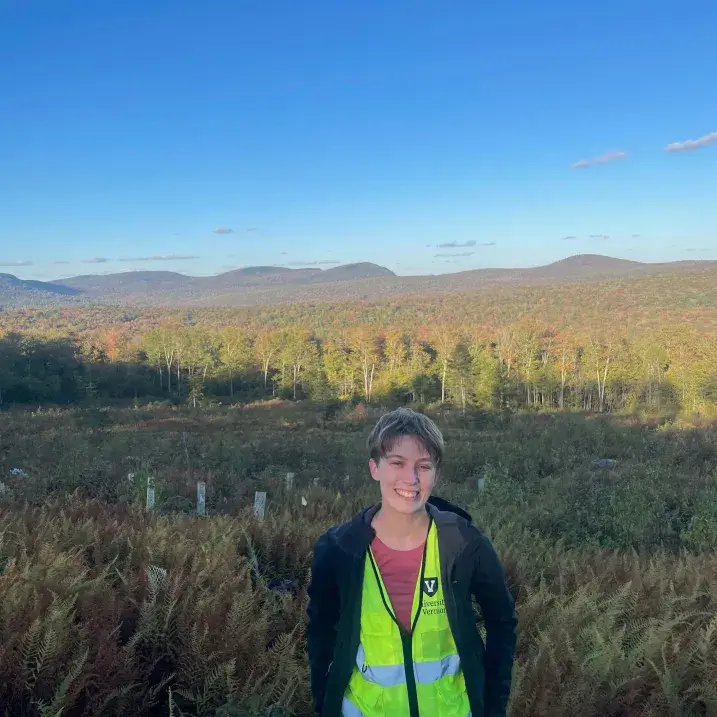
I grew up in New Haven, CT and stayed in my hometown to earn a B.S. in Ecology and Evolutionary Biology at Yale. I then worked as a research assistant in Erika Edwards’ lab, focusing on two projects: one exploring the evolution of an unusual type of photosynthesis that may have allowed the plant genus Portulaca to expand into new environments, and the other investigating whether environmental pressures drove Latin American Viburnum to repeatedly evolve three particular leaf shapes. Before joining the Keller lab in 2023, I lived in Egypt and studied Arabic at the American University in Cairo. In my free time, I enjoy knitting, reading, cooking, and playing fiddle tunes with friends. I'm interested in why plants live where they live and what evolutionary and ecological factors allow them to adapt to environmental change.
As a PhD student in the Keller lab, I study the ecological and evolutionary genetics of hybridization between red spruce and black spruce, two northern forest tree species. We think that introgression from black spruce may play a key role in supporting red spruce’s capacity to adapt to climate change. So far, my PhD research has involved using a giant slingshot to get cones out of the tops of trees, growing thousands of baby spruce trees from seed, and lots of DNA extractions and coding.
Bio
I grew up in New Haven, CT and stayed in my hometown to earn a B.S. in Ecology and Evolutionary Biology at Yale. I then worked as a research assistant in Erika Edwards’ lab, focusing on two projects: one exploring the evolution of an unusual type of photosynthesis that may have allowed the plant genus Portulaca to expand into new environments, and the other investigating whether environmental pressures drove Latin American Viburnum to repeatedly evolve three particular leaf shapes. Before joining the Keller lab in 2023, I lived in Egypt and studied Arabic at the American University in Cairo. In my free time, I enjoy knitting, reading, cooking, and playing fiddle tunes with friends. I'm interested in why plants live where they live and what evolutionary and ecological factors allow them to adapt to environmental change.
As a PhD student in the Keller lab, I study the ecological and evolutionary genetics of hybridization between red spruce and black spruce, two northern forest tree species. We think that introgression from black spruce may play a key role in supporting red spruce’s capacity to adapt to climate change. So far, my PhD research has involved using a giant slingshot to get cones out of the tops of trees, growing thousands of baby spruce trees from seed, and lots of DNA extractions and coding.