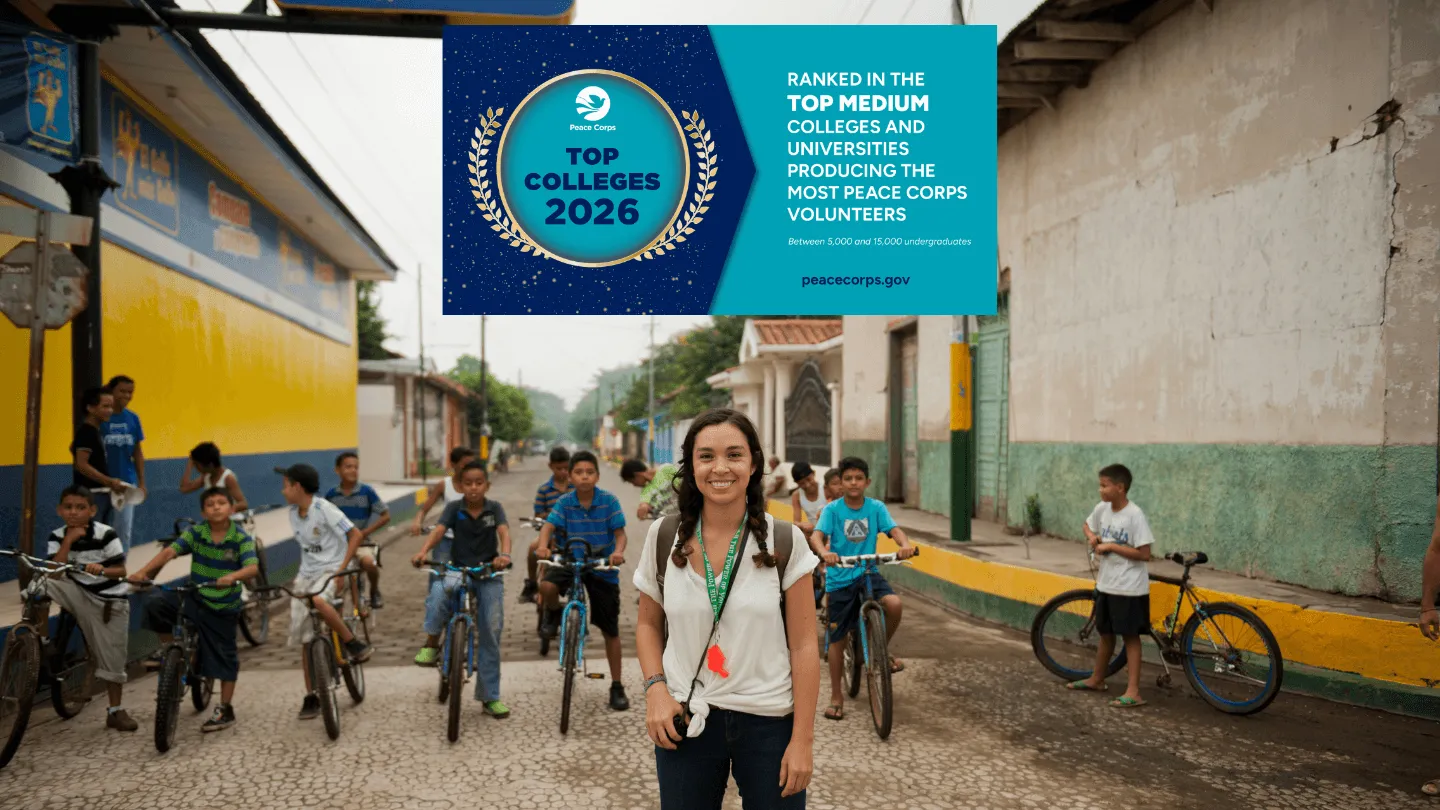
When the University of Vermont was named one of the Peace Corps’ 2026 Top Volunteer Producing Colleges and Universities, it underscored a defining characteristic of the institution: a shared commitment to service and global engagement. At the Grossman School of Business at UVM, that commitment comes to life through programs, faculty leadership, and students who understand business as a tool for meaningful and lasting impact.
For decades, UVM alumni have brought their skills to communities across the globe through the Peace Corps, applying their education in service of public purpose and local collaboration. Within Grossman, those same values shape how students learn to lead—particularly through the Sustainable Innovation MBA (SI‑MBA) and the school’s participation in the Paul D. Coverdell Fellows Program, which supports Returned Peace Corps Volunteers pursuing graduate education.
From Peace Corps Service to the Classroom
That connection is personal for John Kim, Graduate Programs Career Advisor and Part-time Lecturer at the Grossman School of Business, whose own Peace Corps service continues to inform his approach to business education. From 2005 to 2007, Kim and his wife served as Youth Development volunteers in Azilal, Morocco, a small city in the Atlas Mountains.
“Peace Corps service teaches you to listen first, adapt to local context, and build trust before trying to create change,” Kim said. “Those lessons are directly relevant to how we teach sustainable and responsible business at Grossman.”
Although Kim initially thought he would pursue a career in international development, his experience in Morocco reshaped that trajectory. After his service, he came to see business as a lever for impact at scale—one that, when guided by values and relationships, can advance social and environmental outcomes. He has since worked with large organizations and consultancies, including Herman Miller and The Walt Disney Company, focusing on social initiatives and sustainability.
Today, Kim sees strong parallels between Peace Corps volunteers and the students drawn to Grossman’s mission-driven graduate programs.
“They are motivated by impact,” he said. “They want to build systems that work better for people and the planet.”
A Natural Fit for Returned Peace Corps Volunteers
That alignment led Brooks Sherman, SI‑MBA ’25, to Grossman after completing Peace Corps service in Burkina Faso, where he served from 2006 to 2008. Midway through his service, Sherman realized that his original assignment was not producing the intended results. Rather than continuing an unproductive path, he sat down with community members and asked what they wanted to do.
That conversation led to a community driven entrepreneurial farming initiative—and a lasting lesson in leadership.
“It taught me to take my ego out of the equation,” Sherman said. “Real impact comes from listening first and being willing to redesign the plan around what actually works.”
That perspective shaped how Sherman approached the Sustainable Innovation MBA. In the classroom and in team-based projects, he focused on questioning assumptions, centering stakeholders, and remaining open to iteration—an approach he traces directly back to his Peace Corps experience.
“I don’t pretend to have mastered that lesson,” he said. “I keep having to relearn it. But staying centered on impact rather than ego is something Peace Corps instilled in me, and it’s reinforced at Grossman.”
The Coverdell Fellowship at Grossman
The Grossman School of Business joined the Paul D. Coverdell Fellows Program in 2025, awarding \up to two fellowships per year to Returned Peace Corps Volunteers enrolled in the SI‑MBA.
The accelerated, one year SI‑MBA integrates sustainable business practices across disciplines, preparing graduates for careers in impact investing, sustainable development, mission‑driven marketing, supply chain management, nonprofit leadership, and other socially responsible business functions. The program is the highest‑ranked AACSB‑accredited green MBA in the United States, reflecting Grossman’s commitment to both academic rigor and real‑world relevance.
“Peace Corps volunteers bring lived experience in complexity, resilience, and cross‑cultural collaboration,” Kim said. “Those qualities strengthen our classrooms and our community.”
Shared Values, Shared Impact
Whether or not they have served in the Peace Corps, Grossman students are united by a belief that business can—and must—play a role in addressing global challenges.
“The people drawn to the SI‑MBA care deeply about impact,” Sherman said. “They want their work to matter. That mindset is exactly what the Peace Corps instills.”
As the University of Vermont’s Peace Corps recognition demonstrates, service is part of the institution’s DNA. At the Grossman School of Business at UVM, that legacy continues—preparing graduates to lead with purpose, humility, and responsibility in an interconnected world.
About the Peace Corps: The U.S. Government's premier international volunteering agency, the Peace Corps sends passionate and skilled Americans abroad to collaborate on projects that advance both American and host country priorities. This year, the agency commemorates 65 years of promoting world peace and friendship through volunteer service while partnering with America250 to encourage more Americans to give back. Since 1961, the Peace Corps has played a vital role in advancing U.S. global engagement through the work of close to 250,000 volunteers serving in 144 host countries.