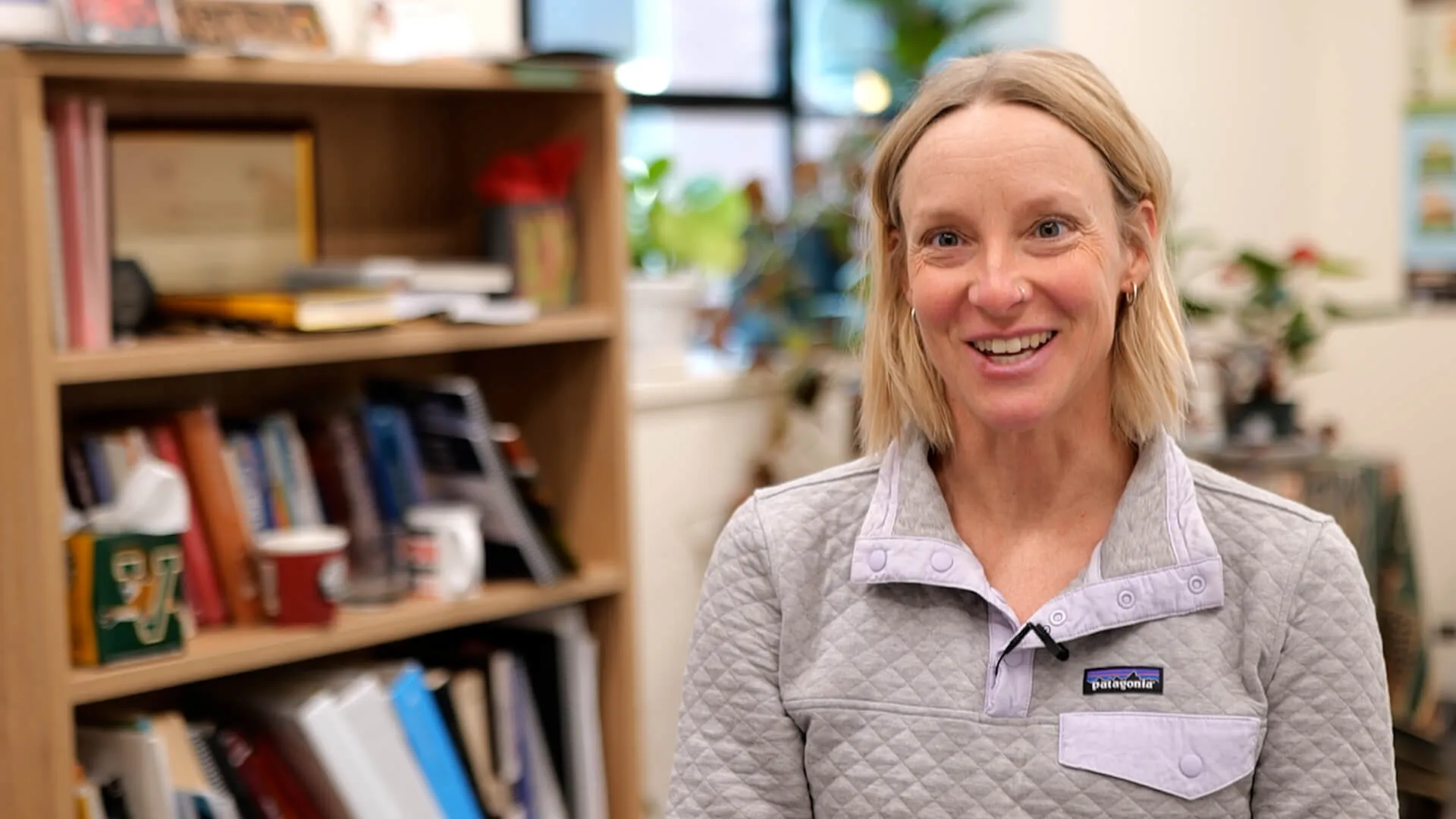
Janet Gamble had taught college nutrition courses for more than a decade and was noticing a troubling trend; her students were more often sharing stories of unhealthy relationships with food. As a dietitian trained in traditional nutrition education, she began to wonder whether the messages students were receiving about food, weight, and health were doing more harm than good. That question led her to pursue her PhD research in Dr. Lizzy Pope’s Weight Inclusive Nutrition (WIN) Lab at the University of Vermont.
Nutrition education is typically taught through a weight-centric approach, meaning that body weight alone is integrally tied to overall health. This often places dichotomies on foods; they are either “good” foods or “bad” foods. As a result, students learn to focus on weight, calories, and body size, and young people learn that bodies too can be “good” or “bad.”
“There is evidence that suggests that girls as young as three have already internalized the thin ideal,” said Gamble. “There has to be a better way to do this.” Rather than teaching students to calculate BMI or restrict food intake, Gamble was interested in weight-inclusive nutrition education which aims to reduce disordered eating and weight-based bullying while helping young people develop a more positive and sustainable relationship with food.
Gamble developed an eight-lesson nutrition curriculum for high school students based on National Health Education Standards and weight-inclusive principles. The curriculum is designed to help students build healthy relationships with food and their bodies without focusing on weight, calorie counting, or labels such as "good" and "bad" foods.
The project grew from earlier research that found weight-normative nutrition practices were common in Vermont schools, even though many educators wanted alternatives. Teachers told researchers that they recognized the need for change but weren’t sure how to get started.
Gamble partnered with health educators in Vermont and Massachusetts. Together, they created lessons using Gamble’s expertise in nutrition and the teacher’s experience in the classroom. The lessons are free for anyone to use on the Weight-Inclusive Nutrition website. They cover everything from Macronutrients, to diet culture, to misinformation to nourishing the body.
After pilot testing, nine teachers implemented the curriculum and provided feedback, while students shared their experiences with the lessons. One of the most encouraging findings, said Gamble, was how engaged the students were to talk about the material. She found that many students were not only aware of diet culture and its influence in their own lives, but eager for adults to talk to them about.
Gamble is a Food Systems Research Institute PhD Fellow and sees nutrition education as an often complex part of the food system. “Everybody eats multiple times a day, every day of their life,” she says. “I want people to know that there is an alternate way to think about nutrition and how it's going to nourish your body so that you aren't scared of food and you can find joy in eating.”
The WIN research team plans to expand the curriculum to middle and elementary schools. They are also beginning to explore nutrition education for athletes, a population at a particularly high risk for disordered eating.
For Gamble, the goal is to help young people see food not as something to fear or feel guilty about, but as a source of nourishment, enjoyment, and well-being. By changing the way nutrition is taught, she hopes to create healthier relationships with food that can last a lifetime.
About the Food Systems Research Institute:
The Food Systems Research Institute (FSRI) at the University of Vermont (UVM) funds collaborative research that puts people and the planet first, unites disciplines and communities, and answers complex questions about food systems.
The FSRI gives researchers the freedom, resources, and time to engage community stakeholders, including decision-makers, farmers, and food systems actors, about issues and opportunities across our food system. This results in relevant, widely disseminated research that informs policies, practices, and programs locally and regionally for a more resilient and accessible food future for all.