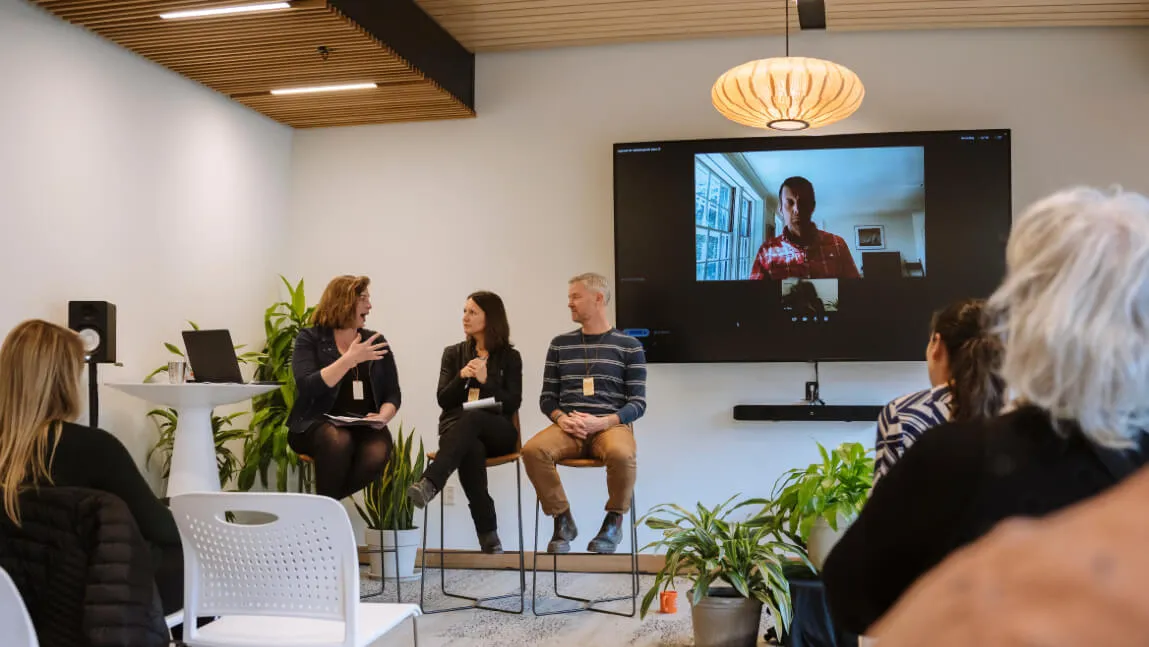
Dozens of environmental change agents descended on Burlington last Friday and Saturday for the first See Change Winter Summit hosted at Hula, the new coworking campus and business accelerator located at the end of Lakeside Avenue.
Among the invitees were UVM Gund Director Taylor Ricketts and UVM Sustainability Director Elizabeth Palchak, who appeared together at a mid-day panel “Lessons for Achieving Net Zero” last Friday before live and virtual audiences.
Hula is a fitting venue for a conference aimed at sharing ideas for a sustainable future. Formerly the old Blodgett Oven factory, it is now a net-zero facility using solar and large-scale geothermal for heat and power. The brick exterior is largely intact but interior spaces have been renovated using mostly local, sustainable materials.
Palchak and Ricketts were two of dozens of invited “climate superheroes” including entrepreneurs, sustainable investment experts, techies and athletes from around the world, each of whom brought unique views to finding solutions to build a greener future. Other guests included Kate Williams, CEO at 1% for the Planet (a tenant of Hula), and Burton Snowboards owner Donna Carpenter.
Ricketts sees his role at UVM’s Gund Institute as similar in spirit to the ethos of See Change. “We bring together researchers from diverse disciplines, and connect the academy to society to create research that inspires action.”
He demystifies the concept of net zero as a budget-balancing exercise. “You’ve got to balance what you are emitting into the atmosphere by removing carbon out of the atmosphere. You can achieve that by emitting less or finding some way of removing the equivalent of what we do emit, which is what we call offsets or carbon removal. Every business and individual is playing with those two main levers.”
Many audience members represented businesses interested in making real progress in reducing their carbon footprint. The panelists challenged them to think beyond the energy resources they use to make their products.
“Measuring an organization’s carbon footprint means getting a full account of everything in your organization related to greenhouse gas emissions,” said Palchak. “The Greenhouse Gas Protocols give us a way to think about this.”
Patchak explained that Scope 1 emissions are a good starting point for organizations to begin accounting for greenhouse gas emissions. “These are emissions generated by energy sources that you are responsible for. Your fleet is a good example—if you have company cars your employees drive around and gas up, those are emissions you have direct control over.”
Emissions under scope 2 are indirect emissions from the generation of purchased electricity, heating and cooling consumed by the company. Scope 3, said the panelists, take into account indirect costs outside of corporate headquarters or manufacturing plants, from raw materials to shipping to waste disposal.
The panel included moderator Ali Hartman, head of responsible investment at Tiger Global Management, and Austin Whitman, leader of the non-profit Climate Neutral, which now helps over 400 businesses measure, offset, and reduce their carbon emissions.
All agreed that while analysis is important, the urgency of the climate crisis demands immediate action.
“The best way to get started is to get started,” Whitman advised. “It’s important to analyze and understand in detail your operation but to do that across a complex enterprise for ten years, without ever doing anything about what you are finding, isn’t productive and isn’t helping the climate crisis.”
“The scariest thing to me about climate change is every year that goes by it gets way harder to stop,” said Ricketts. “So the things we can do fast are the most valuable things, whether it is reducing or offsets. We need to build forward momentum now because it’s going to get exponentially more difficult in the future.”
New technologies increasingly provide promising solutions to slow climate change but the panelists agreed innovation alone won’t solve the crisis.
Palchak says we shouldn’t forget the vast benefits of improving the energy efficiency of existing infrastructure.
“It’s not a new idea, but it is so crucial—simple things like weatherizing buildings or installing heat reducing shades on windows. To paraphrase Amory Lovens, ‘the best megawatt is the one you don’t use.’”
She also emphasized the importance of partnerships in solving the climate crisis.
“Academic researchers like those at the Gund Institute can bring deep expertise and intellectual heft to leaders in industry, who are experts in implementation and scalability. Joining forces can unlock huge opportunities for sustainability solutions. We need to come together to implement the best ideas, which is what this conference is all about.”
Ricketts said investing in natural systems is key.
“To me the most interesting technology is what we call nature-based solutions,” said Ricketts. “Finding ways to store carbon in real and permanent ways—in our farms, in our forests and in the biosphere. We’ve depleted these systems to the extent that they have given up carbon. We can restore them to help them build it back.”
UVM had a wide impact on the See Change Summit. The Gund Institute and Sustainable Innovation MBA Program in the Grossman Business School partnered to make UVM an Alliance Member of the conference. Stephen Posner, Gund director of policy, led the summit kick-off session on Thursday with Molly Kawahata, former Obama White House climate advisor and Google clean energy advisor. Michael Dorsey, a Gund Global Affiliate, was an invited guest. He was one of the first UVM MacMillan Scholars in Residence.