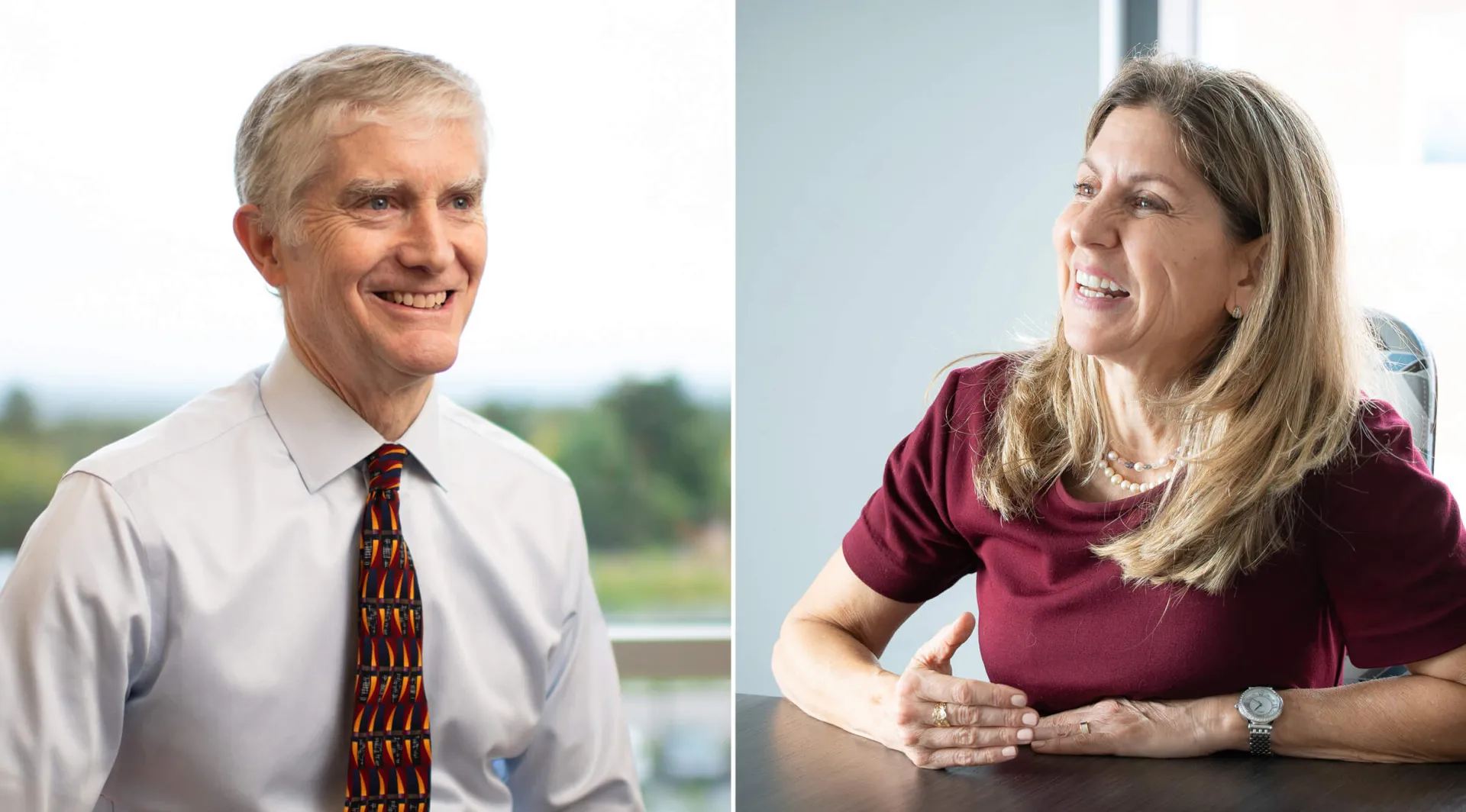
Meet the New Chairs of Neurological Sciences and Pediatrics
Two esteemed physicians recently joined the Larner College of Medicine as new chairs of the departments of Neurological Sciences and Pediatrics. As chairs, they are responsible for the departments’ clinical, research, and education missions, including education and training for students, residents, and fellows. At University of Vermont Health, their responsibilities include leading physicians, residents, fellows, and staff at the network’s locations across Vermont and northern New York.
We sat down with Drs. Calabresi and Schaechter to learn about their backgrounds, what inspired their careers in medicine, and what excites them most about joining the Larner College of Medicine and UVM Health.
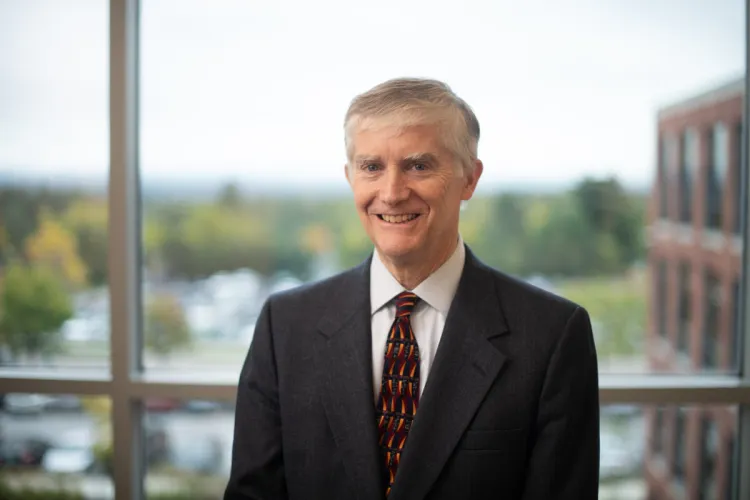
Four Questions with Peter Calabresi, M.D., professor and chair of the UVM Department of Neurological Sciences
Dr. Calabresi joined the University of Vermont in October 2025. An expert in neuroimmunology and multiple sclerosis, Calabresi has studied therapeutic targets on immune cells for more than 30 years, starting with a fellowship at the National Institutes of Health and appointments at the University of Maryland School of Medicine and Johns Hopkins School of Medicine. He most recently served as professor of neurology, neuroscience, and ophthalmology at the Johns Hopkins University School of Medicine; director of the Richard T. Johnson Division of Neuroimmunology and Neurological Infections; and co-director of the Johns Hopkins Precision Medicine Multiple Sclerosis Center of Excellence.
What is the breadth and scope of the neurological sciences department at the University of Vermont Larner College of Medicine and UVM Health?
PC: The neurological sciences department encompasses nearly 60 faculty members who are committed to a shared tripartite mission of providing outstanding clinical care, conducting cutting-edge research, and educating the next generation of physicians and scientists. We are very fortunate to have such a strong academic neurological sciences program in Vermont. That combination of clinical excellence, scientific discovery, and education was one of the things that attracted me to UVM after my time at Johns Hopkins University. I saw tremendous opportunity here, along with an extraordinary group of people who are deeply committed to improving the health of the communities we serve.
Our first responsibility is to provide the very best neurological care to people throughout Vermont and the surrounding region. At the same time, our academic mission gives us the opportunity to advance knowledge and develop new approaches to neurological disease. Larner is one of the oldest medical schools in the country and attracts outstanding students, bringing together people with diverse backgrounds, experiences, and perspectives. Our faculty play an important role in educating undergraduate students, medical students, residents, and fellows. In addition, the department oversees the medical school's anatomy program, providing expert education to students and health professionals across a range of disciplines.
Was there a moment when you decided to become a doctor of neurological sciences? What is your ‘why’?
PC: As a teenager, I began reading philosophy and was struck by Descartes's cogito, ergo sum—“I think, therefore I am.” I began to appreciate that the brain represented perhaps the ultimate frontier, the biological basis of who we are.
The brain makes us human. It shapes our behavior, our thoughts, our personalities, and our ability to understand the world. It also allows for an extraordinary diversity of ideas and perspectives. I believe that diversity is something to embrace because we are stronger when people with different experiences and viewpoints work together.
During medical school, I also became acutely aware of how devastating neurological diseases can be. Simultaneously, it felt as though neuroscience was on the cusp of an era of tremendous progress. That combination—an enormous unmet need and the possibility of making a difference—drew me to the field.
It has been incredibly rewarding to see how far we have come. Diseases for which we once had few or no effective treatments can now be prevented, treated, or placed into long-term remission. The pace of scientific and technological advancement over the past 30 or 40 years has been remarkable.
I believe strongly in the power of science to make the world a better place. But scientific progress also comes with a responsibility to be good citizens—to work together, to respect different perspectives, and to harness these advances for the benefit of society.
You recently published findings in Nature Neuroscience on the specific molecular process that leads to cell death at multiple sclerosis lesion sites. What is next for your research team?
PC: Publications are important landmarks in science, but they are really milestones in a much longer journey. Discovery is a continuum, built on the contributions of many people and generations of scientists, and ultimately our goal is to translate those discoveries into better lives for patients.
Our laboratory is expanding its efforts beyond understanding how nerve cells die. We are increasingly interested in whether we can protect oligodendrocytes—the cells that make myelin—from injury during inflammatory attacks on the brain and spinal cord. If we can keep these cells alive, we may be able to preserve or enhance the brain's own capacity for myelin repair in people living with multiple sclerosis.
What is particularly exciting is that these biological pathways may extend well beyond MS. We are learning that myelin-producing cells have unexpected supportive and regulatory roles in the brain, and similar mechanisms may be relevant to other neurodegenerative diseases. I am excited about the potential to apply what we learn in MS to diseases such as Alzheimer's and Parkinson's disease and related disorders.
What is the value of a neurological sciences team being part of an academic health system?
PC: The integration of neurological sciences within an academic health system is extraordinarily valuable. One of our greatest strengths is having clinicians and scientists working side by side.
At many institutions, clinical medicine, health care research, and basic neuroscience can become siloed. When these disciplines are closely connected, however, discoveries can move much more rapidly from the patient to the laboratory and, ultimately, back to the patient.
For example, our clinicians recognize the remarkable heterogeneity of neurological diseases and can identify meaningful clinical subtypes and obtain carefully characterized biospecimens. Those samples can then be studied by scientists using modern molecular, genetic, cellular, and imaging technologies to understand the biological pathways underlying disease. We can begin to connect what happens to an individual patient with genetics, environmental exposures, lifestyle, and other factors that influence disease. That kind of integration accelerates discovery and creates opportunities for truly translational research
For me, that is one of the defining strengths of an academic health system—and an important part of our vision for the Department of Neurological Sciences at UVM.
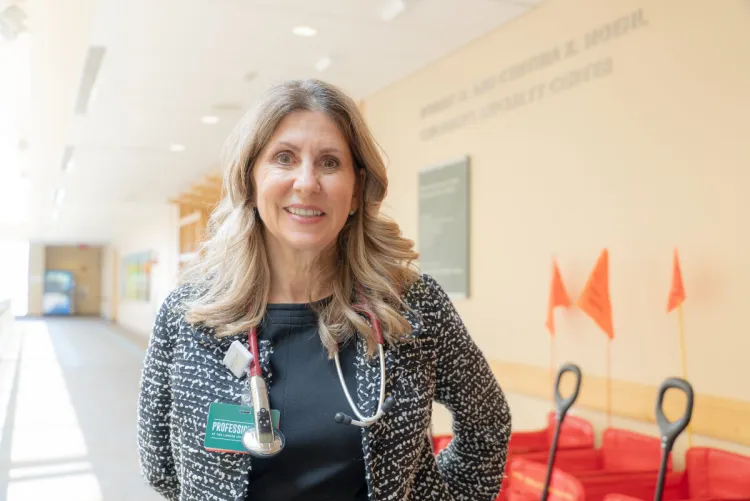
Four Questions with Judy Schaechter, M.D., M.B.A., professor and chair of the Department of Pediatrics
Dr. Schaechter, M.D., M.B.A., joined the University of Vermont in July, 2026 as professor and chair of the Department of Pediatrics. She previously served as director of the Centers for Disease Control and Prevention Division of Violence Prevention. Her career has included leadership roles at the American Board of Pediatrics and the University of Miami Miller School of Medicine. She spent a year as a Robert Wood Johnson Foundation Health Policy Fellow, participating in the legislative process with the United States Senate Health, Education, Labor, and Pensions Committee, Subcommittee on Children and Families.
You have seen health care through a national lens. How does that inform the work you want to do here, and what are some of the common themes that you feel carry over to our rural health care environment?
JS: Prevention is the bread and butter of pediatrics. We are concerned about the future health of our patients, minimizing the negative and optimizing the positive childhood experiences that support their growth, development, and emotional, social, and academic health. We focus on reducing the risks to children, such as injuries from car accidents or burns or violence. That’s a national lens applicable at the very local level, through partnerships and community-based initiatives.
One of the things that I love about Vermont is that medical professionals here understand the intersection between individual health and public health, and that we are all part of taking care of children and families. We have a responsibility that is not only at the medical center, not only in the exam room, but also connected with those who provide services to children—teachers, early childcare providers, dentists, community organizations, and, of course, families—everyone who makes decisions that affect children and the people who love and take care of them.
Health care in rural regions presents a lot of challenges and our health system is currently experiencing those challenges. What do you want families to know about pediatric health care in our region today, and in the future?
JS: Every rural hospital in America is under duress right now, and that has been happening nationwide for a while. What I most want people to know is that our children’s hospital is committed to taking care of our children, and we want children and families to have access to the best pediatric care in their community, close to home. We practice at a high-quality level of excellence that we measure and that is nationally recognized. We follow our metrics and use best practices, and we work on continuous improvement every day.
The Golisano Children’s Alliance found us because we are reaching children across this region and bringing families and patients into the conversation so that we get continuously better. The Golisano funds help mitigate some of the financial strain, but it’s really meant to help us go further as an academic child health center rooted in this community. We will continue to focus on ways we can be more efficient and increase access to provide for everyone. We are expanding care for children with chronic disease and medical complexity, to support families first, as well as their primary care doctors and specialists. We are bringing in, for the first time, a dedicated pediatric allergist, because there’s an increasing need in terms of environmental and food allergies. Our subspecialists in pulmonology and gastroenterology are expanding their practice sites. We recently welcomed a new pediatric neurologist. We want to make sure that we’re addressing all the needs of all our children. No child should slip through the cracks in this community.
I love that our health network is focused on working with the state to figure out how we do this very complex thing that no one in the United States has really figured out, of providing the highest quality comprehensive care in the most compassionate way, with dignity to all our patients, and to do so with innovation and efficiency. In partnership with the Larner College of Medicine, we are educating the next generation to carry that vision forward.
What is the value of a children’s hospital being part of an academic health system?
JS: Academics means we’re constantly aiming to improve health care, education, and we are constantly pushing the envelope in terms of discovery.
The concept of the physician-scientist is important in pediatrics because we need research informed by clinical care, and clinical care needs science to improve health. We’ve had amazing advances in, for example, childhood cancer treatments, care of premature infants, and congenital cardiac disease. That kind of bidirectional inspiration and operationalization only happens in an academic health system, such as Larner College of Medicine and UVM Health.
Education of medical students, residents, and fellows similarly thrives in that context, where learners benefit from an environment that is at the cutting edge, that seeks to do better every day. And we, as the educators, are challenged by their minds, their questioning.
Academic medical centers such as ours feel a deep responsibility to ensure the future will have the trained workforce we need. Our faculty are teaching the next generation of medical providers the facts of medicine, the inquiry and interpretation of science, and the art of doctoring—what it means to be a good communicator, a caring physician.
What issue in child health care worries you the most?
JS: Gun violence. It is the single largest cause of death for children and has been for almost 10 years now, and it’s totally preventable. Gun violence is America’s most preventable disease. It doesn’t just kill and injure; it takes away dreams. Both fatal and non-fatal gun injury destroys families and communities. This isn’t a problem children can fix for themselves. We as adults have to change environments to protect children, to truly care for and about them.