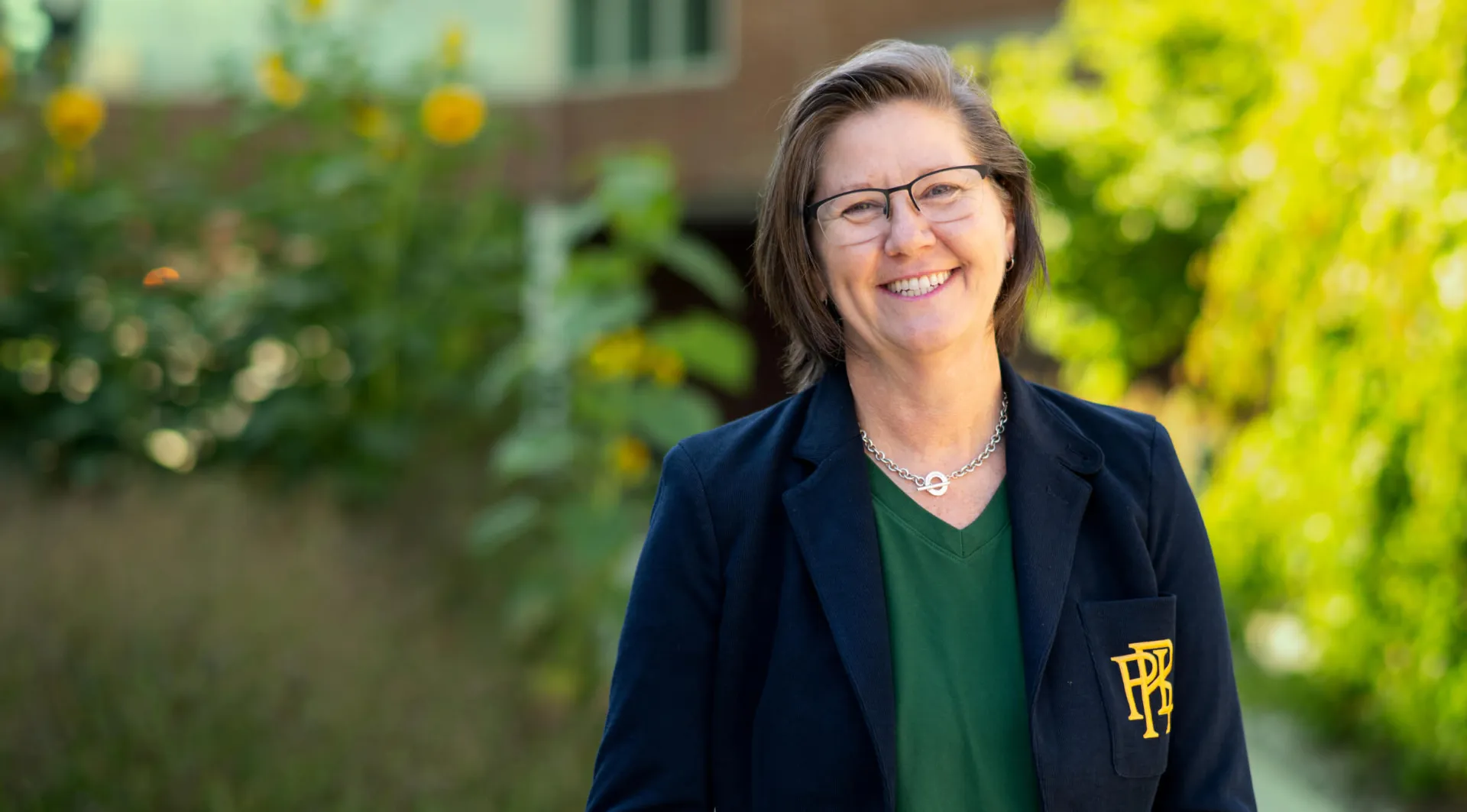
When Kate Tracy, Ph.D., arrived at the Larner College of Medicine nearly four years ago as senior associate dean for research, what stood out to her most was not any single area of scientific excellence. Instead, it was the extraordinary potential that existed at the intersections.
Larner’s expertise spans seven signature areas: rural health, cancer, immunology, pulmonary and environmental health, cardiovascular science, brain health, and aging and longevity. Dr. Tracy saw the potential to tell a larger story about how those strengths connect to create new possibilities for discovery.
“Cancer research plays a central role as we work toward National Cancer Institute designation, while aging and longevity are especially relevant here in Vermont,” Tracy explains.
“Much of our work intersects across disciplines, creating opportunities for collaboration that can lead to discoveries no single discipline could achieve alone.” — Kate Tracy, Ph.D., M.A.
That belief has helped Tracy shape a vision for Larner’s research enterprise centered on connection: connecting fundamental science to patient care, researchers to one another, trainees to mentors, communities to academic medicine, and discoveries made in Vermont to advances that improve health around the world.
For Tracy, the true measure of a research enterprise is how effectively discoveries move beyond the lab to improve health. That journey depends on strong connections among basic scientists, clinicians, engineers, public health experts, and community partners. Strengthening those connections has become a defining focus of her strategy.
While Larner is known for excellence in basic science, Tracy has worked to expand clinical, translational, and community-engaged research. “As an academic medical center embedded within a health system and closely connected to communities across Vermont, Larner is uniquely positioned to bridge research and real-world health challenges,” she says.
But supporting that vision requires more than talented investigators. It requires building an environment where collaboration can flourish.
In partnership with Associate Dean for Faculty Rebecca Wilcox, M.D., Tracy launched the Office for Research and Engagement (ORE) last year to serve as a centralized hub for faculty and trainee development. Co-led by Drs. Renee Stapleton and Michael Toth, ORE serves as a connector across the research enterprise, bringing investigators from all over the academic health system together with the resources, expertise, and professional development opportunities needed to advance their work. Researchers can access grant-writing support, scientific communication training, mentorship, leadership development, and proposal guidance.
Shared resources lower barriers to discovery by providing investigators access to advanced technologies and expertise without requiring individual labs to build those capabilities on their own.
Perhaps the most visible examples of these connections emerge when discoveries move beyond the laboratory and into patient care. The journey from scientific insight to effective treatment often spans decades, requiring collaboration among scientists, clinicians, industry partners, and patients to transform promising discoveries into real-world solutions.
One such success story involves Dave Warshaw, Ph.D., a renowned cardiovascular researcher, University Distinguished Professor, and chair of the Department of Molecular Physiology and Biophysics at Larner. Warshaw was part of a multidisciplinary team whose foundational research on cardiac myosin helped pave the way for the blockbuster medication Camzyos, the first-in-class treatment for obstructive hypertrophic cardiomyopathy (oHCM), a condition in which the heart muscle thickens and struggles to relax.
Warshaw’s story illustrates how fundamental scientific questions can lead to therapies, medical devices, and approaches to care that improve lives. It demonstrates the essential role academic medical centers play in connecting basic science to clinical impact.
Advances like these highlight the importance of bringing together expertise from multiple disciplines and across academic institutions. Increasingly, the most significant scientific questions cannot be solved within a single lab or field. They require collaboration among biologists, clinicians, engineers, data scientists, and public health experts.
That need for collaboration is perhaps most evident in artificial intelligence (AI), which Tracy sees as one of the most transformative opportunities in biomedical research.
“With a relatively small and highly connected population, comprehensive health records, and an integrated health care system, Vermont offers an ideal environment where researchers can study population health in meaningful ways.” — Kate Tracy, Ph.D., M.A.
Those connections across patients, providers, and data systems create new avenues to better understand disease, predict outcomes, and improve care. Yet, Tracy emphasizes, the future of AI is about more than technological capability.
“Just because we can do something doesn’t mean we should,” she says.
As artificial intelligence becomes increasingly integrated into research and health care, questions surrounding ethics, privacy, sustainability, and responsible use become essential. R1-designated universities, in particular, have an important role to play in bringing together expertise from medicine, science, public policy, and the humanities to ensure these powerful tools are used wisely.
Beyond artificial intelligence, Tracy sees tremendous promise in regenerative medicine, digital twins, connectomics, and large-scale cellular mapping initiatives—all areas where Larner scientists are already making their mark.
Two awards announced within a week of each other this fall show just how far that work has come. The Advanced Research Projects Agency for Health (ARPA-H) awarded Gary An, M.D., a trauma surgeon and researcher at Larner, a contract worth up to $38 million, the largest research award in UVM’s history. An’s project, Reprogramming Severe Critical Illness Using Extensible Digital Twins (ReSCUED), will create AI-powered digital twins, real-time virtual models of a patient’s immune response that allow clinicians to test treatments before administering them to patients with severe trauma, burns, or sepsis, where rapidly changing conditions can outpace even the most experienced care teams.
The five-year effort links Larner with clinical partners at Wake Forest University School of Medicine, the University of Alabama at Birmingham, and Washington University School of Medicine, along with technology partners. If successful, the team could significantly shorten intensive care stays and improve outcomes for critically ill patients.
Days earlier, the National Science Foundation awarded $19 million to Davi Bock, Ph.D., associate professor of neurological sciences, to lead the new National Connectomics and Ultrastructure Volume Observatory at UVM. Bock’s lab helped create the first complete wiring diagram of an adult fruit fly brain, work that now supports a new national observatory for high-throughput 3D electron microscopy.
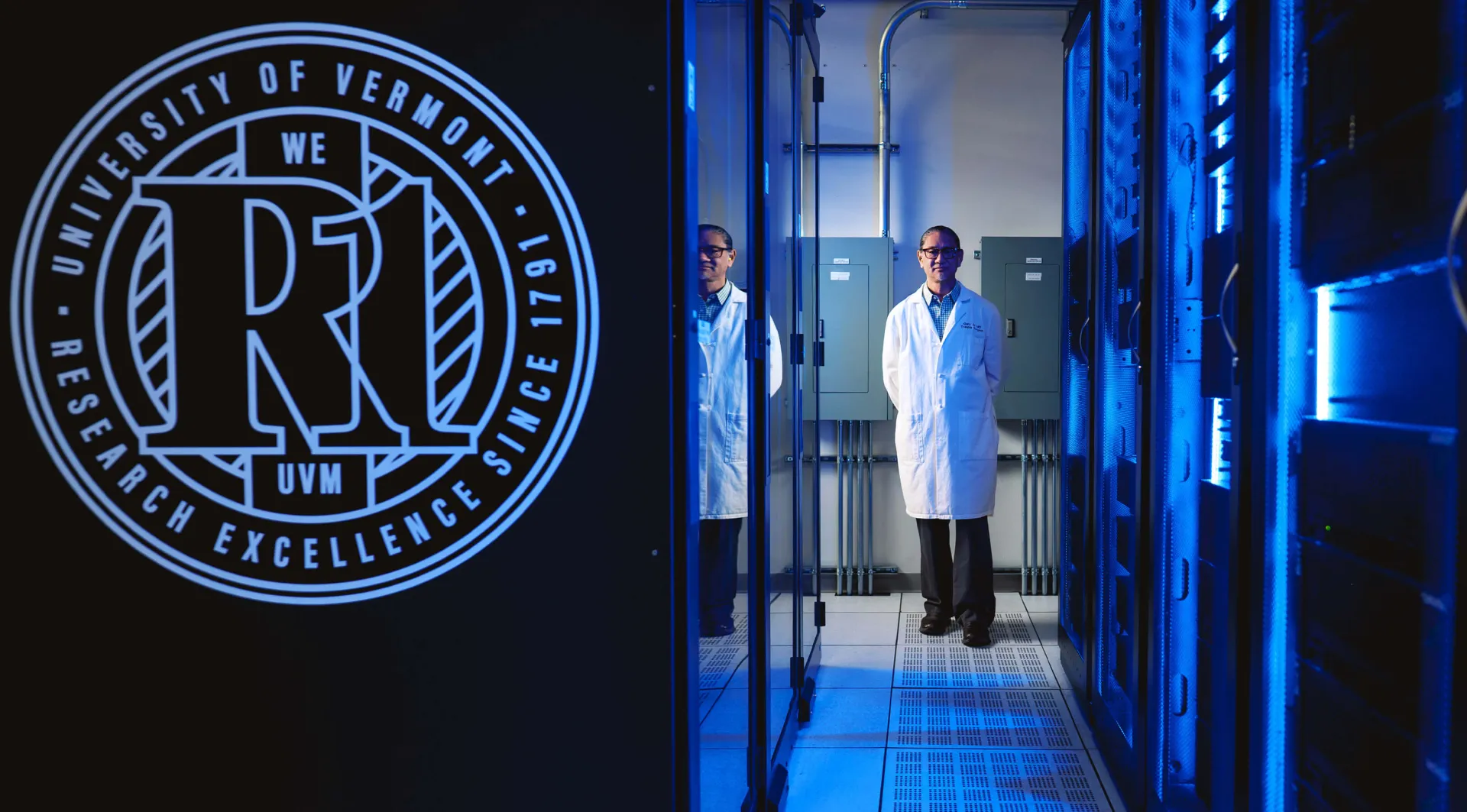
Anchored at UVM and supported by the Vermont Advanced Computing Center, the observatory aims to expand access to advanced imaging technologies across the country. The effort could accelerate discoveries about how cells, tissues, and neural networks are organized; our understanding of Alzheimer’s disease; and other complex conditions.
Both projects are also expected to bring highly skilled research jobs to Vermont and strengthen the state’s growing biotechnology and AI sectors. For Tracy, the awards say as much about Larner’s culture as about its science.
“We are not the biggest medical school, and we don't need to be,” she says. “What these awards show is that a close-knit, collaborative institution in Vermont can lead national efforts on some of the hardest problems in medicine, and that the benefits come home to our patients, our trainees, and our state.”
(See links to related articles on Drs. Bock and An below.)
Discoveries like these also need a path to the people and companies that can put them to use. That is where UVM’s partnership with Cambridge, Massachusetts–based BioLabs comes in, creating new pathways for ideas to move from the bench to the marketplace.
Opened in 2025, the BioLabs Innovation Center at UVM gives life-science startups access to the university’s world-class facilities, research expertise, and scientific community. By bringing entrepreneurs and researchers together, the center helps ensure innovation sparked in Vermont can grow in Vermont.
Although digital twins, brain mapping, and startup incubation may seem unrelated, Tracy sees them as examples of the same principle: Breakthroughs emerge when disciplines, technologies, and people connect.
“The future of medicine will be shaped not by any single laboratory or discovery, but by the convergence of disciplines. Institutions that can bring those fields together will be best positioned to address the health challenges of the future.” — Kate Tracy, Ph.D., M.A.
At Larner, that work is already under way. Across laboratories, clinics, classrooms, and communities, researchers are building the connections that transform ideas into discoveries, discoveries into treatments, and research into better health for people in Vermont and far beyond.