This past fall, the UVM Institute for Agroecology was involved in a host of international conferences, gatherings, and governance meetings. Partners, consultants, faculty, and staff were in attendance at the 3rd Nyéléni Global Forum held in Sri Lanka, the Agroecology Europe Forum in Sweden, COP30 in Brazil, and the Food and Agriculture Organization of the United Nations Science and Innovation Forum, Civil Society & Indigenous Peoples’ Mechanism Forum, and the Committee on World Food Security Plenary all held in Rome.
The involvement of an institution like the IFA in these international bodies comes at a critical junction with the United States government continuing to abnegate its responsibility to participate in such processes.
“We have a deep responsibility to act in solidarity with movements who are shielding farmers from negative extraterritorial impacts of American agriculture and trade policies,” writes Faris Ahmed, a consultant in sustainable food systems with the IFA, in his sharp primer published this fall – Agroecology Can Build a More Resilient Future: The Responsibility of U.S. Institutions in the Global Struggle.
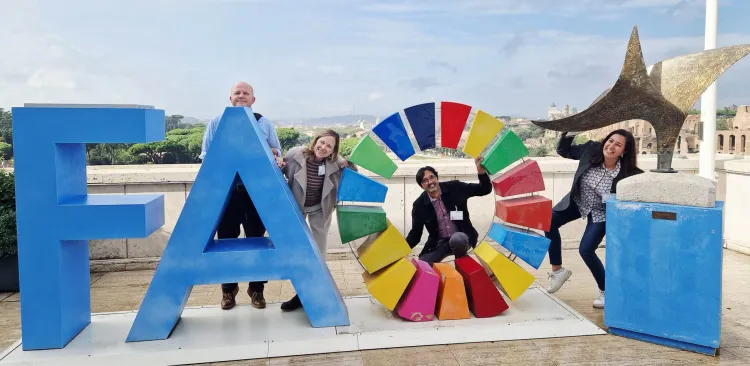
Molly Anderson and Faris Ahmed were both part of the delegation representing and supporting the IFA in some of the spaces in Rome this fall. Below they answered some questions about their time this past fall.
Tell us about being in Rome. What was the atmosphere like? The people? The food?
Faris Ahmed (FA): There's always a buzz in the air. Longtime friends greet each other with big hugs and radiant smiles. When you work on supporting each other’s struggles for justice, the solidarity and camaraderie are incredibly important. Many of us have been friends for more than a decade, but don't often get together in person, so being in Rome together is always sweet.
That said, we are often being pulled in different directions -- between rekindling friendships, running to get to a side event, writing notes or remarks for an invention or side event, deciding which event or plenary to go do (there are usually several simultaneous events happening and you have to decide quickly); and of course making the best use of our time in Rome by meeting people we wouldn't have access to otherwise. It's all quite frenetic and we're constantly making choices. So, by the end of the day, we're happy to have a gelato... our choices are more fun at the gelato counter.
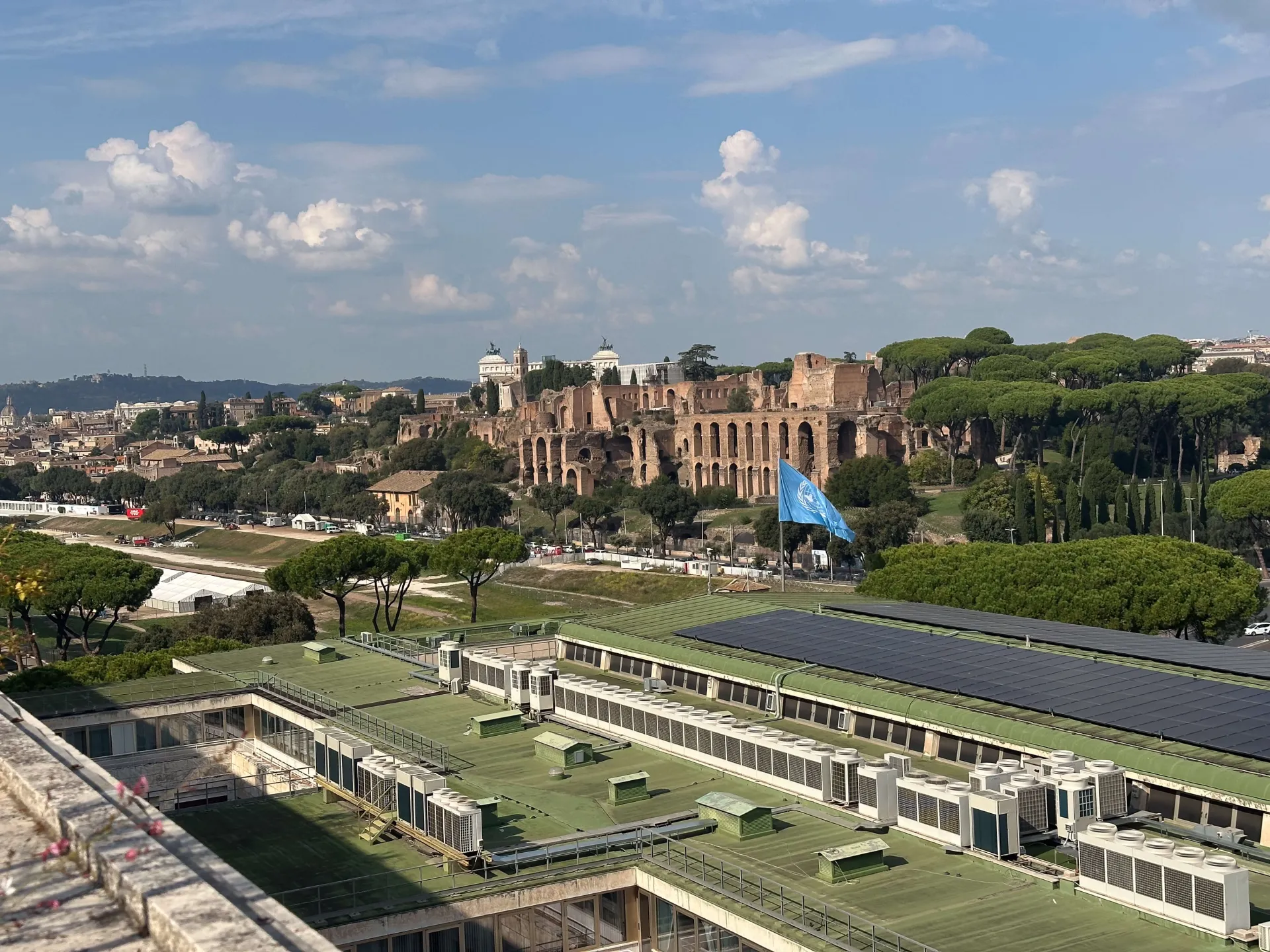
Molly Anderson (MA): Ah, Roma! One of my favorite cities for that inimitable mix of ancient and modern. The food is excellent—especially the subsidized meals at FAO with the opportunity to take in the view from the 8th floor. My strongest associations with Rome are meetings of the Committee on World Food Security (CFS) and the Civil Society & Indigenous Peoples’ Mechanism (CSIPM). The latter attracts passionate advocates for the right to food and other human rights that are being violated from all around the world, and provides a unique opportunity to hear first-hand how the current political situation is affecting marginalized people. But Rome is hectic and so were the meetings. It’s often hard to know which events to attend, given the plethora of things on the agenda. The plenary sessions of the CFS are often the LEAST interesting, because country delegates read self-congratulatory statements about what great work their own countries are doing.
Why was the IFA in the Rome? What was important about having a presence there?
MA: Some IFA team members went to Rome to have face-to-face meetings with several partners and potential partners, hold a very well-attended and successful side-event, and to assess what is most important now for the CSIPM. To be recognized as a “player” in international food security and agroecology debates, it’s a place where we really must show up.
FA: Rome is an important point of convergence for those of us working on international food policy, as CFS is a vital space where we can dialogue with governments and push for more ambitious, more coordinated, and more systemic actions on food and agriculture. It’s also an important meeting point of many social movements who wouldn’t normally have a chance to interact, such as movements of pastoralists, fishers or Indigenous Peoples. Similarly, there’s a powerful youth movement for food sovereignty and climate justice whose voices and solutions we need to hear and amplify. So, for the IFA it was an important opportunity to meet and learn from these communities.
Each of us at IFA also has important connections with key people within the Rome-based agencies, and international donors who are present in the CFS space. So we all play important roles as connectors – and we do this through diverse ways, including connecting farmer organization leaders to decision makers within CFS or FAO, or bringing the attention of foundations or researchers to the experiences of social movements, to help inform policy solutions – or simply to introduce them to sources of funding. This year IFA also organized a side event - Agroecology as a Transformative Pathway towards Sustainable Food Systems: Scaling Investments, Policies and Practices, a dialogue between governments, foundations and civil society on how to fund and support transformative agroecology.
How do you think the side event went? What was a takeaway? What do you see resulting from it?
FA: It's important to always recognize our positionality in these spaces - to know who we are (and aren't), which then helps us answer important questions like where do we have legitimacy, and where do we have leverage. IFA is not a social movement but an accompanier of vital movements, rightsholders and knowledge holders.
We put together a side event because we know from experience that CFS side events play a key role in policy influence. In some venues or UN conferences you can have hundreds of side events, but CFS limits the number to have a higher impact. So, if your event is selected, the chances of having a good audience, and a quality conversation, are high -- assuming people don't all go in droves to the event next door!
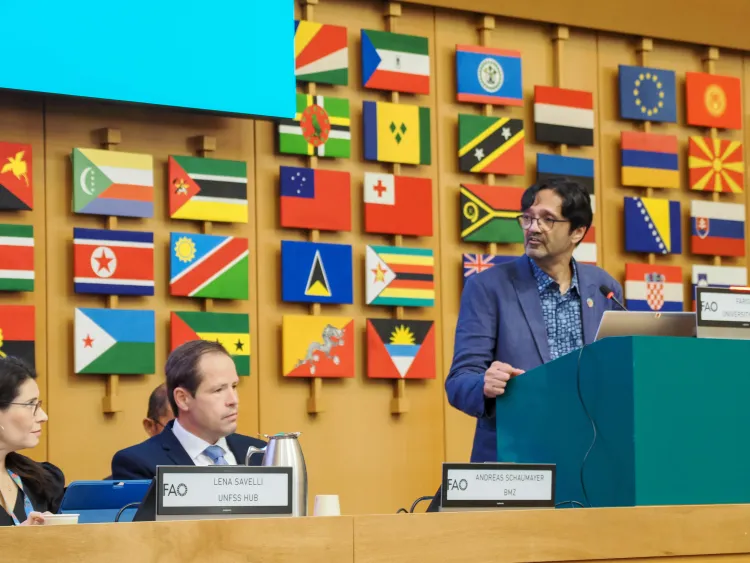
In the end our side event was merged with another from our friends at the Agroecology Coalition, of which the IFA is a member, and we ended up with a large group of 17 collaborators. While co-organizing a large group can present some challenges, we felt things went smoothly and we were able to assemble a great panel with several governments - Senegal, Germany, Switzerland, Ireland - in conversation with a farmers organization from Kenya - Haki Nawiri; a philanthropic funder - Agroecology Fund; and a NGO from Italy that works in Southern Africa - ICEI.
The event was very well attended! We actually had the largest possible room, other than the plenary hall itself, for this event. We had about 100 people. And about 40 people online - so you couldn't ask for a better turnout given that it was at 8:30 AM in Rome, before the plenary started, and very late in the week.
In terms of what we accomplished, we were able to really get into the nitty gritty of getting to the 'transformative' aspects of food system change. It was a good and open conversation, with the panelists and audience exchanging on what to do (and what not to do) to get there. We know there were governments in the room, and they need this kind of dialogue to validate their own push for agroecology within their national context. You can watch the recording of the event here: https://youtu.be/AQJMpePBm14?si=-mnMOKuOVwpMUNnC
What do you see resulting from the trip, in general, to Rome?
FA: IFA is still in the processes of establishing itself as a well-recognized actor and supporter of vital research and knowledge for transforming food systems. Being present in many circles and spaces in Rome was key to solidifying this role. Being associated with a diverse number of initiatives also helps spread the value and recognition of IFA and its contribution.
Finally, bringing an experienced team that has well established credentials and trust amongst the players in Rome helped us open many doors and gain trust in key circles. Gaining trust is a vital but often slow process, and it helps to 'speed it up' by associating or collaborating with key people who have already earned that trust from CSOs and movements.
MA: We got updates from lots of other organizations and people who will be good allies for the IFA, such as FIAN International and UNDP’s Food & Power initiative. Now we need to figure out which of these we should follow up on, and how. It would be easy to stretch IFA's capacities beyond their limit, so we need to be strategic and to balance international with domestic issues.
_
Molly Anderson is an IFA affiliate, research associate professor at University of Vermont, and Food Studies Professor Emerita at Middlebury College. Faris Ahmed is a consultant in sustainable food systems, biodiversity, agroecology, and climate resilience and has been working with the IFA for several years.