It was late afternoon on the second day of the three-day residential climate activists’ retreat. The winter sun was sinking and so was my confidence. The exchange unfolding across our circle was ratcheting up, and so was the tension in the room and the heat in my body.
To my right, a member had begun to express concern with some of the words we were using to describe the structure of our organizational work. They asked us to revisit the language before moving on, sharing their view that the words we use are of the utmost importance, carry significance and meaning, and thus must be aligned and copacetic. Across the circle, another member responded with an urgency to action rather than wordsmithing.
“We don’t have time to waste on this,” they lamented.
The conflict volleyed back and forth, and I began to sense the eyes of the other group members looking to me, as the facilitator, to do something. But what?
For this retreat, I’d volunteered to facilitate my community of change-makers in creating a strategic action plan for the year ahead. Ahead of the retreat, my co-facilitator and I consulted with the group members and carefully built an agenda that we’d hoped would meet the stated needs and prepare us to launch the work forward. By this point in the gathering, we’d gotten to know one another through a series of community building activities, sharing meals and laughs. We’d defined our vision and goals and had begun to work on strategy and tactics.
And now, conflict plopped right in the middle of the circle.
As I tried not to panic, mentally flipping through possible responses , I remembered one of yesterday’s icebreaker. Yes, those icebreakers, the ones that often elicit groans and eye rolls
We’d used a process called Compass Points, where the facilitators describe a series of four different ways of showing up in collaborative work, asking each group member to self-identify where they best align.
People of the North - These folks, like the buffalo, charge ahead into action, driving the group forward regardless of the weather or obstacles.
People of the East – These folks are visionary, like the eagle soaring above and taking in the whole landscape, orienting to the big picture and holding the vision.
People of the South – These folks are our caretakers, like small but mighty mice, who make sure all are heard and included and bring care and love to our work.
People of the West - These folks are like the bear, who knows exactly what to do and when; our detail keepers, tracking everything and making sure all our bases are covered.
Once the group self-sorted into cardinal directions, we took time to recognize and acknowledge the gifts of each perspective and the importance of their representation in our collective work. Without all four orientations represented, we lack something: direction, care, action, or details.
The member who voiced their concern about word choice identified as a South; our comrade across the circle chose North. Suddenly this conflict made perfect sense; I reminded the group of our Compass Points activity and named the North-South tension. Around the circle people nodded in affirmation and I felt the pressure begin to dissipate. This wasn’t a binary, your-way-or-my-way situation — it was a both/and. Both perspectives were necessary. The path forward became clear. We decided to break into smaller groups. One group would make a proposal for refining descriptive language and the other would begin to develop tactics. Collaboration crisis avoided! (If only it was so easy to avoid the climate crisis, sigh.)
This story illuminates many essential elements of successful facilitation. Relationship and community building – in this case, through creating shared language and frameworks – is essential to navigating tensions when, not if, they arise. These strategies take time up front and are often viewed as the unnecessary, “touchy-feely” parts of gatherings that could be done away with. But we must “build the container” - create human connection within the group - to hold discord. Without the ability to pivot conflict into generative tension, the group could have easily fallen apart. Instead, our work continued, because we’d prepared to acknowledge the value of multiple perspectives, and recognized them when they emerged.
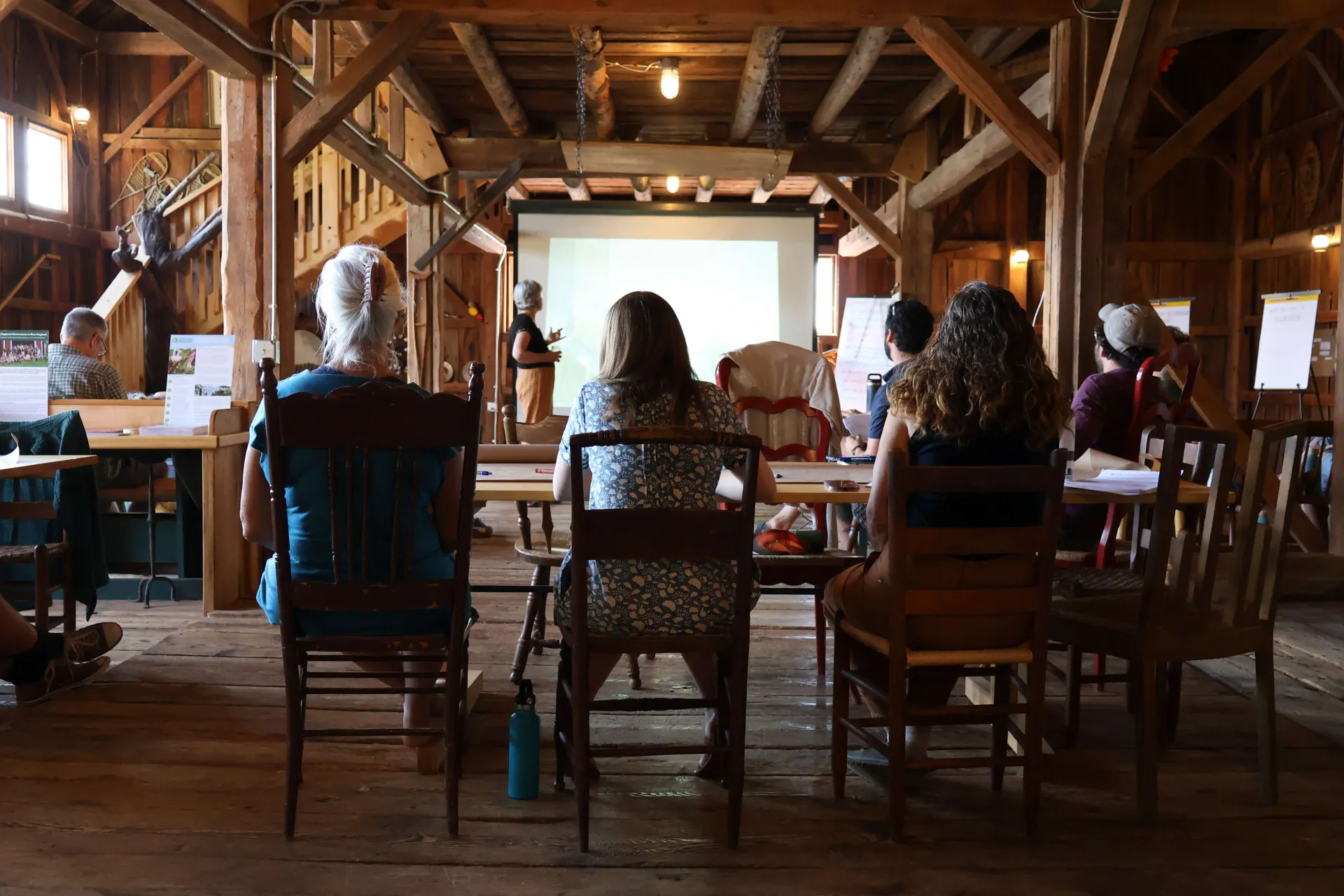
In late November, I shared this story as part of a workshop I co-led entitled Hive Mind - Designing for Collaboration at Vermont’s Farm to Plate conference. In planning our workshop (which, pro tip, should take at least as long to plan as the session itself will run), my co-facilitators Vera Simon-Nobes (Shelburne Farms), Christine Gall (Saint Michael's College), and I sorted our strategies and design considerations into three categories: Plan, Do, Reflect. In other words, effective collaboration is carefully planned, mindfully facilitated, and deeply reflected upon to inform the next collaboration.
Whether working on event logistics with collaborators, running meetings, leading farm crews, or even facilitating activists’ retreats, we all rely on this strategic planning loop.
Plan: Ahead of the collaboration, we make sure we’re clear on the goals and outcomes. From there, we design the structure and process of the collaboration (an “agenda”) with attention to all the details. E.g., how decisions will be made (majority voting, consensus), how we’ll keep people actively engaged rather than passively listening (turn & talks, small group work, opportunities to make the work personal), and how much time we can realistically dedicate to each item. And of course, we plan how we will help foster those human-to-human connections: those community-building activities.
Do: With a clear plan, it’s time to roll. It’s important that the whole group knows the plan and is clear on the goals and outcomes , and we’ve tended to elationship-building and personal connections. Sometimes this looks like activities (such as the Compass Points), or creating shared agreements for how we want to show up. There are infinite ways to foster connections and set the rules of engagement; what’s most important is that we do it. As facilitators, we’re also reading the energy of the group and making micro (or macro) adjustments along the way. Yes, we always have a solid plan. But I’d say at least 50% or the time (or more) what happens is not what was planned. Learning when to stick to the plan and when to let the group lead is a skill that builds over time. And asking the group for feedback directly and in-the-moment (what we call “transparent facilitation”) often helps us choose the right path.
Reflect: The collaboration is closing, but we’re not done! Before the group disperses, make space for gratitude and acknowledgements, review any action steps or follow ups, and celebrate the good work. It’s also crucial to gather feedback from the group on both content and process. What worked for folks? What didn’t? What changes would help us be more successful next time? Collect and document this feedback.
And then the loop repeats. Bring this feedback forward into planning for the next collaboration. If it will be with the same group, reflect how you used their feedback to build the new agenda. The more folks know that their feedback is valued and applied, the better feedback and engagement you’ll generate.
Facilitation is not easy, but it is necessary. When done well and thoughtfully, facilitation becomes a key component of any change making space, helping to foster an environment that is collaborative, iterative, inspiring, and action-oriented. But when done without preparation and intentionality, even those with the best aspirations quickly find themselves at odds about how to move forward and what to do next. Good facilitation is needed now more than ever as we strive to build a truly just and resilient future in the food system and beyond. And yes, conflict still exists and tensions arise. But with proactive and thoughtful planning, we can make it through almost anything. Better. Together.