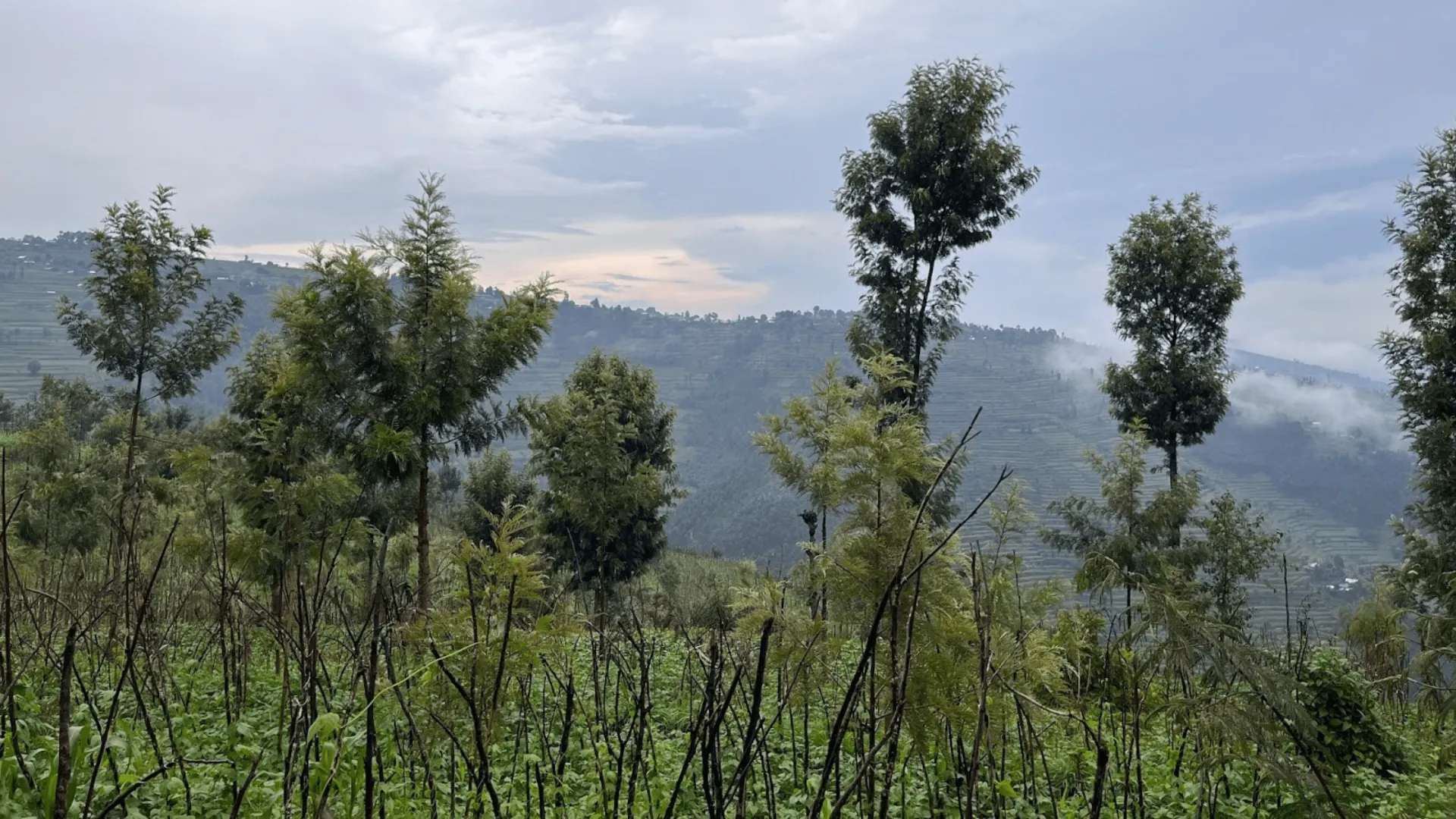
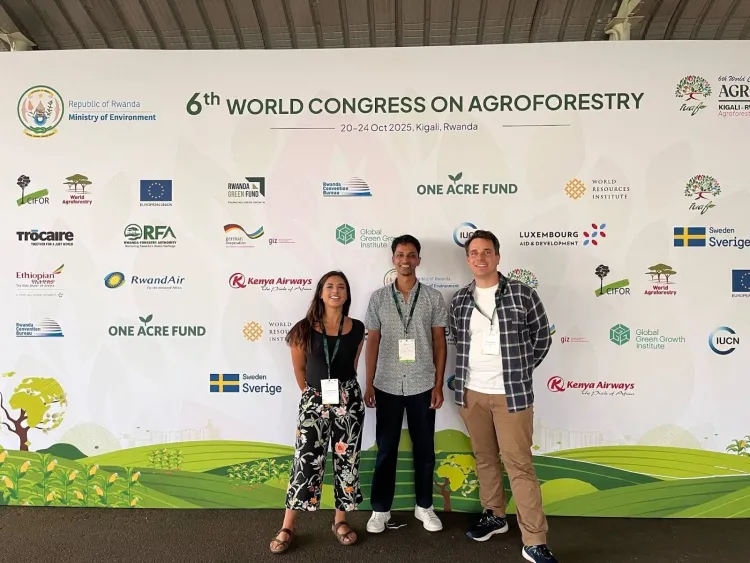
As the temperature in Burlington, Vt. plummets to near zero (don’t even ask me about the “feels like” temperature, spoiler alert: it feels COLD), I’ve been reflecting on warmer days. In mid-October, I traveled to Kigali, Rwanda as a delegate to the 6th World Congress on Agroforestry, representing the Institute for Agroecology (IfA) and Food Systems at UVM. I was there to share my PhD research on community food forests and learn from the 700-plus delegates from 63 countries, working across research, practice, policy, and civil society.
As I shared my research, listened to other presentations, and went on site visits, I was buoyed by the extensive work taking place in agroforestry across the globe. But, at the same time, I was grappling with the gaps - especially around participatory and community co-designed processes. There is a lot of good work happening, and we still have much to do.
About the World Congress on Agroforestry
The World Congress on Agroforestry (WCA) started in 2004 in Orlando, Fl., with the aspiration of creating a global forum for science, policy, and practice to move forward global agroforestry transitions. The WCA is now the place where the field of agroforestry periodically “re-anchors” itself, addresses new debates, tensions, and questions, and reflects on what has and hasn’t worked in practice. Convened by the International Union for Agroforestry (IUAF) with rotating host country’s Ministries of Environment, the WCA has strong participation from Center for International Forestry Research and World Agroforestry (CIFOR-ICRAF), the United Nations Food and Agriculture Organization (UN FAO), and other international partners.
This year’s WCA in Kigali was the sixth (following Nairobi, Delhi, Montpellier, and Québec City). Under the theme of “agroforestry for people, planet and profit,” Kigali built on the 5th Congress in Québec (2022), which called on agroforestry to support the “transition to a viable world.” The 6th Congress advanced this vision by examining the interconnected ecological, social, and economic challenges of scaling agroforestry.
Why Rwanda?
Rwanda was an early and ambitious adopter of the Bonn Challenge- a global effort to restore 350 million hectares of the world’s degraded and deforested lands by 2030 using Forest Landscape Restoration (FLR). FLR is a planned process to regain, improve, and maintain a deforested or degraded landscape’s long term ecological functions and enhance human wellbeing (César et al., 2021). Rwanda made the highest proportional commitment of any country to date by committing to two million hectares, nearly 80% of its total land area, by 2030 (Mukuralinda et al., 2016). As of 2021, Rwanda had reached 40% of its commitment, restoring 800,000 hectares of land, with investments to date estimated at $560 million (US), according to the Bonn Challenge Barometer (IUCN | Restoration Barometer Report 2022.).
On the ground, Rwanda’s restoration work is being undertaken through afforestation, sustainable management of existing forests, and, importantly, through agroforestry which accounts for the major share of the effort at 1.1 million hectares. To address the challenges and barriers associated with implementation of agroforestry at such a large scale, the government adopted a National Agroforestry Strategy and Action Plan (2018–2027) and established an Agroforestry Task Force composed of government partners, NGOs, civil society, and CBOs to operationalize it (Iiyama et al., 2018) .
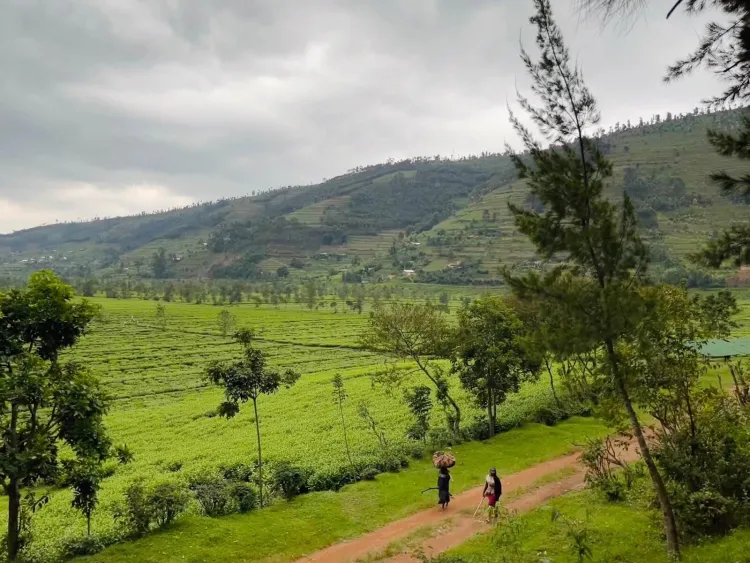
Some participants of the WCA were taken on a field visit into the highlands of the Gicumbi District in Rwanda’s Northern Province where the Green Gicumbi project has planted nearly 25,000 acres of agroforestry trees in cropped areas and restored 4,000+ acres of degraded forest. This is in addition to building 100 climate-resilient housing units constructed for farming families relocated from high-risk areas.
Along the drive, state-funded nurseries, terraced hillsides, riparian buffers, and mixed tree-crop systems were prominent, making it obvious why Rwanda’s Ministry of Environment wanted people to see this up close. While the work of scaling agroforestry is certainly not without its challenges, the country’s efforts demonstrate a living example where restoration targets, national policy and incentives, and farming practices are beginning to move towards alignment, even as familiar questions remain about power and participation
What 1.1M hectares of agroforestry means for farms and farmers:
Scaling agroforestry to 1.1M hectares (roughly 2.5 million acres) is a significant climate milestone with its benefits extending well beyond carbon sequestration to farm level agroecosystems and the farming communities that tend them. Integrated, diversified tree-crop-livestock systems tend to raise whole farm productivity. Deep-rooted perennials ‘pump’ nutrients from deeper depths and return them to the topsoil via litter and shallow root turnover so annuals can make use of the nutrients. Trees protect soil and water by reducing raindrop impact and runoff, reducing erosion and keeping nutrients in the ground. Mycorrhizae on tree roots, fueled by root exudates (tiny compounds that roots release), help mobilize phosphorus and micronutrients and build stable soil structure, making nutrients and water easier for plants to use. And the belle of the ball, leguminous perennials, add biologically fixed nitrogen, reducing the need for off-farm fertilizer inputs.
Crucially, for farmers, fruit, nuts, timber, forages, resins, and medicines that come from agroforestry systems provide important economic value and strengthen livelihoods. At the landscape scale, multistrata canopies, hedgerows, and understories link farm fields to the surrounding habitat. That connectivity stabilizes ecosystem functions (pollinators, natural enemies, soil biota, and wildlife movement) beyond a single field and can open doors to conservation cost-share programs, certifications, premiums or payments for ecosystem services.
Agroforestry and Agroecology
The jury is in regarding agroforestry. The benefits are well researched and clear. So what gives? In practice, agroforestry’s ability to support farmers hinges on things like secure tenure, accessible credit, reliable markets, supportive policies, and financial assistance. Put simply, agroforestry’s power to drive social transformation must answer the questions - who participates, who benefits, whose knowledge counts, and how are support systems structured? Questions that also ground the work of agroecology.
Agroforestry and agroecology are essentially first cousins. They share the same core premise: the closer an agroecosystem resembles a diverse, functioning ecosystem, the more resilient and productive it can be. Neither is new; both find their center of gravity in Indigenous and place-based land stewardship that has long worked within (and even enhanced) local ecologies. But, they grew up in different institutional homes: agroforestry largely within forestry and agronomy, tied to restoration, climate programs, and biophysical accounting; agroecology within agronomy, ecology, and social movements like food sovereignty and peasant rights, embodying a more explicitly transformative framework. Funding architectures sharpen the divide even further. Climate and restoration finance associated with agroforestry tend to reward what is easily measured at scale (carbon, canopy, hectares), while agroecology’s strengths - co-creation of knowledge, food sovereignty, cultural continuity- are harder to quantify but are equally, if not more, important to realizing transformation on the scale that is required.
How can agroforestry and agroecology move forward together? By borrowing the best from each. From agroecology, agroforestry can take co-design and Participatory Action Research (PAR) and bake them in as defaults, building trials around farmer-led experimentation and treating farmers as collaborators, not adopters. It can also bring a governance and justice lens by explicitly addressing and planning for land tenure, labor, credit, and biocultural goals. Importantly, it should also explicitly resource the social ecosystems of agriculture, like farmer-to-farmer exchanges and shared infrastructure like nurseries, so that knowledge and material resources move together. From agroforestry, agroecology can draw more strategically on large data sets on carbon, hydrology, soils and landscape tools (remote sensing, GIS, biodiversity indicators, land-equivalent ratios) that make systems-level impacts legible to policy and finance without surrendering transformative social aims.
In this sense, agroecology sets the compass- the why, for whom, and how- while agroforestry draws the map- the where and what of tree-based designs (alley cropping, food forests, windbreaks, riparian buffers, silvopasture) that can deliver those principles from small farms to entire landscapes. Both are needed for whole-systems level transitions.
Bringing It All Home
All these thoughts were top of mind throughout my time at the 6th WCA because they are the very same tensions I’m working through in my dissertation. The paper I presented focuses on a Participatory Action Research project to support the establishment of a community food forest in Grafton, Mass. My research within this project asks two core questions:
- What role can participatory action research play in aligning institutional support for agroforestry with community-defined priorities?
- How can community-based approaches to agroforestry (food forests as focal case) serve as entry points for farmer adoption, peer to peer learning, and public education?
I arrived at these questions because promotion and technical assistance efforts too often emphasize a narrow set of species and “technology packages,” thin market pathways, and insufficient attention to farmer knowledge, lived constraints, or broader agroecological dynamics. I work with primarily black, indigenous, and farmers of color who face adoption barriers like land access, tailored technical assistance, and patient capital that is rooted in, and amplified by, historic and ongoing inequities.
The early findings I shared at the WCA demonstrate how structural barriers outweigh technical ones, cultural continuity and intergenerational care act as core motivations for engaging in agroforestry in the Northeast, and the role of demonstration sites/living labs and community governance accelerate adoption.
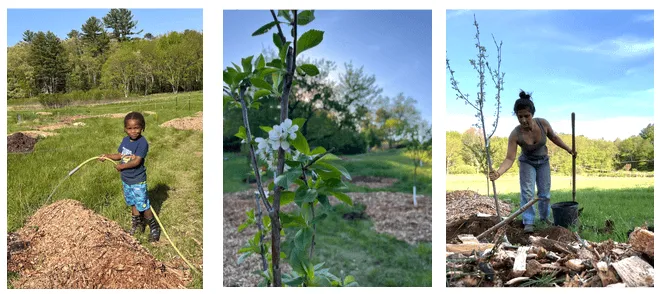
So far, the site boasts 100+ fruit trees and 250+ shrubs and berries planted by Matt Feinstein and Ulum Pixan of the Global Village farming cooperative, community volunteers, and many by me and my special helper, Micah, who affectionately calls it his “fruit forest.” Through our collaborative efforts, we hope to show how community food forests can enable farmer-to-farmer exchange on practical questions (varieties, spacing, yield expectations, labor, market fit, and establishment costs) while also providing public education through open workshops, signage, and youth curricula. The hope is that the site will reduce perceived and real risk, build the material conditions needed for adoption, and generate locally grounded evidence. Equally important, the project is grounded in an equity-centered design that aims to reconnect BIPOC farmers and land stewards with regional plants and ecologies- relationships disrupted by colonialism and industrial food systems- while integrating Traditional Ecological Knowledge with agroforestry science and practice. As I move forward, I hope to see this project keep building that connective tissue agroecology and agroforestry have been missing.
Funding acknowledgment: This work would not be possible without the support from UVM’s Sustainable Campus Fund, Northeast SARE (USDA-NIFA), and UVM’s Institute for Agroecology, with additional funding support and collaboration from the Massachusetts Department of Conservation and Recreation, Pocasset Pokanoket Land Trust, and Global Village at Tuckaway Farms.
Sources:
César, R. G., Belei, L., Badari, C. G., Viani, R. A. G., Gutierrez, V., Chazdon, R. L., Brancalion, P. H. S., & Morsello, C. (2021). Forest and Landscape Restoration: A Review Emphasizing Principles, Concepts, and Practices. Land, 10(1), 28. https://doi.org/10.3390/land10010028
Iiyama, M., Mukuralinda, A., Ndayambaje, J. D., Musana, B., Ndoli, A., Mowo, J. G., Garrity, D., Ling, S., & Ruganzu, V. (2018). Tree-Based Ecosystem Approaches (TBEAs) as Multi-Functional Land Management Strategies—Evidence from Rwanda. Sustainability, 10(5), 1360. https://doi.org/10.3390/su10051360
IUCN | Restoration Barometer Report 2022. (n.d.). Retrieved December 1, 2025, from https://restorationbarometer.org/restorationreport/
Ministry of Environment. (2018). National agroforestry strategy (2018–2027). Kigali, Rwanda: Republic of Rwanda.
Mukuralinda, A., Ndayambaje, J. D., Iiyama, M., Ndoli, A., Musana, B. S., Garrity, D. P., & Ling, S. (2016, December 30). Taking to Scale Tree-Based Systems in Rwanda to Enhance Food Security, Restore Degraded Land, Improve Resilience to Climate Change and Sequester Carbon. CIFOR-ICRAF. https://www.cifor-icraf.org/knowledge/publication/18476/