It’s 5:36 AM in early July and the morning dew clings to dark green kale leaves like tiny glass beads as a new summer day settles into the foothills of Vermont. The sun hovers low on the horizon, its rays slicing through a layer of clouds. tanamá varas, a farmer, activist, and North America Youth Coordinator for La Via Campensina, steadily carries three harvest crates out to the field, a sheathed knife attached to his hip, and a to-do list crumpled in his pocket. tanamá pauses, drawing a long breath that fills his lungs with a swirl of nitrogen, oxygen, and summer humidity. When he kneels to test the soil moisture with his fingertips, his nails gather a microscopic world: bacteria, pollen, and microbes. Overhead, wood thrushes beat their wings toward nesting sites, preparing to lay little blue eggs. By autumn, they’ll travel thousands of miles to winter in the Global South, carrying traces of this Vermont soil with them. From their vantage high above the Atlantic Ocean, the interconnectedness of air, land, and water is undeniable. Despite the geopolitical boundaries forced by governments, the ecosystems that shape the lives of these birds, and the communities they fly between, are part of one continuous web. Agroecology knows this truth of interconnectedness, and in that lies the opportunity for solidarity, shared learning, co-creating, and collective action.
The United States in Global Spaces
The United States has long used its political and economic influence to shape agriculture systems worldwide, with motives often entrenched in industrial, profit-driven models. In the 1940s, the Green Revolution, a movement bringing new agricultural technologies to developing countries, increased food production. But, it also created a dependency on capitalist models of agriculture, like high yield seed varieties, synthetic fertilizers, pesticides, and large farm models. According to Colin Anderson, co-director of the University of Vermont Institute for Agroecology, the Green Revolution was promoted as a project for reducing hunger and supporting farmers, but was actually a Trojan horse, resulting in a boost for Western strategic interests and United States power on the global stage. That power was used, in turn, to influence global processes, helping the United States and Western powers avoid accountability for their actions. (E.g. withholding pivotal resources from countries unless they embraced certain practices, exerting pressure on international bodies to adopt and promote capital-driven approaches).
Anderson has witnessed firsthand the impact Western global influence has had in international food and agricultural convenings, especially when a global superpower, like the United States, takes an adversarial approach to community needs or doesn’t even show up.
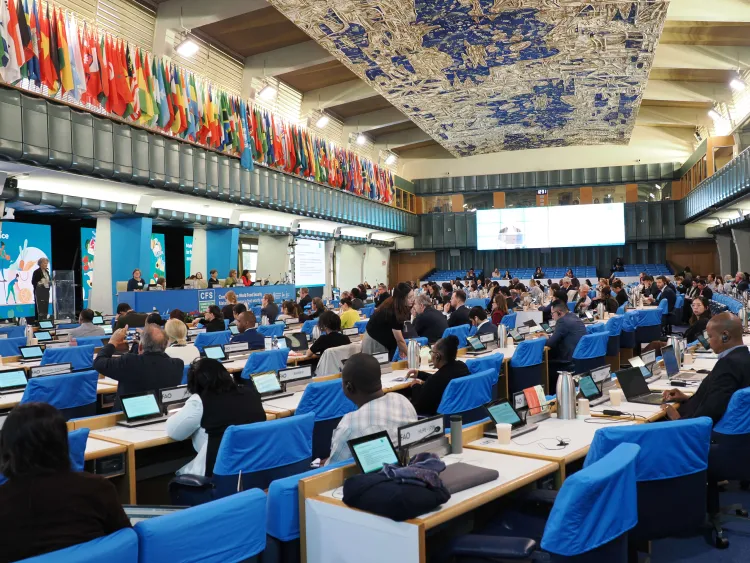
“When agroecology is brought into these conversations, it’s clear how the states are trying to keep agroecology more as a technical scientific project than getting at the underpinning politics of food sovereignty,” says Anderson. While sitting in meetings as part of the High-Level Panel of Experts on Food Security and Nutrition of the United Nations Committee on World Food Security in Rome and witnessing the United Nations Climate Change Conference (COP), Anderson observed the U.S. “delegitimizing international cooperation, undermining agroecology and continuing to pour money into the industrial, corporate-led food system.”
But when governments fall short, people show up. While U.S. delegates continue to sidestep global cooperation, grassroots movements such as La Via Campesina, a decentralized agrarian movement of over 200 million farmers, peasants, pastoralists, fisherfolk, and more, are weaving transnational networks that uplift food sovereignty and agroecology from the bottom up. These types of global relationships are informing and inspiring regional and local work.
“The most important work that we can do is always going to be at home in the territories that we know, live, and farm in,” says Mollie Wills, Grassroots Organizing Director at Rural Vermont, a farmer-led grassroots advocacy organization who has worked with La Via Campensina through their membership with National Family Farm Coalition.
Power Steeped in People and Community
As United States officials pull their chairs back from global tables, people-power is growing in the global peasant farmer movements. Folks from all over the map are joining, including from Vermont. Wills and varas both describe these relationships as essential to strengthening agroecology at home and legitimizing it more broadly. Through solidarity and bearing witness to policies in action elsewhere, organizers can adapt successful campaigns of partners to their own communities.
Wills points to the Rights of Nature frameworks in Ecuador and Bolivia, which legally recognize ecosystems as living entities. It’s a sharp contrast to the approach of the United States.
“Corporations have significantly more rights than the air or the water or the soil that we all rely on to survive,” she notes, adding that seeing national governments institutionalize such worldviews “can be hugely inspiring for other movements across the country."
The same is true for cooperative ownership models and agrarian reform. varas points to Cuba’s 1960s land redistribution where land concentrated in the hands of a few was transferred to landless farmers who wanted to steward it and grow food for their community.
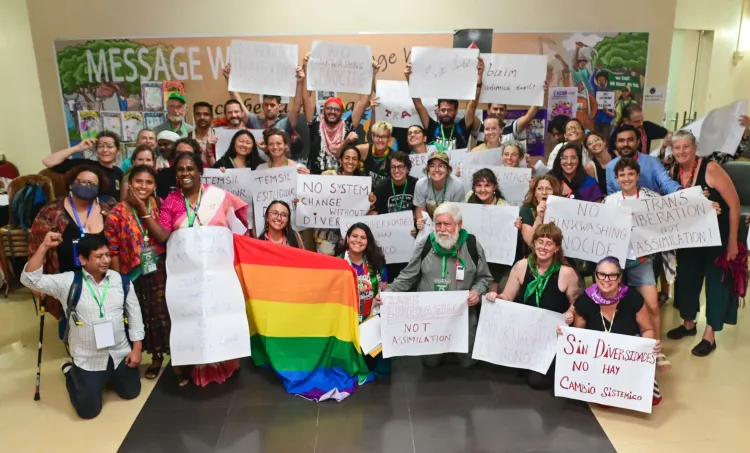
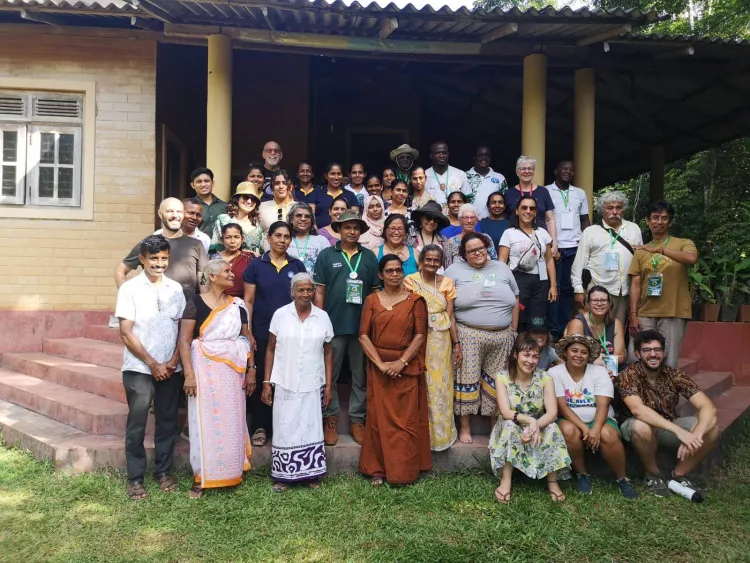
Solidarity is also built through global gatherings. At this year’s Nyéléni Global Forum, more than 700 representatives, communicating across 18 languages, co-authored a shared declaration and political agenda – The Kandy Declaration: A Collective Roadmap for Systemic Transformation. Wills describes it as a “roadmap to work together back home in solidarity with global movements” grounding those global principles in local realities. These gatherings also center political education, contextual analysis, and intergenerational, diverse leadership.
varas notes that “there is a lot of space created for youth and for women,” in these international convenings, noting that mandated representation uplifts voices historically excluded from decision-making.
Perhaps most importantly, these exchanges affirm that solidarity exists between people, not necessarily their governments.
“There's a degree of understanding in the global community about how peoples are not necessarily a reflection of their governments,” Wills says.
As a United States organizer, she finds that is “a very generous worldview,” and one that allows organizers like her and varas to show up in these spaces and make visible the activism against rising authoritarianism at home.
“It is important to do the work locally ... and then do these exchanges globally, exchanging struggles, because a lot of our struggles are shared,” varas adds.
Even as global solidarity grows, Vermont agroecologists emphasize that the heart of agroecology lies in place-based solutions. The IFA worked with Wills and Rural Vermont through the Seeding Partnerships for Agroecological Transitions in the NEK project led by Martha Caswell, IFA research associate and former founding co-director of the IFA, and Katie Horner, former IFA postdoctoral associate, and funded by the Leahy Institute for Rural Partnerships. Wills points to Vermont’s distinct geography: steep slopes, narrow valleys, and small parcels that resist large-scale industrial agriculture.
“Blanket approaches to certain regulations might be really important for a more industrial scale operation,” she shares as an example, “but in Vermont those policies could be unnecessary or impractical and put a lot of burden on small scale farms.”
“Local rules should reflect the local realities and conditions,” she adds. “It really must be that way to grow our food sovereignty and be true to our roots.”
Weaving Global Threads Back Home
As shared by varas, Wills, and Anderson, agroecology flourishes when communities shape their own strategies rooted in the needs of the place, culture, and people. Those local efforts, in turn, radiate outward, carried like microbial passengers on a thrush’s wings.
Movements like La Via Campesina exemplify how local action feeds global momentum. With autonomous regions, agroecology schools, and working groups on seeds, biodiversity, migration, and more, the movement spans continents while staying grounded in community realities of food sovereignty.
Varas describes his role as the North American youth coordinator for La Via Campensina as helping “build momentum in the region to get more activity around food sovereignty in North America through ecological exchanges, policy work and engaging youth.”
Mostly he says, it is facilitation, “putting things together, outreaching, making connections with other farmers and folks doing this work.”
Varas works closely with Wills and Rural Vermont and focuses on shifting power from corporate systems to community control in Vermont and beyond. Rural Vermont does this through policy initiatives supporting community-scale farmers, citizen advocacy programs, protests, and legal footholds to support traditional practices.
Both are involved with the People’s Agroecology School of Vermont, a project of Rural Vermont, which uses popular education models to build solidarity, break down barriers, and engage in a holistic education of social, political, spiritual, and emotional spaces along with ecological practice.
“We work towards food sovereignty,” Wills says in describing Rural Vermont’s role in the state and beyond. “At the end of the day, we’re shifting power from a corporately dominated and controlled food system toward one that’s community controlled.”
From a Vermont kale field to a global peasant gathering, agroecology is held together by the same truth the wood thrushes know instinctively: borders don’t contain ecological connection. The work begins at home – regenerating ecosystems, feeding communities, and shifting power – but its impact is carried outward. Agroecology grows through relationships between people and land, between neighbors, and among movements that stretch across continents.