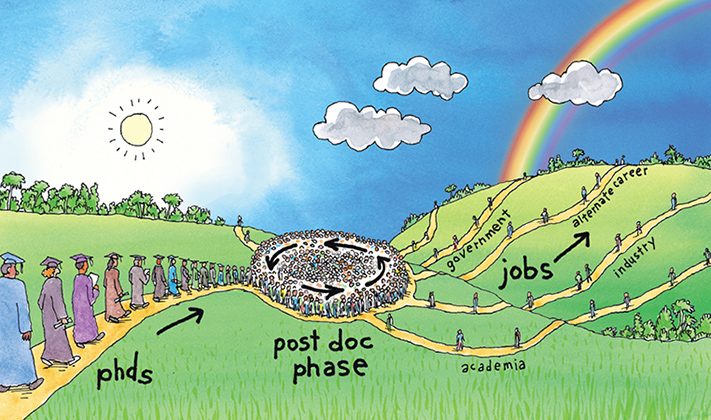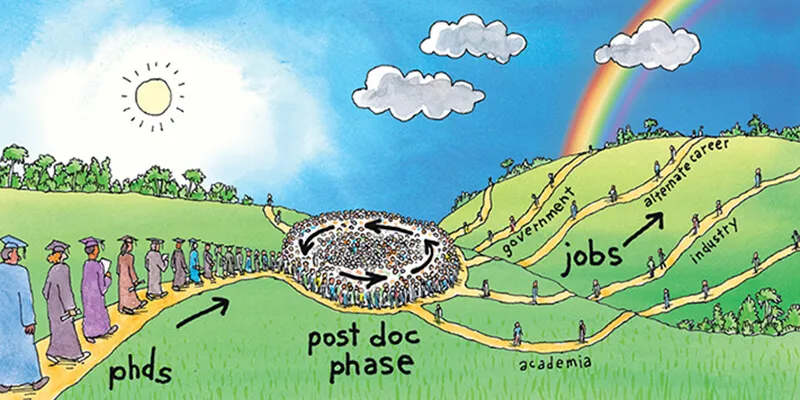
Ever been stuck driving on the inside of a rotary or roundabout and had to go around again?
The postdoc phase, as depicted in the illustration by Tom Dunne, is analogous in many ways. Unlike graduate school, the postdoc phase is not linear; it has no pre-defined endpoint, such as a successful dissertation defense. This allows postdocs to gain real-life experiences and acquire the professional skills necessary for success in academia, industry, government, policy, and a variety of “alternate” careers. During this transition period, postdocs often take many “laps,” with exposure to multiple successful career opportunities. However, postdoctoral trainees can get stuck circling on an inside loop (“permadoc”).
The mentorship received during this time of exploration and skillset development greatly influences a postdoc’s career trajectory. Importantly, postdocs are both trainees, under their research mentor(s), and mentors themselves, teaching and supervising undergraduate and graduate students. Thus, postdocs are uniquely positioned to adopt and pass on beneficial mentoring practices while receiving realtime feedback on their mentorship skills from both mentor and trainee.
Recent studies have investigated various factors that influence career decisions and academic success of postdocs in an effort to help guide postdoc-specific policy development. In a 2018 eLife manuscript (eLife 2018;7:e40189 DOI: 10.7554/eLife.40189), McConnell et al. surveyed 7,603 postdocs at 351 US institutions, both academic and non-academic, in 2016. The authors conclude that being trained on how to be a mentor (pedagogy) was a positive factor leading to increased postdoc satisfaction while overall mentorship quality/satisfaction most influenced postdoc career choices. Relatedly, Liénard et al. set out to identify characteristics of both successful mentors and successful trainees (Nature Communications 2018;9:4840 DOI: 10.1038/s41467-018-07034-y). Using data from 18,865 biomedical researchers (Academic Family Tree), the authors discovered that successful postdocs integrated expertises obtained during graduate school into their postdoctoral research, oftentimes bringing new skillsets to the postdoctoral mentor. Interestingly, postdoc mentors had a larger impact on success than did graduate mentors.
Speaking on a personal level, I have received excellent mentorship at UVM and am lucky that our research group is led by three Senior Principal Investigators. In addition to “the bosses,” I have received quality mentoring from UVM entities including the UVM Cancer Center, the Graduate College, the Office of the VP/Research, Grossman School of Business, Larner College of Medicine, College of Nursing and Health Sciences, and our clinical collaborators at the UVM Medical Center. Importantly, I have had the opportunity to mentor numerous undergraduate and graduate students. UVM’s focus on strong student training has greatly facilitated these experiences which have provided many necessary skills for the next step in my career.
The importance of providing quality mentorship for postdocs is becoming more widely recognized, with many funding agencies requiring mentoring plans. At UVM, some programs, such as the Vermont Lung Center, have a guide for mentor-trainee expectations/responsibilities to ensure that the mentor-trainee relationship is mutually beneficial. The University of Vermont Postdoctoral Association is currently developing templates for establishing expectations of mentor and trainee as a tool for UVM postdocs. For more information and other resources, see the UVM Postdoctoral Association website.