FieldLabs

Centennial Woods

Natural Area: Centennial Woods

About Centennial Woods

Body

Centennial Woods is perhaps the most used of UVM’s Natural Areas, and consists of a forested area with a robust trail system just a few minutes walk from campus. A stream network runs through the center of the woods, and a mowed strip for a Vermont Electric Company (VELCO) line provides open habitat crossing the property. This variety of environments makes Centennial an ideal teaching location, and many students across disciplines take advantage of Centennial’s offerings throughout the year. 
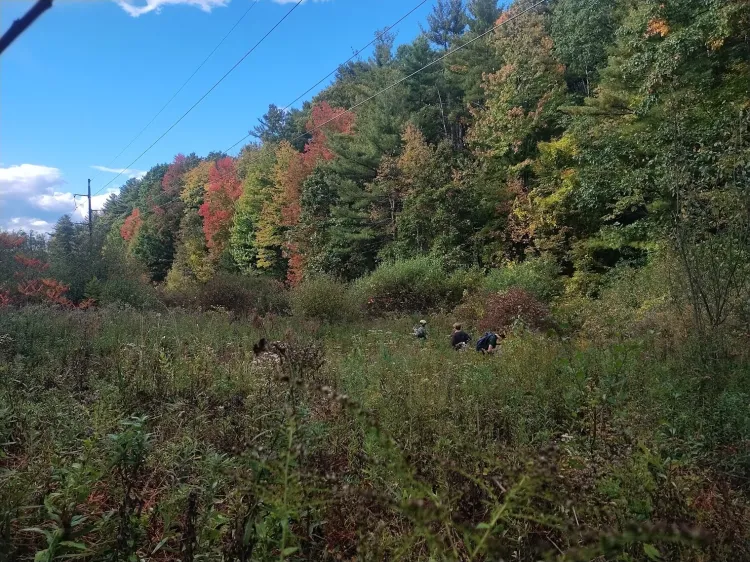
Students in a clearing in Centennial

Research

Body

UVM faculty and doctoral candidates have used Centennial Woods for various ecological research projects over decades. Recent research includes a study on deer tick abundance and disease presence, wood frog vocalization research, and research on topsoil as it relates to post-wildfire landslide occurrence. Long term forest monitoring plots were established in 2023. 

The property contains long-term forest monitoring plots that were established in 2023. Contact natural.areas@uvm.edu to access data or site locations. 

Education

Body

Students in Environmental Studies, Botany, Zoology, Forestry, Recreation Management, and Education use this area extensively for academic study. Restoration ecology classes have identified numerous habitat restoration opportunities in Centennial Woods.  Students have implemented projects to reduce erosion, remove invasive plants, stabilize streambanks, and increase native plant populations. Engineering students are actively involved with bridge and trail designs for the area. Several thousand students utilize Centennial Woods as an outdoor classroom each year. 

Outreach

Body

Centennial Woods is open to the public, and is frequently used by local neighborhood residents for hiking, dog walking, running, birdwatching, and more.  

Property Description

Body

A collection of mature conifer stands, mixed hardwoods, early successional woodlands and shrublands, streams, and wetlands.  A mowed powerline bisects the area providing open habitat.  A small number of mineral seeps can also be found in the area.  

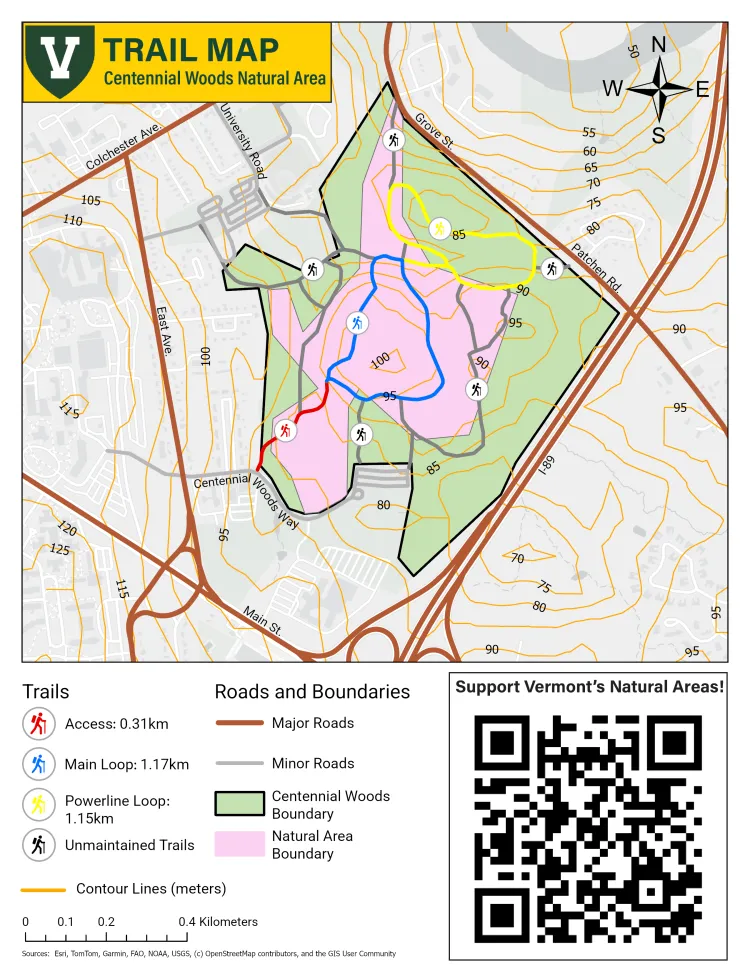
The Centennial Woods Natural Area is a 70-acre subset of a 147-acre contiguous undeveloped property owned by UVM. It is one of the most frequently visited UVM natural areas. This area contains over 65 acres of mature conifer stands, mixed hardwoods, fields, streams, and wetland areas. Within the city limits of Burlington and adjacent to the UVM campus, this area serves as an excellent natural laboratory to study the region’s plants, animals, and natural processes, as well as cultural history. It sits adjacent to the Winooski River, connected by Centennial Brook, and thus provides connected habitat for wildlife traveling up and down the river corridor. A well-developed trail system wanders through Centennial Woods, offering visitors samples of the natural communities and landscape features thriving here.   

History

Body

The University acquired several farms in the area east of the main campus in 1903 and 1908 for future campus expansion opportunities. The portion that remained undeveloped eventually became known as Centennial Woods and was designated as a natural area by the Board of Trustees in 1974. There remained uncertainty as to the exact size of the natural area until 1994 when 65 of the total 147 acres were officially designated. The development rights and a conservation easement on the acreage were conveyed to the Vermont Land Trust. This latter action was taken to assuage concerns about the lack of long-term protection for Centennial Woods. Five acres were added in 2008 when a co-housing project was developed adjacent to the natural area off of East Avenue.   

Site Access, Maps, and Facilities

Body

Directions to Centennial Woods via Google Maps 

Parking and Directions  

Parking for the Centennial Woods Drive entrance to East Woods is limited to a few metered parking spaces in front of the UVM Library Research Annex building, 82 Centennial Woods Way. These spaces are metered by Park Mobile. Free weekend parking is available at 320 Centennial Woods Way. 

Trail Map (In Development)  

Facilities:  

No facilities other than parking; best suited for day use.  

Site Characteristics

Body
  • Size: 70 acres

  • Average summer high: 80.1 

  • Average summer low: 57.9 

  • Average winter high: 26.9 

  • Average winter low: 12.7 

  • Elevation: 115-170m/375-55 ft 

  • Precipitation: 37.53 in rain/87.5 in snow 

  • Soils: loamy sands, Adams & Winsor series or Hartland sandy loam 

Stakeholders & Partnerships

Body
  • Vermont Land Trust 

  • City of Burlington Conservation Commission 

  • City of South Burlington Natural Resources Committee 

  • VELCO 

  • UVM Police Services 

  • VT Department of Environmental Conservation, Storm Water Unit 


Field Lab Bibliography

Body

UVM Libraries' Research Guide to Centennial Woods 

A full PDF of past research at Centennial Woods can be found here.