FieldLabs

Colchester Bog

Natural Area: Colchester Bog

About Colchester Bog

Body

Colchester Bog sits on a peninsula just a few miles north of Burlington, and is a hot spot of diversity of flora and fauna. Bordering Airport Park in Colchester, the site is an ideal spot to research wetland plants, animals, and natural communities, and is also a popular birding location. Several uncommon or rare wetland species can be found near the boardwalks of Colchester Bog, making this natural area a popular research and recreational area.
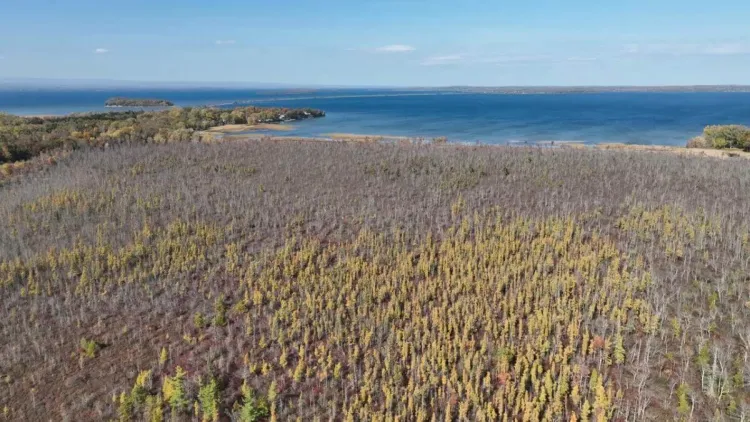
An aerial photo of Colchester Bog

Education, Research, and Community

Research

Body

Research at the Colchester Bog Natural Area has historically focused on post-glacial ecological succession and wetland dynamics. Studies have documented the bog's 9,000-year geomorphic history, tracing its transition from the ancient Champlain Sea to a freshwater peatland. Key scientific contributions include Nicholas Gotelli’s influential work on northern pitcher plants (Sarracenia purpurea), which demonstrated how these plants adapt morphologically to atmospheric nitrogen levels.

Education

Body

UVM students in forestry and environmental science courses use this natural area to conduct field learning experiences, especially focused on plant identification and local ecology. The site maintains an iNaturalist community for citizen science and educational engagement. 

Community

Body

Colchester Bog boardwalk is one of the top ten places to walk in Colchester, according to the town Parks and Recreation Department.  Colchester Bog is highlighted as a best walk for plant enthusiasts by VT Fish and Wildlife Department.  Birders visit the bog due to over 140 species of birds that can be sighted.

Property Description

Body

The nearly 200-acre natural area contains peatland, cattail marshes, shrub and tree dominated swamps, open water areas along the perimeter called lags, and upland sand dune and woodland habitat.  Due to its proximity, the bog’s water level rises and falls with the level of the lake. 

Some of the tree types at Colchester Bog include maple, ash, and elm, as well as white cedar, pitch pine, black spruce, and tamarack.  Some of the common shrubs include mountain holly, rhodora, sheep laurel, and labrador tea. In an effort to allow visitor to see this special natural area while minimizing the impacts of trampling on the bog, community members and an array of students constructed a boardwalk and observation deck made of wooden planks which are kept in place by plastic floats. 

History

Body

With the help of The Nature Conservancy, the University of Vermont acquired 180 acres in 1973 and has since managed them as the Colchester Bog Natural Area.  The Nature Conservancy conveyed the land to UVM without cost but with conditions that it be managed appropriately as a natural area.

Ongoing Monitoring & Research

Body

The UVM Natural Areas Program monitors a small population of black gum trees.  Black gum is an uncommon tree species in Vermont. Several years ago the black gum trees in Colchester Bog were being gnawed by beavers.  UVM personnel placed chicken wire around the trees to prevent beavers from reaching them.  The trees are periodically monitored for growth and survival.

Site Access, Maps, and Facilities

Body

The trail system is open to the public.  

Directions to Colchester Bog via Google Maps 

Parking and Directions 

500 Colchester Point Rd, Colchester. Parking is at Airport Park; walk towards the forest behind the baseball fields to access boardwalk trail.

Trail Map (In Development) 

Facilities: 

No facilities in the Natural Area. The Town of Colchester Airport Park provides restrooms and parking; best suited for day use. 

Site Characteristics

Body
  • Size: 180 acres 
  • Temperatures 
  • Average summer high: 79.8 
  • Average summer low: 59.4 
  • Average winter high: 26.9 
  • Average winter low: 8.4 
  • Elevation: 25-30m/95-110ft 
  • Precipitation: 37.53 in rain//87.5 in snow annually 
  • Soils: Mostly muck and peat 

Stakeholders, Partnerships, and Resources

Body

Stakeholders & Partnerships

  • The Nature Conservancy
  • Colchester Parks and Recreation
  • Colchester Police
  • VT Natural Heritage Program
  • Winooski Valley Park District

Resources

https://storymaps.arcgis.com/stories/db5cbc53504b4908b5a39ac86318ec06

Past Research

Body

https://libraries.uvm.edu/research-guides/colchester-bog 

A full pdf of past research at Colchester Bog is in development.