FieldLabs

East Woods

Natural Area: East Woods

About East Woods

Body

East Woods is a small, forested area in the heart of South Burlington, providing students with an excellent opportunity to study human-environment interactions and semi-developed areas. Potash Brook runs through the middle of the natural area and allows students and researchers to study the effects of development on watersheds and water quality. 
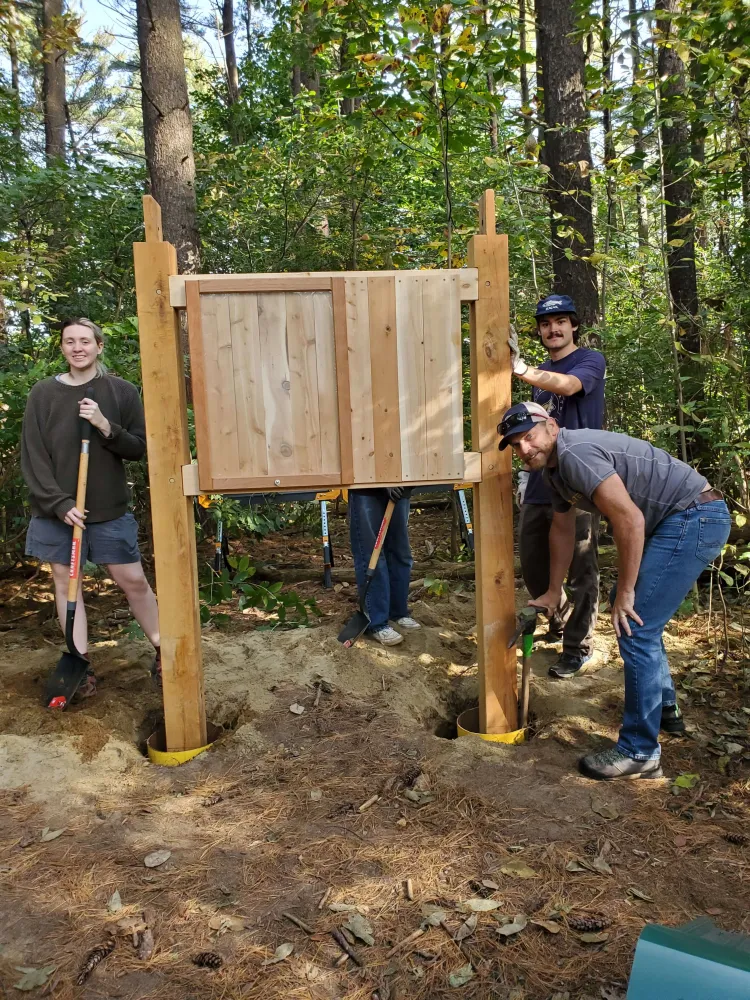
Employees installing a kiosk at East Woods


Research

Body

One group, led by Anne Jefferson, studied how the forested area of East Woods serves to mitigate the impacts of urban watershed pollutants. This research focused on the amount and timing of sediment transport along Potash Brook, as well as collected data about the accumulation and movement of trash. The study sampled from seven sites along Potash Brook, including upstream and downstream of East Woods. Results will be published in 2026. 

Education

Body

East Woods is used to teach undergraduate students about stream ecology, microbiology, and urban environmentalism. 

Outreach

Body

The trail network at East woods is popular with local residents and dog walkers. A community effort has led to organized volunteer disposal of dog waste. East Woods is the only Natural Area where dogs are allowed off-leash if kept under strict voice control. Dogs that cannot be controlled by voice must be on a leash. Report all incidents to UVM police at 802 656-3473. 

Property Description

Body

East Woods Natural Area consists of 40 acres of forested landscape adjacent to Interstate 189 in South Burlington. Forest types include mixed hardwood stands and white pine/hemlock forests.  There are many large and mature trees throughout the area with ample snags, deadfall, and lots of coarse woody debris.  Riparian and in-stream habitat can also be found along Potash Brook.  Although somewhat more removed from campus than Centennial Woods, the proximity of this natural area to Burlington and the University results in moderate use by both UVM students and faculty and other visitors.  It is also close to a bike path that is found just across Swift Street near the entrance to the natural area.    

Potash Brook flows through East Woods and divides the area into two use zones. Visitors typically use the south zone with frontage on Swift Street in South Burlington.  Here there is a small parking area, an interpretive sign and the trailhead for the loop trail.  A small information kiosk is found just beyond the trail entrance.  A secondary trailhead is located along the west side of the natural area behind a commercial development providing minimal access.  The north zone between Potash Brook and Interstate 189 connector is not developed for use and is infrequently visited.  There are currently no bridges across Potash Brook and visitors can cross only during low water or precariously at other times over downed trees.  

History

Body

In 1949, the University purchased approximately 100 acres in South Burlington from a local developer with financial help from neighbors and friends.  The intent at that time was to protect the land from development in a rapidly developing area near Burlington.  When the Interstate 189 connector was constructed in the 1960’s, over half of the land was lost with the remaining 40 acres designated as East Woods Natural Area in 1974.   

Ongoing Monitoring & Research

Body

East Woods is used by students in environmental science programs to study the ecosystems of urban watersheds. 

Site Access, Maps, and Facilities

Body

Directions to Carse Wetlands via Google Maps  

Parking and Directions  

240-110 Swift St, S Burlington; Parking is in a small lot in front of the trailhead 

Trail Map (In Development)  

Facilities:

No facilities other than parking; best suited for day use.  

Site Characteristics

Body
  • Size: 40 acres

  • Average summer high: 82.4 

  • Average summer low: 62.4 

  • Average winter high: 31.5 

  • Average winter low: 14.3 

  • Elevation: 58-86m/190-280ft 

  • Precipitation: 37.53 in rain/87.5 in snow 

  • Soils: Mostly loamy sands with some clay  

Stakeholders, Partnerships, and Resources

Body

Stakeholders and Partnerships  

  • South Burlington Natural Resources Committee 

  • Vermont Department of Environmental Conservation, Stormwater Unit 

  • Green Mountain Power Company 

Past Research

Body

A full PDF of past research at East Woods can be found here.