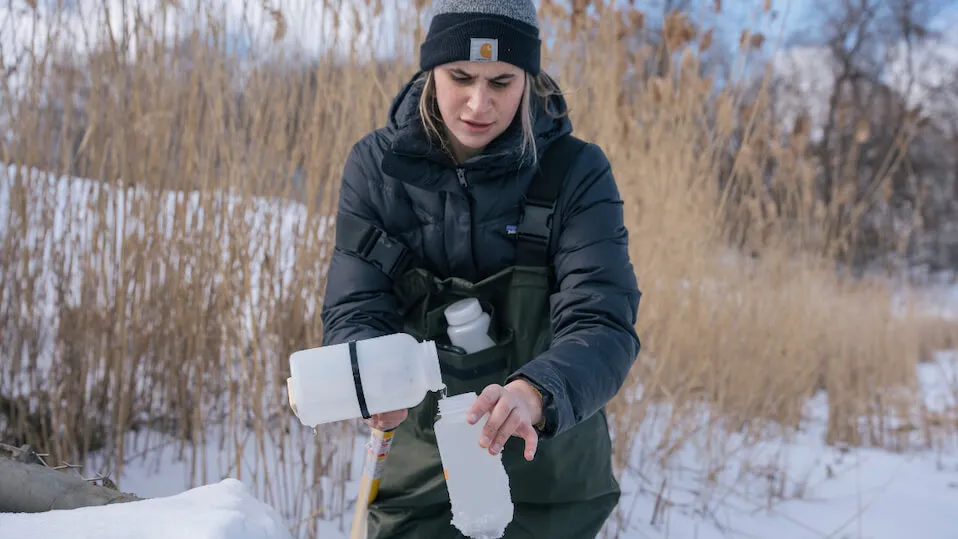
On Tuesday afternoon, the University of Vermont Stream Ecology class tromped into the wintry Centennial Woods. After some searching and digging around in the snow, they reached the ice, then the water beneath it.
Students stuck a probe the size of a toothpaste tube through a hole in the ice to measure how well the water conducted electricity. Why? Because there's a strong relationship between water conductivity and chloride concentration, i.e., how much road salt is in there. And for Winter Salt Week, held Jan. 26-30, that's what students were looking for in local streams: a salt snapshot.
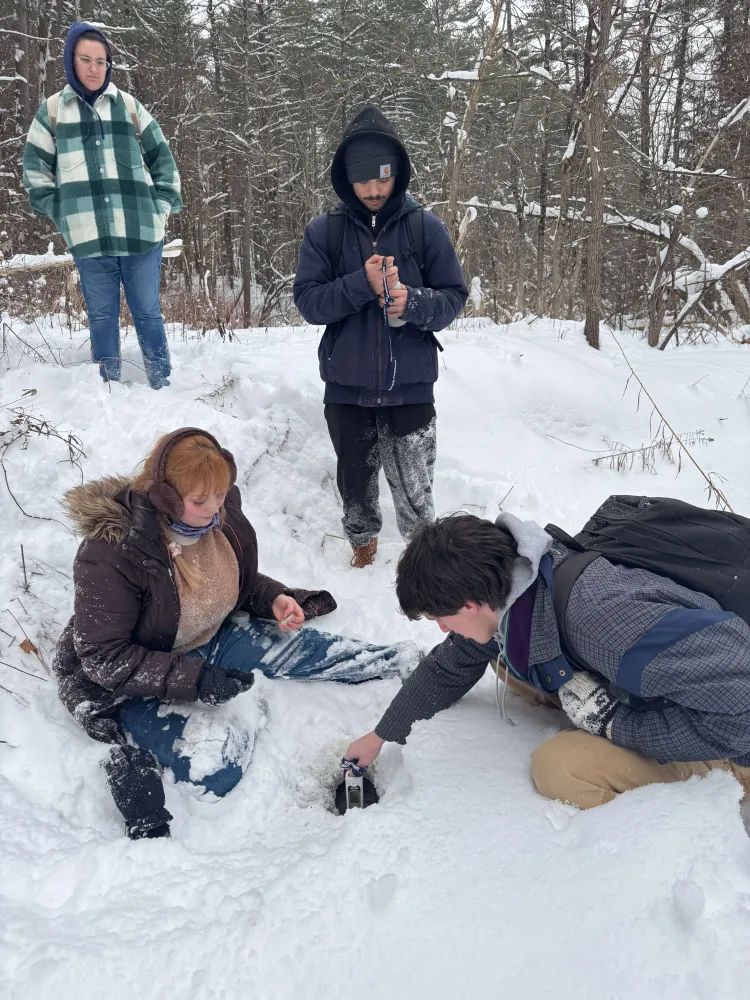
Guiding the Stream Ecology class was Kris Stepenuck. She's a UVM Extension Associate Professor, the Associate Director and Extension Program Leader for Lake Champlain Sea Grant and an affiliate at the Gund Institute for Environment.
She's also really interested in reducing the use of road salt. Because in the U.S, we spread a whole lot of it.
"It's about 20 million metric tons, and a metric ton is 2,200 pounds," Stepenuck told Across The Fence this week. "If you take a town's plow, put the salt in the back, fill it up, OK, this is a traffic jam of plow trucks from Burlington, Vermont to Seattle, back to Burlington, and back to Glacier National Park."
She said Vermont is responsible for about a little more than 1% of that salt use, spreading between 225,000 and 275,000 metric tons annually.
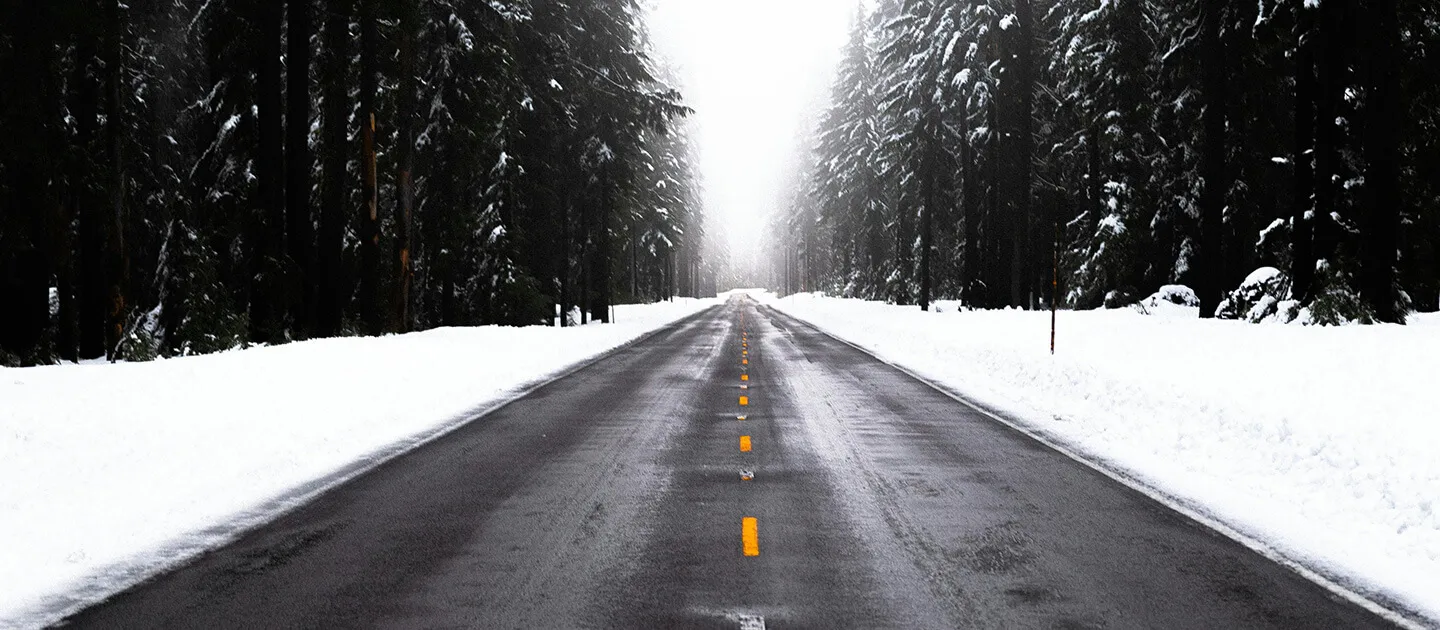
And while none of us want to slip around on roadways, sidewalks or driveways during the wintertime -- this writer came across one social media video of someone literally ice skating down the middle of their road at the end of December -- there are costs, environmental as well as financial, to using salt.
"That salt, if it's rolling off the road, it can impact vegetation next to the road, it can compact soils next to the road," Stepenuck said.
And then there's the water contamination. Drinking water wells, streams, lakes and ponds.
"There's examples in the Adirondacks where lakes are not able to cycle in the way that they normally do, and it basically means that fish don't have adequate habitat," Stepenuck told Across The Fence this week. "The salt has created a space where there's no oxygen in the lake."
In the Lake Champlain basin, the main lake, it's tributaries and smaller lakes are experiencing increased chloride levels over time, with seven tributaries state-designated as "impaired." That's according to a report from the Lake Champlain Committee to the Vermont Legislature in late 2024, which cites data from the Lake Champlain Long-Term Monitoring Program and quotes a UVM research paper co-authored by Stepenuck.
In addition to the environmental consequences of high road salt use, there are the financial impacts of salt-corroded infrastructure.
"A few years ago, UVM started a salt reduction team, because they were facing a lot of expenses in replacing stairways and doorframes and doors," Stepenuck said on Across the Fence. "So we have some buildings that have historic wood or glass, and they have electronics built into them for our key cards, and to replace those doors is significant expense -- it can be $100,000 to replace a door."
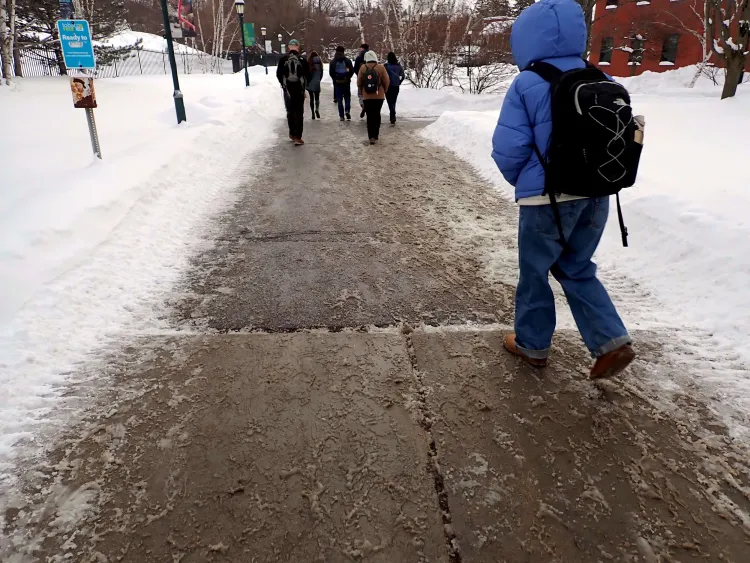
And of course, more salt is more expensive for municipalities. News outlets have reported salt shortages in cities and towns across Vermont after so many snowy, icy days this winter.
But there is another way to do it. That's what Winter Salt Week was all about. The national effort shares with communities the impacts of salt pollution and explores practical steps to protect freshwater.
In addition to the UVM Stream Ecology students capturing a salt snapshot in local streams, Lake Champlain Sea Grant and UVM Extension hosted an educational table about road salt at the Lake Champlain Research conference held this week at UVM. Table visitors tested water samples for conductivity and guessed which local streams the water came from, for the chance to win a Lake Champlain Chocolates chocolate bar (salted caramel flavor).
And there was a live webinar series that remains available online. Included in the webinar videos are methods for road salt reduction -- methods already being implemented here in Vermont.
Like in Hyde Park. Starting in 2016, Road Foreman Mark French and his team began using new technology and techniques. They started measuring the ground air temperature to determine whether or not to spread salt, and they are now pre-wetting rock salt with a salt-water mixture called brine right before the salt is placed onto the road. This is more effective and efficient in preventing ice, because the salt stays in place better on the roads and is activated as soon as it hits the pavement -- rather than taking time to activate after it hits the pavement.
As a result, Hyde Park's highway department has cut its salt use by about 40%.
"We've reduced our salt budget," French said in a 2023 interview with Lake Champlain Sea Grant. "Our taxpayers have been happy, our select board's been happy, and we've been happy."
That interview is from a video about municipal road salt reduction that Lake Champlain Sea Grant made with Mark French, using funds from the Lake Champlain Basin Program. The video and in-person trainings hosted by Hyde Park provided educational opportunities for the communities of Cambridge, Jeffersonville and Winooski. In turn, they adopted sustainable road salting practices across 74 lane miles, plus 20 sidewalk miles, and at least 133,000 square feet of parking areas.
In Winooski, for example, Public Works Department crew leader Jason Benjamin told Across The Fence this week that the department now pre-wets rock salt with brine, and the city is putting down brine as a pre-storm treatment for the roads.
"We call it anti-ice," Benjamin said. "And we'll go out if we know a storm's coming, and we'll lay it down on the road... it gives us a little bit of time to respond to bad weather."
Also using the funds from Lake Champlain Basin Program, Lake Champlain Sea Grant took an English-language video on winter maintenance salting and translated it into the four most common languages spoken by University of Vermont custodians. That was in response to the custodians' interest in more sustainable practices. Of the custodians who completed post-training evaluations, 70% said they were very likely to change or adopt new salting practices in the next 6-12 months because of the workshop.
Individuals can make a difference too. Things like: shoveling snow before spreading salt, scattering it so grains are 3 inches apart and sweeping up extra salt for later use.
There's a list of many more salt reduction tips on the Lake Champlain Sea Grant "Salt Savvy Champlain" site.