Toddlerhood spans roughly ages 1 to 3 and is one of the most rapid, transformative periods of human development. During this time, children quickly progress from walking to running and climbing, from single words to short sentences and early thinking skills, and from simple exploration to problem-solving and imaginative play. Combined with a growing sense of independence, intense emotions, and early attempts at self-expression, these changes can create a range of challenges for both toddlers and their caregivers, starting with simply keeping up.
For communication sciences and disorders researcher Sara Benham, who studies toddlers’ engagement with the world to identify early markers of language disorder in speech production, this developmental stage presents a distinct challenge. Dr. Benham outfits her young participants with head‑mounted cameras, a method adapted from her postdoctoral work at Indiana University with renowned developmental psychologist Linda Smith. Smith similarly used small, GoPro‑like cameras on infants to observe behavior in home environments. Although a handful of researchers employ comparable techniques, Benham notes that most pursue different research questions and focus primarily on infants. By contrast, Benham is interested in the alignment between vocalizations and object handling—an interaction that, to her knowledge, has not yet been examined using head‑mounted cameras.
“It’s important for us to understand the child’s perspective, what we call their egocentric perspective, of their environment and how they interact with it,” Benham explains. “If they’re moving around, what are they looking at? What are they touching? What are they focusing on? Where are they going? The head cameras give us a really interesting window into early language development in a more naturalistic setting.”
Through these interactions, Benham gains insight into how toddlers build early word knowledge. “Children learn to say words before they learn to say sentences,” she says. “My research focuses on finding cues in the sounds of their first words that can tell us how they’re organizing what we call a mental lexicon—how words are structured in the mind—and how that supports later language development.”
“Children learn words before they learn sentences. The sounds of those first words tell us a lot about how language is developing.” — Sara Benham
In Benham’s lab, toddlers participate in play-based experiments where they are taught made-up words: silly words they have never heard before. Using unfamiliar, 3D‑printed toy shapes, she observes how children repeat new labels, how easily they learn them, and how their speech production develops. And while her primary focus is on speech production, Benham is also interested in how children physically interact with objects. Many early words refer to things in a child’s immediate environment: “cup,” “spoon,” or “dog.” Understanding how toddlers touch and manipulate objects, and how those actions align with their speech, is central to Benham’s research and the reason head-mounted cameras are integral to the work.
But head-mounted cameras can be clunky, and two-year-olds have far more agency than babies. They can pull the cameras off, jostle them out of position while running around, or shift the angle so the footage no longer captures what they’re doing.
The Collaboration
To address the toddler camera design challenge, Benham partnered with a team of four senior engineering majors through the Senior Experience in Engineering Design (SEED) program, with support from a UVM EXPRESS Grant. SEED is the capstone program for mechanical and electrical engineering students in UVM’s College of Engineering and Mathematical Sciences. In team-based projects, seniors take on real-world engineering challenges posed by industry partners, nonprofits, faculty, and student innovators, translating client problem statements into practical solutions over the course of the academic year. The project culminates at Engineering Design Night on April 24, from 5–7 p.m. in the Davis Center, where students present their work to industry partners, alumni, and members of the campus community.
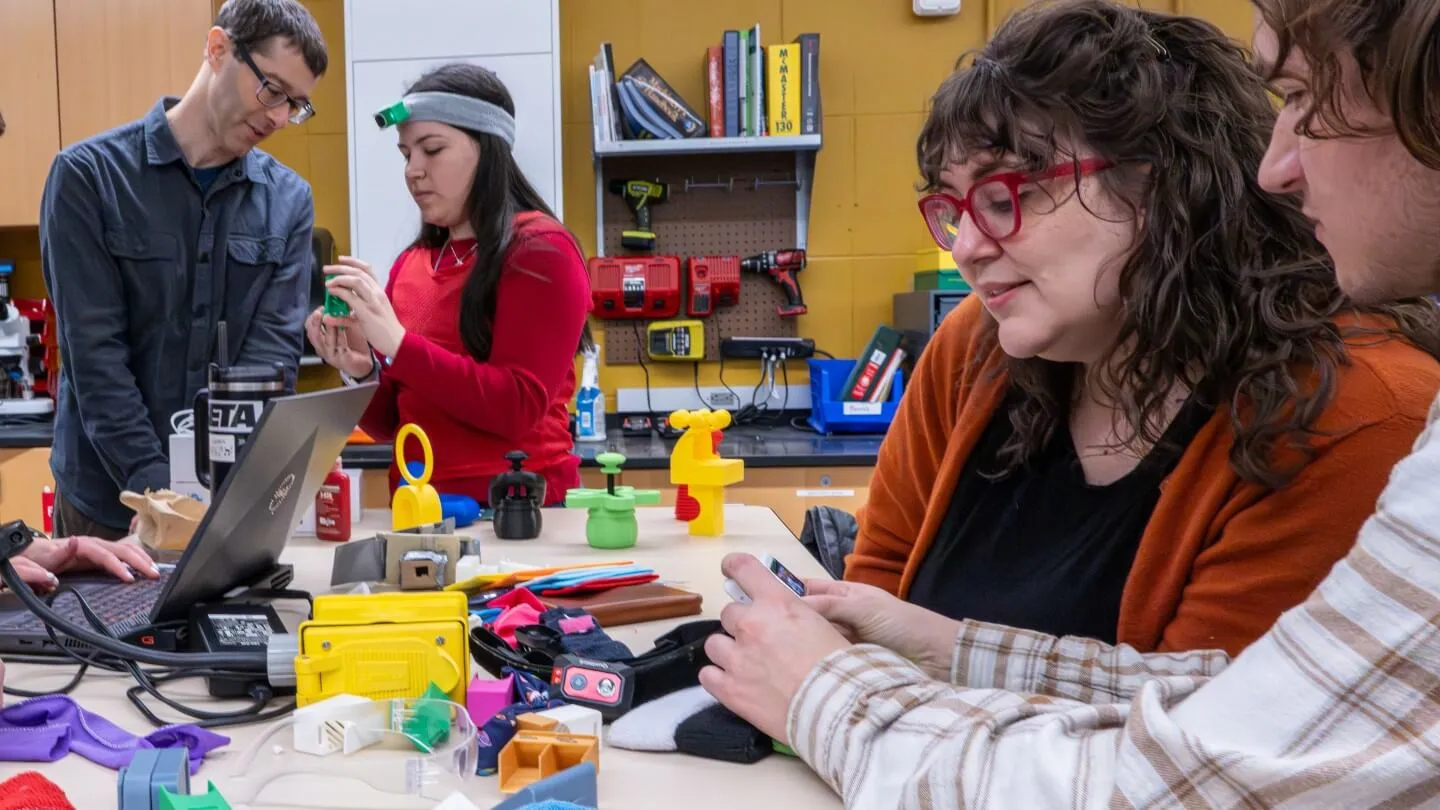
Benham tasked the students with both improving the existing head-mounted camera design and developing a second camera fitting specifically angled down at toddlers’ hands, allowing her to observe how they manipulate objects. With one camera mounted on the head to capture the surrounding environment and another focused on the hands, she could record both perspectives simultaneously. The collaboration blends creativity and technical ingenuity, bringing together two disciplines that rarely share the same lab space.
“I gave some initial specifications, and then they translated those into engineering specifications,” Benham explains. “When I say something needs to be easy to use, they think in terms of reliability or battery life. When I say it needs to be lightweight, they define that as a specific number of grams.”
Design with Care
Mechanical engineering student Caroline Cavicchi noted that one of the team’s earliest realizations was just how different it is to design for toddlers compared to adult users. “Children are a lot smaller than I thought they were,” she reflected. Because the team was unable to test prototypes directly on children as they iterated, they had to become creative problem-solvers, building in adjustability so components could be modeled on themselves while still remaining appropriate for much smaller bodies. This constraint sharpened the team’s focus on comfort, scale, and flexibility in design.
“A breakthrough moment that we had was when we decided to move away from two cameras on the head to adding a camera to the chest area,” said Cavicchi. By relocating one of the cameras, the team significantly reduced the weight and intrusiveness of the head-mounted portion. This shift aligned squarely with their shared goal: creating a device that would fade into the background of a child’s natural movement and play, while still allowing researchers to collect meaningful data about how children experience their environments.
Electrical engineering student Ben Cunningham joined the project anticipating a primarily electronics-focused role but quickly learned to adapt. After assessing camera specifications such as resolution, frame rate, and bit rate, the team ultimately selected an off-the-shelf camera that met most of their requirements. This decision prompted Ben to pivot toward mechanical design, where he contributed by creating a shirt clip and other camera attachment components. “I wasn’t expecting to develop my mechanical engineering skills as much,” he said, highlighting how interdisciplinary projects can push students beyond the boundaries of their primary discipline.
Like many real-world design efforts, the project was not without setbacks. One challenge arose when the camera’s maximum recording duration fell short of the team’s initial goal. Rather than treating this as a failure, the students worked closely with Dr. Benham to define expectations, ultimately determining that shorter recording intervals would still meet the research needs. Another obstacle emerged during 3D printing, when a camera angle adjustment mechanism that worked well in digital models proved too delicate to fabricate cleanly. Mechanical engineering student Laila Leo described this moment as an important lesson in translating theory into practice, reminding the team that manufacturability is just as critical as design intent.
Throughout the project, collaboration and communication emerged as the team’s greatest strengths. Responsibilities were shared deliberately, with each member leading different design components that ultimately came together as a modular “tool kit” for Dr. Benham’s research team. Along the way, the students also developed unexpected skills (including sewing fabric headbands) which underscored the hands-on, iterative nature of the work. Together, the team gained not only technical experience, but also a deeper appreciation for collaboration.
“Our team’s greatest strength was communication. We communicated often to check in on what each member was doing and to make sure all our deliverables were met.” – Ben Cunningham, electrical engineering
A Parent’s Perspective
“Indy is a full‑blown 'threenager,' complete with very big opinions about very little things,” says Kelsey Wentz, whose son is participating in Benham’s research program. “Like many toddlers his age, he is sensitive, smart, and deeply expressive: sometimes to the point of throwing himself on the floor when asked to wash his hands. At the same time, he is a sweet, snuggly little boy who is kind, caring, and endlessly loved.”
"He’s a full‑blown 'threenager' with very big opinions about very little things, and also sweet, snuggly, and endlessly loved.” – Kelsey Wentz, parent
Indy’s language skills are quite strong, Wentz explains, though his speech includes some articulation errors that result in what the family affectionately calls “Indinese,” a language few outside their household understand. His distorted pronunciations, like “fumblesoim” for “thunderstorm” and “yiddie” for “little,” are endearing reminders of how hard he is working to express himself.
As a graduate student training to become a speech‑language pathologist, Wentz was uniquely positioned to participate in Dr. Benham’s research both as a parent and as someone interested in the research process. “I went into the study without expectations of direct benefits for Indy, but with a strong desire to contribute to science,” she says.
Indy served as a participant in the study using a wearable toddler camera, an experience he enjoyed (after watching his more adventurous older sister try it first). What was particularly eye‑opening about their experience, Wentz says, was learning just how many words Indy already understands and uses. Overall, she says participating in the project was a positive and enriching experience for their family and further strengthened her interest in research, so much so that she will begin assisting Dr. Benham’s research herself later this summer.
The toddler camera redesign stands out for its human-centered approach and potential impact on early childhood research, and offers a compelling example of how UVM fosters hands-on learning, interdisciplinary collaboration, and research that begins with real human needs.
Early Intervention, Research, and Support for Families
Many parents, particularly first‑time parents, ask questions such as, “Is my child on track? Is my child okay?” says Benham. These concerns lie at the heart of early intervention.
“The research is clear that earlier intervention leads to better outcomes as children enter the school years,” Benham says. “Early language development plays a foundational role in social, academic, and vocational growth, including literacy, making it important well beyond early childhood.” She adds that by examining children’s natural environments and everyday experiences, professionals can better understand individual language development pathways and tailor interventions to each child’s specific needs.
“If we can start to think about the naturalistic environments children experience and how their everyday experiences influence the pathway toward language development, we can begin to intervene very precisely and tailor interventions on an individual basis.” — Sara Benham
The future of Benham’s research centers on a precision medicine approach that emphasizes individual differences and how targeted supports can improve outcomes for each child. She explains that seemingly specific questions, for example, how a child produces certain words, are part of a much larger developmental picture. Early skills related to how children engage with objects and caregivers, where they direct their attention, and what captures their visual focus are closely connected to speech development. Even small, everyday interactions can provide valuable insight and help guide decisions about how best to support children’s language growth.
For families seeking guidance, Benham recommends Vermont’s early intervention program, Child Integrated Services (CIS), as a starting point. Families can also reach out to local speech‑language clinics, including UVM's on‑campus clinic, the Eleanor M. Luse Center, where children can receive evaluations and referrals as needed. Benham encourages parents with any concerns to pursue an evaluation so they can ask questions, learn more, and connect with appropriate support.