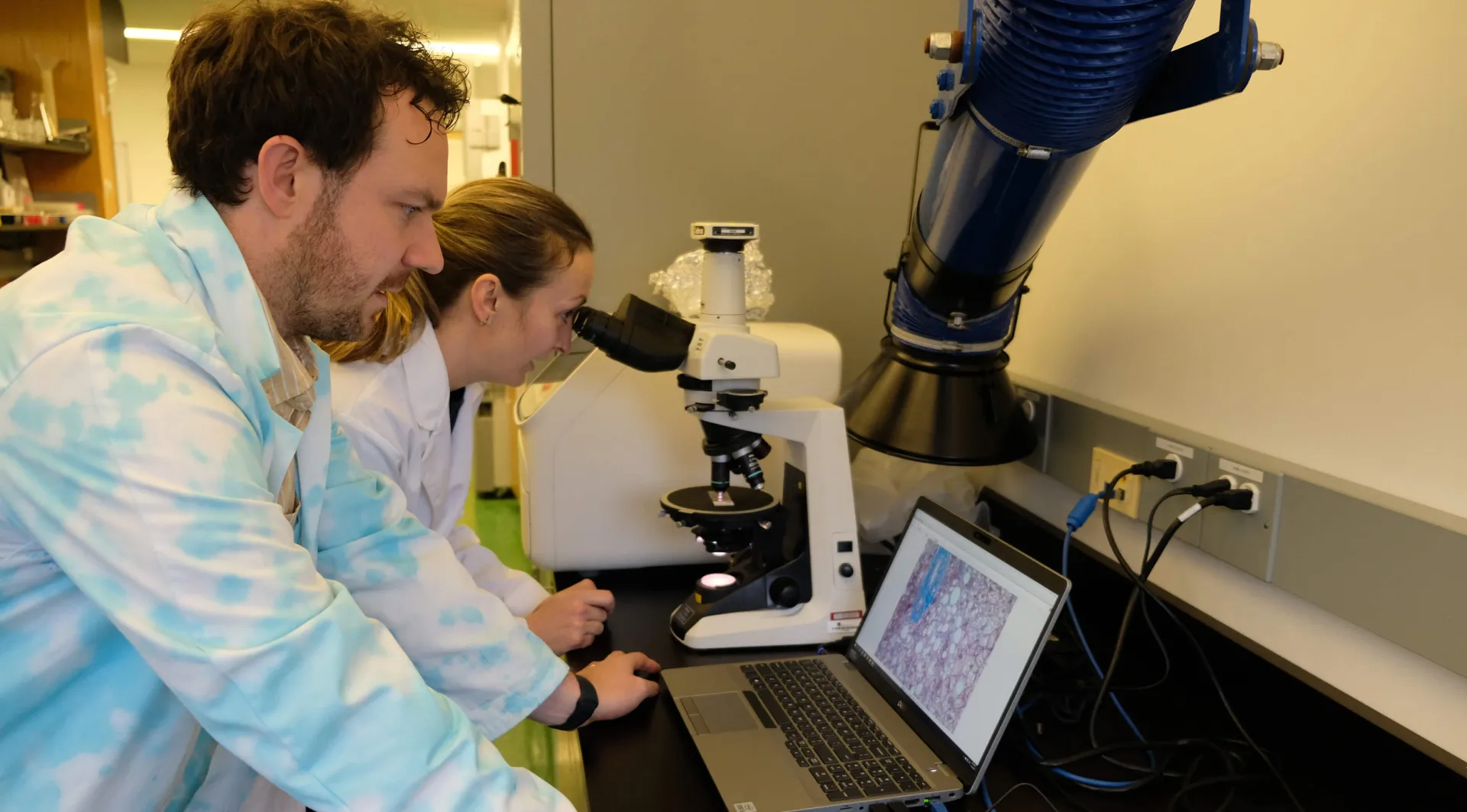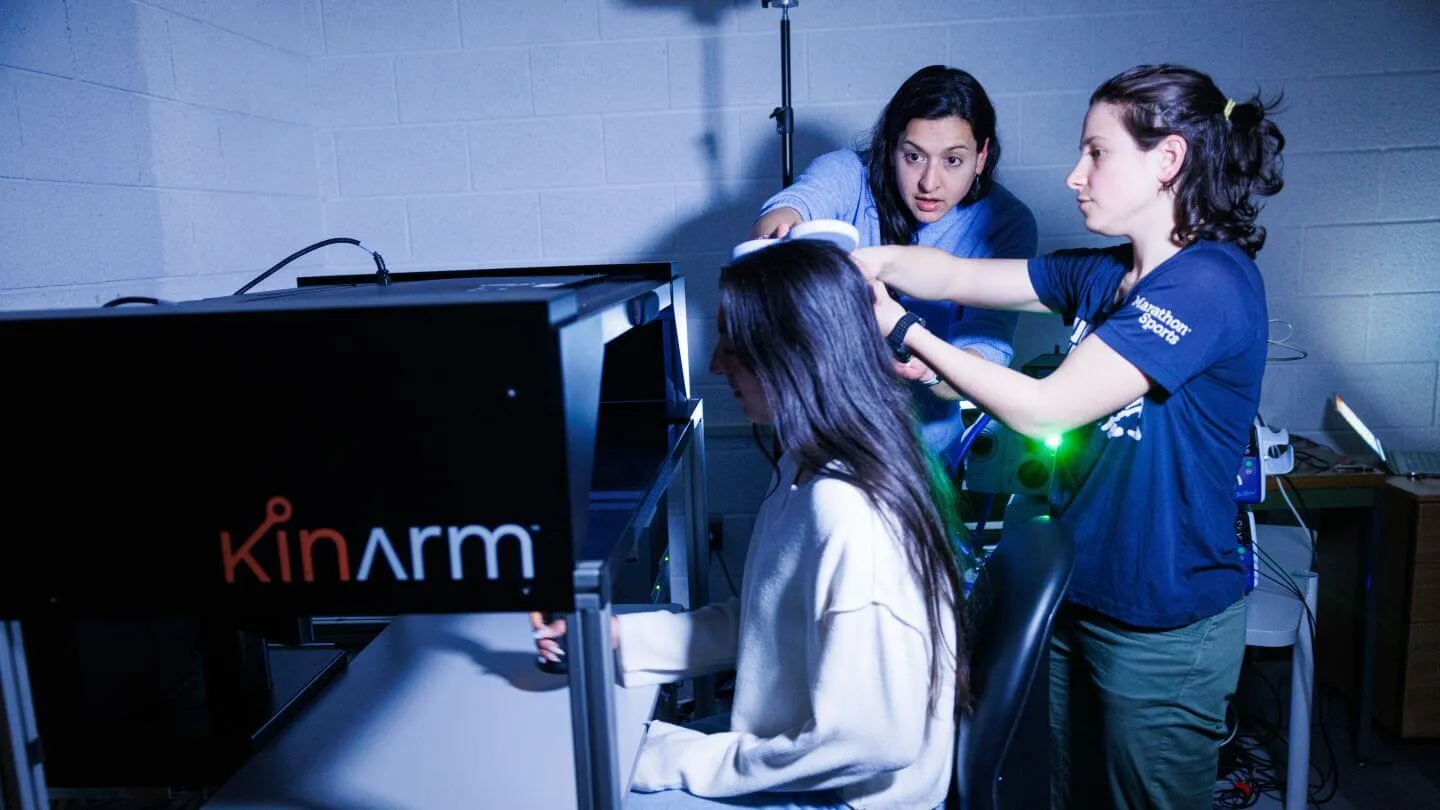
Mirdamadi is an assistant professor in UVM's Department of Rehabilitation and Movement Science and is affiliated with the Exercise Science and Neuroscience programs. She directs the Functional Sensorimotor Integration and Neuroplasticity (FUSION) Lab, where her team uses advanced technologies to study brain function, movement and neuroplasticity. Guided by a commitment to connecting research with real-world needs, Mirdamadi hopes her work will contribute to better tools and approaches that support patients, clinicians, and communities.
Understanding the Brain-Body Connection
Q: Can you tell us about your research lab and the questions that inspire your work?
Jasmine Mirdamadi: I direct the FUSION (Functional Sensorimotor Integration and Neuroplasticity) Lab. We do a lot of work to understand how the brain and body communicate with each other to perceive our bodies, interact with our environment, and move effectively. Primarily, I study the central nervous system: how the brain processes sensory information, how we perceive where our body is in space and how it’s moving, and then how the brain sends signals to muscles to control movement. Most recently, I've expanded into the cardiovascular system because the brain can’t function without healthy blood flow.
My research questions are often inspired by people who are living with certain conditions, whether that's people who have experienced a stroke or Parkinson's disease. For instance, my uncle had a stroke. After a stroke, people often have weakness, or paresis, on one side of the body, and you can typically see deficits. A person might have wobbly balance, or their arm might be locked in a certain position, making it difficult to use their fingers. As a result, they often avoid using that stroke-affected side altogether.
My uncle actually recovered his movement really well. Looking at him, you might not know that he had a stroke because he's a farmer, he's active, and he's moving around. But he actually doesn't have any somatosensory function on the stroke-affected side, meaning he can't feel touch, pressure, pain, or even know where his arm is in space. He has the strength to carry two things, one in each hand, but unless he's paying attention, one will just drop without him knowing. He would often have scrapes and bruises on that side because his arm would be moving around without his awareness.
That's one example of why the sensory system is so important. Movement matters, of course, but if our brain doesn't know where our body is in space, movement becomes really challenging. It's about understanding not just the output side of the nervous system, but also the input that's coming in.
Q: For someone unfamiliar with your field, how would you describe the work happening in your lab?
My lab is multidisciplinary. I'm not a clinician, and I'm not an engineer, but I collaborate with both. I'm trying to integrate different fields to make research clinically relevant and impactful, developing better assessments and predictive tools so that we can, for instance, predict how someone will recover after a stroke or tailor rehabilitation to an individual's level of function. A common thread is individual differences: two people with the same diagnosis can face very different sensory, cognitive, and movement challenges, and we want to understand why. In Parkinson’s disease, for example, objective measures, such as brain activity or even something as simple as heart rate, could one day help clinicians tailor treatment to each person.
We're also interested in understanding how people move beyond the laboratory. A lab is a very different place from real life. People come in focused and on their best behavior, and that changes how they move. Freezing of gait is a great example. People with Parkinson’s describe it as feeling like their feet are suddenly glued to the ground, and it’s a major cause of falls. Someone with Parkinson’s might freeze every day in a narrow doorway at home and then never freeze once during a lab visit. If we only study people in the lab, we can miss the problems that affect their lives most. That’s why we’re taking our research into people’s homes, and into clinical settings like inpatient rehabilitation, the neurology clinic, and UVM Health’s Frederick C. Binter Center for Parkinson’s Disease & Movement Disorders.
Predicting Recovery After Stroke
Q: What projects is your team currently exploring?
One project is a collaboration with Denise Peters, director of UVM's Doctor of Physical Therapy program in the College of Nursing and Health Sciences, and Michael Rosenberg, a biomedical engineering faculty member in the College of Engineering and Mathematical Sciences. The study aims to develop a predictive marker for balance recovery after stroke and has been selected for pilot funding through the Center for Advancing Precision Neural Circuit-Based Rehabilitation (Neuro-PRECISE), a national NIH-funded rehabilitation research center based at the Medical University of South Carolina.
In the context of balance function and falls, we don't really have good ways to identify, early on, who will be at the greatest risk. Studying balance in the first few weeks after a stroke is especially challenging because many people cannot stand independently during that time. The study will include individuals across the full spectrum of stroke recovery, from those who are highly functional to those who cannot stand independently. We're trying to determine whether brain activity associated with balance can predict future fall risk. We're focusing on sitting postural control, how the trunk functions during seated tasks, and measuring brain activity during those tasks to see whether it can predict balance recovery at three and six months post-stroke.
A New Direction in Parkinson's Disease Research
Our upcoming projects will bring the heart into the study of Parkinson’s disease to understand freezing of gait. When you think about Parkinson’s disease, you don’t necessarily think about the heart. But research shows that changes in the autonomic nervous system, which helps regulate heart rate and blood pressure, can appear years before someone develops motor symptoms. Sleep disturbances and loss of smell can also show up much earlier than we tend to recognize. So, long before tremor, slowed movement, or freezing of gait appear, the body’s cardiovascular control may already be changing. We want to know whether what’s happening in the heart and blood vessels helps explain when and why someone freezes.
That made the Vermont Center for Cardiovascular and Brain Health (VCCBH) a natural place to take this work. Much of its research has focused on stroke, cognitive impairment, atrial fibrillation, and other cardiovascular conditions, so I asked, “Is anyone doing Parkinson’s?”
Dr. Rosenberg and I recently received a FIRE (Fostering Innovative Research Excellence) grant from VCCBH to pursue this question together. I bring expertise in how the brain controls balance, and he brings data-driven modeling of walking function. We’ll use wearable sensors and other physiological measures to study how the cardiovascular system and the brain interact during freezing of gait, both in the lab and in people’s daily lives at home. If we can understand what sets the stage for a freezing episode, we may eventually be able to predict it, and find new ways to prevent it.
Q: If your research is developing predictive tools, could those eventually become part of healthcare providers' assessments?
That's the goal. That's why I talk with clinicians so much. Sometimes I come up with what I think are really interesting ideas, and then I have to ask: How clinically feasible is this? Could a simple blood test predict who is at risk for developing cognitive or balance impairments? UVM has internationally recognized expertise in using blood biomarkers to predict future health outcomes, built on decades of research following thousands of people over time. That's one reason I'm excited to be part of VCCBH, which helps early-career faculty build research programs in cardiovascular and brain health spanning basic, clinical, and population research. Could something as simple as a blood test help identify people at risk for mobility problems before they experience a fall?
The brain is fascinating, but maybe we don't always need complex brain-imaging tools. Maybe a blood test is enough. Maybe it's even a pen-and-paper test. There are simple screening tools that take less than five minutes and can help identify fall risk in older adults and people with Parkinson's disease. Can we make those tools a routine part of physicals and doctor visits? We need to understand the underlying mechanisms, but once we do, we also need to create tools that can be widely used, whether that's in inpatient rehabilitation after a stroke or during an annual physical exam.
Researchers and clinicians have taken a similar approach with movement disorders. Some clinics now use advanced 3D motion-capture technology—something we typically associate with a research laboratory—to quantitatively measure how patients move as part of a clinical assessment. These assessments can be billed using established clinical codes. That's a great example of how sophisticated research tools can ultimately be integrated into clinical care to provide objective information that may help clinicians evaluate patients and make treatment decisions.
Q: How does your research connect to real-world challenges?
Balance impairments and falls are the big ones. But falls are incredibly complex. It's not just a balance problem. There are cognitive changes that occur with aging, and there are sensory changes as well.
Someone may not have had a fall yet, but we want to understand what's happening before that first fall occurs. If people are showing subtle cognitive changes, their movement may still look fine, and they may not have experienced a fall. But can we identify what's happening in the brain before those problems become obvious? If we can detect those changes earlier, we may be able to intervene sooner. That applies to normal aging as well as conditions such as stroke and Parkinson's disease.
Q: What role do students play in your lab?
I really like to immerse students in the full research process. My lab is still brand new, so students are helping build our studies from the ground up. There's so much more to research than just data collection. Students learn how research questions are developed, what motivates those questions, and how we go about answering them. They also learn how to analyze data and interpret what the findings mean. I think of research as a lot like storytelling. It's about taking information and telling a story that is meaningful and impactful.
When I was an undergraduate, I knew nothing about research. I think that's partly what drives me to work with undergraduates now. I pictured research as people in lab coats working with microscopes, with very little interaction with others. It seemed a little siloed, and I thought, "I don't want to do that. I want to work with people."
Part of what I hope to do is challenge some of those misconceptions about what researchers look like and what research can involve. Drawing from my own experience, I want students to realize that there are opportunities to do research as undergraduates that connect with their interests, whether that's learning about the brain, understanding how we move, or exploring questions that have real-world applications in everyday life.
Q: How important is collaboration to your research?
Collaboration is central to my research. To understand why someone with Parkinson’s falls, or who will regain their balance after a stroke, you need neurologists, therapists, engineers, and scientists in the same conversation. At UVM Health’s Frederick C. Binter Center for Parkinson’s Disease & Movement Disorders, I work with movement disorders neurologists who see these challenges in their patients every day. Michael Rosenberg builds data-driven models that can turn our measurements into predictive tools. Denise Peters, a clinician-scientist, brings deep expertise in gait and mobility after stroke from both research and clinical practice. I focus on the neuroscience and work to bring those perspectives together. And some of the most important members of the team are people living with Parkinson’s or stroke, and their care partners. They tell us what actually matters in daily life, which helps us ask better questions.
I send a lot of emails to people with different areas of expertise, and some of my favorite projects started that way. Asking “Is anyone doing Parkinson’s?” connected me with experts in cardiovascular physiology, blood biomarkers, and cognitive aging, areas I never expected to become part of my research. Everyone is connected to everyone in some way. It's just a matter of figuring out where those connections are, how to make the most of them, and what we can build together.
Q: What excites you most about the future of this work?
What excites me most is the opportunity to bridge the gap between basic science and clinical practice. Stroke is one of the most common neurological conditions in the United States and remains a leading cause of long-term disability, especially among an aging population. Meanwhile, Parkinson's disease is growing so rapidly that some experts now refer to it as a "Parkinson's pandemic." By 2021, nearly 12 million people worldwide were living with Parkinson's, close to the number researchers had once projected for 2040. Better tools for catching problems early and tailoring rehabilitation to each person could make a real difference for millions of people and their families.
The FIRE grant to Mirdamadi and Rosenberg is awarded through the Vermont Center for Cardiovascular and Brain Health (VCCBH), with support from investments by UVM’s deans and department chairs.