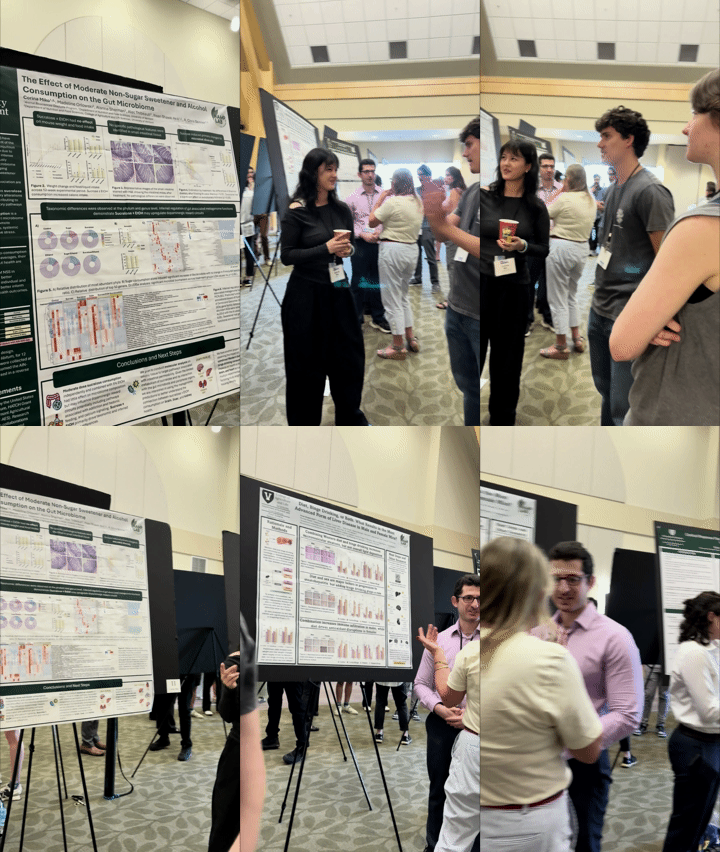
At a state-of-the-art biomedical research center at the University of Vermont, a cadre of early-career scientists explores the complexities of heart and brain health with a shared mission: Find new ways to detect, prevent, and treat cardiovascular and neurodegenerative diseases. The researchers—experts in biophysics, chemistry, epidemiology, exercise science, hematology, molecular physiology, neurology, oncology, pharmacology, and more—shared their diverse projects and celebrated a renewed grant at a public symposium June 11–12. The event took place at the UVM Davis Center.
The $12 million, five-year grant from the National Institutes of Health Center of Biomedical Research Excellence (COBRE) supports the work of the Vermont Center for Cardiovascular and Brain Health (VCCBH) to further research for prevention and treatments for cardiovascular disease, dementia, pregnancy risks, migraine, traumatic brain injury, and more. The VCCBH launched in 2020 with an initial $12 million Phase I NIH grant. Over the past six years it has funded 10 research project leaders and eight pilot grant leaders, and supported 55 individual pipeline investigators on their way to establishing their own, independent research projects.
Co-led by Mary Cushman, M.D.’89, M.Sc., University Distinguished Professor and vice chair in the Department of Medicine, and Mark Nelson, Ph.D., University Distinguished Professor and chair of the Department of Pharmacology, the goal of the center is to expand UVM’s research capacity and support early-career investigators exploring cardiovascular and brain health. The renewed funding will create more jobs for researchers and laboratory staff while building the research community in Vermont.
“We support early-career investigators so they can grow the research mission, apply for new grants, attract new students and postdoctoral fellows, and conduct cutting-edge research here in Vermont,” Dr. Cushman said. “We are developing the next generation of world-class researchers on major scientific and health issues. This is good for UVM, for the health network, and for the community.”
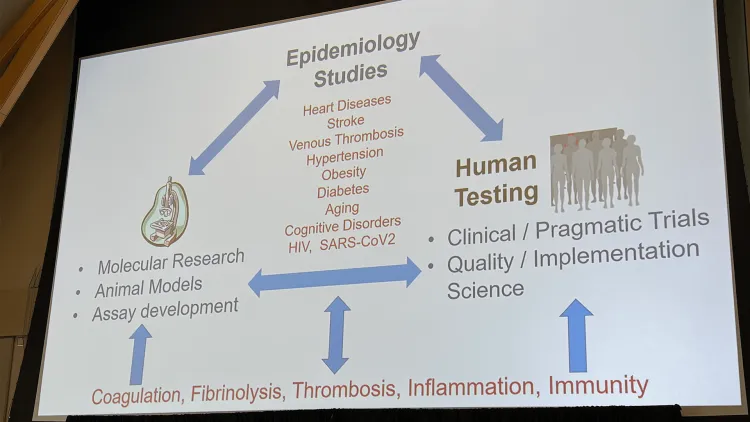
A distinctive aspect of the VCCBH is its emphasis on team-based, interprofessional collaboration and mentorship from senior investigators and peers. The variety of disciplines and research topics focused on brain and cardiovascular health leads to collaborations that can help answer complex scientific riddles and find solutions to the most pressing health problems. The center hosts monthly conferences and career development activities to foster rich discussions and the sharing of ideas.
“Some of the best science happens when someone who doesn’t know much about a topic asks questions about someone else’s work,” Cushman said. For example, “scientists doing epidemiology studies looking at patient data can collaborate with scientists who are doing molecular research on human tissue, with a mutual goal of preventing a disease.”
Panels and Flash Talks
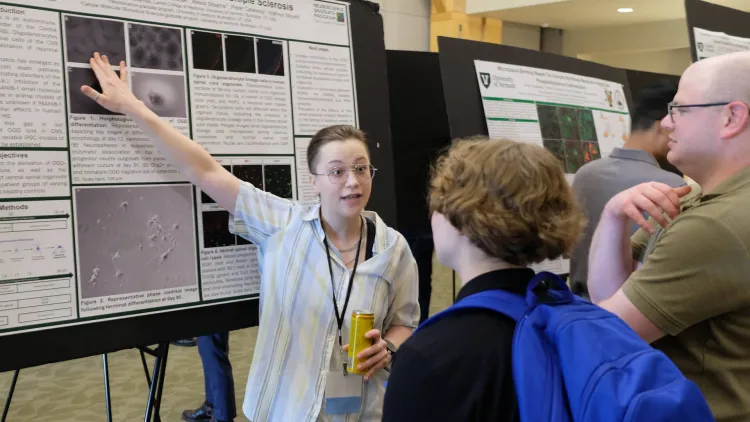
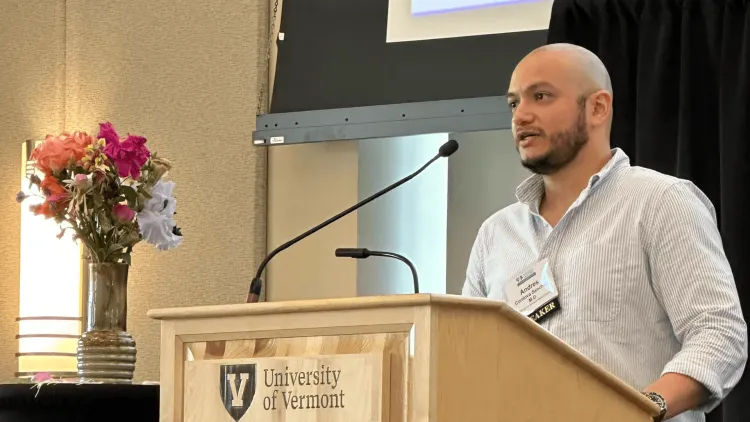
At the two-day symposium, more than 30 early-career investigators presented their research projects in five- to 15-minute presentations, and 39 presented posters. The investigators and their projects included:
- Maria-Cristina Bravo, Ph.D., assistant professor of pathology and laboratory medicine, described predictive clues for blood clots in pregnancies with and without preeclampsia, a potentially fatal complication that impacts 1 in 15 pregnancies in the United States. Dr. Bravo’s research seeks to measure the amount and functional clotting properties of vesicles—sub-cellular components that are released from cells—during and after pregnancy to potentially lower the risk of a mother developing a blood clot.
- Mansour Gergi, M.D., assistant professor of medicine, described his efforts to identify cancer patients who are at high risk for major bleeding, which impacts one in seven cancer patients admitted to the hospital. Many of these bleeding events are related to medical interventions that could be modified, such as tumor surgery or anticoagulant medication, if clinicians know a patient has a high risk for bleeding.
- Jasmine Mirdamadi, Ph.D., assistant professor of rehabilitation and movement science in the College of Nursing and Health Sciences, presented research on cortical controls of balance in various diseases and age groups. She showed how she uses mobile brain–body imaging with electroencephalography and noninvasive brain stimulation to investigate balance and mobility in neurological conditions including Parkinson’s disease and stroke.
- Daniela Zambrano, M.D., M.P.H., assistant professor of neurological sciences, discussed sex, race, and ethnicity differences in the association of hyperthyroidism and cerebral venous sinus thrombosis, a rare but serious type of stroke where a blood clot forms in the brain causing swelling and hemorrhaging.
The symposium also featured a keynote address about the gut microbiome’s role in producing biomarkers for stroke and dementia, presented by W. Taylor Kimberly, M.D., Ph.D., chief of neurocritical care at Massachusetts General Hospital and associate professor of neurology at Harvard Medical School.
View the VCCBH Symposium agenda
Learn more about the VCCBH
Read media coverage about this topic