Browse by Topic: Adaptation Practices

Filter by subtopic. Click here to search all resources with more filters (e.g. production type, state, issue).

  • Adaptation Practices, Climate Impacts

    Climate Resilience for Organic Vegetable Production: Ongoing and previous research

    November 20, 2025 • Rue Genger • Climate Resilience for Organic Vegetable Production

    This page collects research around reduced tillage topics for vegetables, including living mulch under organic acorn squash and Brussel sprouts, tarps to terminate cover crops, sorghum sudan grass residue as mulch for tomatoes, and more....

  • Planning, Adaptation Practices

    Clovercrest Farm: A Family Dairy in Charleston, Maine

    November 23, 2019 • Rachel Schattman • USDA Northeast Climate Hub

    A case study of Clovercrest Farm, a small-scale dairy farm in Charleston, Maine. Includes the impacts of climate change on the farm and their adaptation strategies. The farm milks 95 Jersey cattle on 250 acres, of which 125 acres are pasture and 125 acres are wooded. The farm rents 350 acres of cropland in the surrounding area to grow winter forage. Clovercrest Farm is pasture-based and has been certified USDA organic since 1998.

  • Adaptation Practices

    Conservation Buffers: Design Guidelines for Buffers, Corridors, and Greenways

    September 4, 2025 • Gary Bentrup • USDA Forest Service

    Over 80 illustrated design guidelines for conservation buffers are synthesized and developed from a review of over 1,400 research publications. Each guideline describes a specific way that a vegetative buffer can be applied to protect soil, improve air and water quality, enhance fish and wildlife habitat, produce economic products, provide recreation opportunities, or beautify the landscape. These science-based guidelines are presented as easy-to-understand rules-of-thumb for facilitating the planning and designing of conservation buffers in rural and urban landscapes. The online version of the guide includes the reference publication list as well as other buffer design resources

  • Adaptation Practices

    Continued Conversations with Cecarelli Farms

    November 23, 2019 • USDA Northeast Climate Hub

    Farm managers speak about their diversified vegetable operation in Northford, Connecticut, and the changes that Cecarelli Farms has gone through to become both a more sustainable and efficient operation.

  • Adaptation Practices

    Cover Crop Chart and Descriptions

    September 4, 2025 • USDA Agricultural Research Service

    Excellent charts on cover crop types divided by cool or warm season, and grass, legume, or broadleaf. Also has a chart on crop sequence effects, as well as one-page fact sheets on characteristics and growing conditions of 65 different cover crops.

  • Planning, Adaptation Practices

    Cover Crop Decision Tool

    September 4, 2025 • Northeast Cover Crops Council

    Tools to explore cover crops in the Northeast, select species, calculate nitrogen credits, and more. Cover crop selector tool gives recommendations based on your specific site and soil conditions. Website also includes further cover crop resources.

  • Planning, Adaptation Practices

    Cover Crop Nitrogen Calculator

    September 4, 2025 • Precision Sustainable Agriculture

    This calculator aids farmers with decision support regarding cover crop residue persistence, as well as the amount and timing of nitrogen availability.

  • Adaptation Practices, Climate Impacts

    Cover Cropping to Improve Climate Resiliency

    November 23, 2019 • USDA Northeast Climate Hub

    Heavy rains are becoming more frequent across the Northeastern United States and increasing soil erosion and nutrient runoff problems. Wetter weather in the spring and fall is reducing the number of days that fields can be worked. Consider planting cover crops to help adapt to these climate trends.

  • Planning, Adaptation Practices

    Crop Rotation on Organic Farms: A Planning Manuel

    September 4, 2025 • SARE

    The purpose of this book is to help growers and farm advisors understand the management of crop rotations; avoid crop rotation problems; and use crop rotation to build better soil, control pests, and develop profitable farms that support satisfied families.

  • Adaptation Practices

    Cut and Carry for Weed Management and Fertility in Organic Cropping Systems

    September 4, 2025 • American Farmland Trust

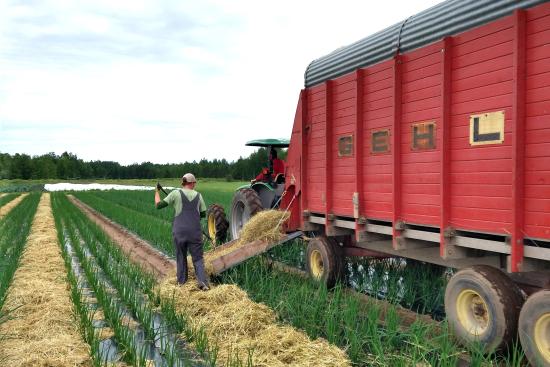
    Also known as ‘transferred mulch,’ “cut and carry” refers to the practice of growing, harvesting and moving loads of mulch from one part of the farm (or a neighboring farm) to another, usually as loose greenchop or ensiled material. This practice has been used to reduce tillage in organic vegetable production systems by using thick mulch to suppress weeds. Cut and carry can also be used as a fertility strategy, through the harvest, application, and incorporation of legumes onto cropped acres.

  • Adaptation Practices

    Dairies and Environmental Stewardship

    September 4, 2025 • US Environmental Protection Agency

    A short visual guide to manure management and other livestock production environmental issues, including nutrient management and application, managing public perception, best management practices in production areas, and infrastructure and facility practices.

  • Adaptation Practices

    Dickinson College Farm's Silvopasture

    November 23, 2019 • USDA Northeast Climate Hub

    This tour explores the silvopasture systems and adaptive management practices at Dickinson College Farm.

  • Adaptation Practices, Funding

    Digging into Biochar

    September 4, 2025 • USDA Northeast Climate Hub

    Biochar basics: what it is, how it is produced, how it is applied, benefits for farms and the climate, and federal funding sources.

  • Adaptation Practices, Planning

    Diversification of Your Operation, Why

    September 4, 2025 • Jeffrey Hyde • PennState Extension

    A concise article on the benefits of spreading your risk over more than one enterprise.

  • Planning, Adaptation Practices

    Drip-Irrigation Systems for Small Conventional Vegetable Farms and Organic Vegetable Farms

    November 21, 2025 • Eric Simonne, Robert Hochmuth, Jacque Breman, William Lamont, Danielle Treadwell, and Aparna Gazula • University of Florida IFAS Extension

    The goals of this publication are to present the principles behind drip irrigation and some practical guidelines for successful and profitable use of drip irrigation.

  • Climate Impacts, Adaptation Practices

    Economics of Gully Erosion Stabilization

    November 23, 2019 • USDA Northeast Climate Hub

    Rainfall intensity is increasing in the Northeastern U.S. Stabilizing gullies is one strategy for adapting to this changing climate. This case study evaluates the costs and benefits of restoring gullies at Last Resort Farm.

  • Adaptation Practices, Planning

    Emerging Manure to Energy Technologies - Are Cost Effective Small Scale Digesters Possible?

    November 23, 2019 • USDA Northeast Climate Hub

    Participate to understand current research, available technologies, future possibilities, and the benefits and costs of small-scale manure digesters. Learn about REAP program eligibility, application deadlines, program grant and loan opportunities and how existing digesters used REAP as part of their funding package.

  • Adaptation Practices

    Energy Strategies for Farm Resilience in the Northeast

    November 23, 2019 • USDA Northeast Climate Hub

    Participants will learn how energy-oriented design and operation can impact the resilience (the capacity to recover quickly from challenges) and long term success of farm operations, as well as identify common energy strategies for farm viability and resilience.

  • Adaptation Practices

    Farm Energy, Carbon, and Greenhouse Gases

    September 4, 2025 • David Wolfe, Jeff Beem-Miller, Allison Chatrchyan, and Lauren Chambliss • Cornell Cooperative Extension

    Farmers today face rising energy costs and uncertainty about future energy policies that affect agriculture. Many farmers are responding by improving the energy efficiency of their operations and exploring alternatives to traditional fossil fuels such as wind, solar, and biofuel crops. Improving nitrogen fertilizer use efficiency is another important strategy. Fertilizer cost is important because it is tightly linked to energy prices, and excessive applications increase the release of nitrous oxide (N2O), a very potent greenhouse gas (GHG). This fact sheet addresses efficient fertilizer management, infrastructure changes, and best management practices for farmers that make economic sense and also address concerns about GHG emissions and climate change.

  • Adaptation Practices, Climate Impacts

    Farmer Led Innovations in Reduced Tillage Vegetables

    November 20, 2025 • American Farmland Trust

    Farmer-Led Innovations for Reduced Tillage (FLI) cultivates co-learning and innovation among organic vegetable farmers in New England. This site features the trials of a small cohort of innovative farmers trialing reduced tillage practices.

  • Adaptation Practices, Climate Impacts

    Farming & Climate Change: Intervale Community Farm

    September 4, 2025 • UVM Center for Sustainable Agriculture

    Andy Jones, Manager, Intervale Community Farm in Burlington, Vermont talks about farming successfully on the floodplain in the face of climate change. Andy talks about his strategies including managing water, protecting soils, and using high tunnels; the specifics about his seeding rates and timing for cover crops and see the equipment he uses; how he manages extended wet periods and dry periods with different irrigation methods and crop rotations.

  • Adaptation Practices, Planning

    Farming Success in an Uncertain Climate

    September 4, 2025 • David Wolfe, Jeff Beem-Miller, Lauren Chambliss, Allison Chatrchyan, and Holly Menninger. • Cornell Cooperative Extension

    Climate change is already posing new challenges, such as increased risk of flooding, summer heat stress, and more intense pest and weed pressures. This fact sheet details challenges and adaptation solutions on farms to the major effects of climate change.

  • Climate Impacts, Adaptation Practices

    Farming the Floodplain: Trade-Offs and Opportunities

    January 9, 2020 • Rachel Schattman, Benjamin P. Warner, and Christine E. Hatch • USDA Northeast Climate Hub

    This two-page research summary addresses the trade-offs rural communities face when increased flooding damages public and private land, and makes farming more risky. The authors also provide a link for teaching resources on this topic.

  • Planning, Adaptation Practices

    Getting Started With Drip Irrigation: Components and Costs

    September 27, 2019 • Rachel Schattman and Chloe Boutelle • UVM Extension

    This fact sheet presents an overview of the most common components and options in drip irrigation systems, accompanied by estimated costs.