Browse by Topic: Adaptation Practices

Filter by subtopic. Click here to search all resources with more filters (e.g. production type, state, issue).

  • Adaptation Practices

    Advantages to Cover Crops and the Best Choices to Fill Each Need

    September 4, 2025 • AgPhD

    A list of the best cover crops by need, including reducing compaction, weed suppression, increasing soil nitrogen, mycorrhizal fungi association, and more.

  • Adaptation Practices

    Alternative Continuous-Cover Dairy Forage System for Profitability, Flexibility, and Soil Health

    September 4, 2025 • Lisa Bauer • Cornell Cooperative Extension

    The Alternative Continuous-Cover Forage system (ACCF)—produces high-quality dairy cattle forage with yields comparable to traditional cropping systems, and is based on soil health management, as opposed to the traditional crop rotation of corn silage for three or more years without the use of cover crops This fact sheet outlines the basic rotations and potential crop choices of the ACCF, describes how to implement the system, and provides a summary of its environmental and economic benefits

  • Adaptation Practices

    Building Soils for Better Crops

    September 4, 2025 • Fred Magdoff and Harold Van Es • SARE

    A practical guide to ecological soil management that provides background information as well as details of soil-improving practices. This book is meant to give the reader a holistic appreciation of the importance of soil health and to suggest ecologically sound practices that help to develop and maintain healthy soils.

  • Adaptation Practices, Planning

    Climate Adaptation Resources for Northern New England Farmers

    February 26, 2024 • USDA, UVM Extension, and University of Maine

    The economic tools, visualizations, and resources on this website were designed with and for small, medium, and beginning farmers and ranchers in New England to help address their unique challenges in adapting to a changing climate. These resources are available for three agricultural practices - silvopasture, irrigation, and tarping - that were identified as areas of particular interest and need among New England farmers.

  • Adaptation Practices, Climate Impacts

    Climate Resilience for Organic Vegetable Production: Ongoing and previous research

    November 20, 2025 • Rue Genger • Climate Resilience for Organic Vegetable Production

    This page collects research around reduced tillage topics for vegetables, including living mulch under organic acorn squash and Brussel sprouts, tarps to terminate cover crops, sorghum sudan grass residue as mulch for tomatoes, and more....

  • Adaptation Practices

    Continued Conversations with Cecarelli Farms

    November 23, 2019 • USDA Northeast Climate Hub

    Farm managers speak about their diversified vegetable operation in Northford, Connecticut, and the changes that Cecarelli Farms has gone through to become both a more sustainable and efficient operation.

  • Adaptation Practices

    Cover Crop Chart and Descriptions

    September 4, 2025 • USDA Agricultural Research Service

    Excellent charts on cover crop types divided by cool or warm season, and grass, legume, or broadleaf. Also has a chart on crop sequence effects, as well as one-page fact sheets on characteristics and growing conditions of 65 different cover crops.

  • Planning, Adaptation Practices

    Cover Crop Decision Tool

    September 4, 2025 • Northeast Cover Crops Council

    Tools to explore cover crops in the Northeast, select species, calculate nitrogen credits, and more. Cover crop selector tool gives recommendations based on your specific site and soil conditions. Website also includes further cover crop resources.

  • Planning, Adaptation Practices

    Cover Crop Nitrogen Calculator

    September 4, 2025 • Precision Sustainable Agriculture

    This calculator aids farmers with decision support regarding cover crop residue persistence, as well as the amount and timing of nitrogen availability.

  • Adaptation Practices, Climate Impacts

    Cover Cropping to Improve Climate Resiliency

    November 23, 2019 • USDA Northeast Climate Hub

    Heavy rains are becoming more frequent across the Northeastern United States and increasing soil erosion and nutrient runoff problems. Wetter weather in the spring and fall is reducing the number of days that fields can be worked. Consider planting cover crops to help adapt to these climate trends.

  • Planning, Adaptation Practices

    Crop Rotation on Organic Farms: A Planning Manuel

    September 4, 2025 • SARE

    The purpose of this book is to help growers and farm advisors understand the management of crop rotations; avoid crop rotation problems; and use crop rotation to build better soil, control pests, and develop profitable farms that support satisfied families.

  • Adaptation Practices

    Cut and Carry for Weed Management and Fertility in Organic Cropping Systems

    September 4, 2025 • American Farmland Trust

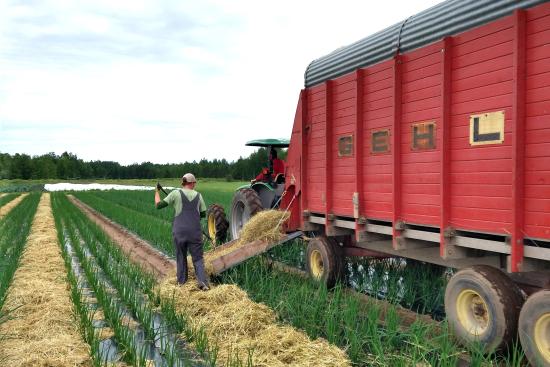
    Also known as ‘transferred mulch,’ “cut and carry” refers to the practice of growing, harvesting and moving loads of mulch from one part of the farm (or a neighboring farm) to another, usually as loose greenchop or ensiled material. This practice has been used to reduce tillage in organic vegetable production systems by using thick mulch to suppress weeds. Cut and carry can also be used as a fertility strategy, through the harvest, application, and incorporation of legumes onto cropped acres.

  • Adaptation Practices, Funding

    Digging into Biochar

    September 4, 2025 • USDA Northeast Climate Hub

    Biochar basics: what it is, how it is produced, how it is applied, benefits for farms and the climate, and federal funding sources.

  • Adaptation Practices, Climate Impacts

    Farmer Led Innovations in Reduced Tillage Vegetables

    November 20, 2025 • American Farmland Trust

    Farmer-Led Innovations for Reduced Tillage (FLI) cultivates co-learning and innovation among organic vegetable farmers in New England. This site features the trials of a small cohort of innovative farmers trialing reduced tillage practices.

  • Adaptation Practices, Climate Impacts

    Hang onto your soil! Reduced Tillage At Scale

    November 20, 2025 • Vermont Vegetable & Berry Growers Association

    This webinar explores the spectrum of reduced tillage practices at all scales, covering equipment and methods that can improve soil health and save labor. Speakers: Julie Fine, American Farmland Trust; Natalie Lounsbury, University of New Hampshire.

  • Adaptation Practices

    How Does Tillage Intensity Affect Soil Organic Carbon?

    November 25, 2019 • Neal R. Haddaway, Katarina Hedlund, Louise E. Jackson, Thomas Kätterer, Emanuele Lugato, Ingrid K. Thomsen, Helene B. Jørgensen, and Per-Erik Isberg • Mistra EviEM

    Researchers from MISTRA EviEM reviewed 351 published research studies looking at carbon(C) sequestration in the soil profile under different tillage management systems. They found C stock increases under no-tillage compared to full tillage in the upper soil (0-30 cm) in studies of 10 years or more, while no effect was detected in the full soil profile.

  • Adaptation Practices

    Managing Cover Crops Profitably

    September 4, 2025 • SARE

    Cover crops slow erosion, improve soil, smother weeds, enhance nutrient and moisture availability, help control many pests and bring a host of other benefits to your farm. At the same time, they can reduce costs, increase profits and even create new sources of income. You’ll reap dividends on your cover crop investments for years, because their benefits accumulate over the long term. There is a cover crop to fit just about every farming situation.The purpose of this book is to help you find which ones are right for you.

  • Adaptation Practices, Planning

    Nutrient Tracking Tool (NTT)

    November 21, 2019 • Texas Institute for Applied Environmental Research

    NTT is a web-based, site-specific application that estimates nutrient and sediment losses for crop and pasture at the field and/or watershed scales. Agricultural producers and land managers can define a number of management scenarios for any given field or area of interest (AOI). NTT will estimate nutrient (nitrogen and phosphorus) losses, sediment losses, and crop yields differences between the scenarios and present results in customizable reports

  • Adaptation Practices

    Practical Approaches to Establishing No-Till Systems: Reflections from Winter Street Farm

    September 4, 2025 • Caro Roszell • NOFA/Mass

    An article on a small-farm's approach to no-till practices, including tarping, mulching paths and beds, intercropping, use of plastic mulch and weed mats, flail mowing, and more.

  • Adaptation Practices

    Raising Soil Organic Matter Content to Improve Water Holding Capacity

    November 21, 2025 • Jehangir H. Bhadha, Jay M. Capasso, Raju Khatiwada, Stewart Swanson, and Christopher LaBorde • University of Florida IFAS Extension

    This publication explains how increased soil health and organic matter content help retain moisture to aid during droughty periods. It also discusses soil health management strategies to improve organic matter content.

  • Adaptation Practices, Climate Impacts

    Regenerative Farming at Freedom Food Farm with Chuck Currie

    November 20, 2025 • NOFA/Mass

    This workshop covers regenerative systems used at Freedom Food Farm: no-till crops, livestock integration, rotational grazing, biodiversity, soil preservation, input reduction, and more! From the 2020 NOFA Summer Conference

  • Adaptation Practices

    Rhode Island's Changing Climate Creates New Opportunities for Summer Cover Crops

    September 4, 2025

    Summer cover crops traditionally have not been used in Rhode Island because of the short summer fallow period. However, as the fall season becomes milder, fall cash crops are now being planted as late as the end of September. This creates an increasing gap period between the harvesting of early summer crops and the planting of fall crops. The fall cash crops are also being harvested later, which means that winter cover crops are planted later and are unable to produce as much biomass as in the past. These shifts in planting times are making traditional winter cover cropping less practical and summer cover cropping more worthwhile. This short articles explores teff and Japanese millet to fill this gap.

  • Adaptation Practices

    Toolkit: How to Reduce Synthetic Fertilizer Use

    September 4, 2025 • ATTRA Sustainable Agriculture

    Transitioning to a production method that is not reliant on synthetic fertilizers can be accomplished strategically over three to five years. The following publications, tipsheets, and videos are a good place to start learning how things like cover crops, green manures, and alternative soil amendments can result in reduced input costs and increased self-reliance.

  • Adaptation Practices

    Using Cover Crops to Direct the Soil Microbiome

    September 4, 2025 • Heidi Reed, Sjoerd Willem Duiker, Sarah Richards, Kara Reardon, Terrence Bell, and Estelle Couradeau • PennState Extension

    This article discusses how cover crops have the potential to boost key aspects of the soil microbiome typically associated with healthy soils.