Agricultural Drainage
This publication addresses basic concepts related to agricultural drainage.

Filter by subtopic. Click here to search all resources with more filters (e.g. production type, state, issue).
This publication addresses basic concepts related to agricultural drainage.
Production, business, and funding resources from the University of Vermont.
A case study of Clovercrest Farm, a small-scale dairy farm in Charleston, Maine, including the impacts of climate change on the farm and their adaptation strategies. Clovercrest Farm is pasture-based and milks 95 Jersey cattle on 250 acres.
Over 80 illustrated science-based design guidelines that describe how a vegetative buffer can be applied to protect soil, improve air and water quality, enhance fish and wildlife habitat, produce economic products, provide recreation opportunities, or beautify the landscape.
A visual guide covering manure management and livestock environmental issues, including nutrient application, public perception, best practices, and facility infrastructure.
Rainfall intensity is increasing in the Northeastern U.S. Stabilizing gullies is one strategy for adapting to this changing climate. This case study evaluates the costs and benefits of restoring gullies at Last Resort Farm.
This recording features a talk by Sara Keleman, who shares current data exploring climate trends and projected impacts on agriculture. At minute 1:10:10 Sara reviews several tools available for monitoring weather and implementing adaptive practices.
This series of articles covers key topics for launching a new agroforestry project with a guided step-by-step process to evaluate your goals, assess the opportunities on your site, and get your trees off to the best possible start.
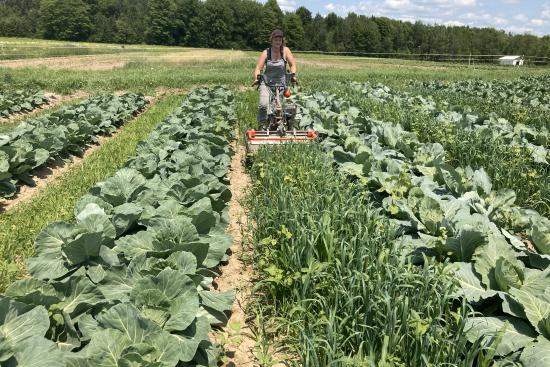
In this article, we highlight four case studies from farms of varying sizes and production goals to showcase the opportunities and challenges of adopting living aisle systems.
Illustrated design guidelines for multifunctional buffers are synthesized and developed from a review of 1,900+ research publications. These guidelines are presented as easy-to-understand rules of thumb for facilitating the planning and designing of multifunctional buffers.
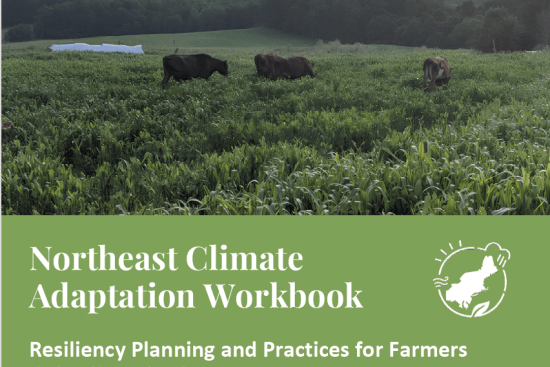
A practical guide for farmers in the Northeast to prepare for a changing climate by developing an Adaptation Plan for their Farm. The workbook introduces the observed and expected changes affecting agriculture, as well as adaptation strategies to consider, and worksheets.
The ReadyAG workbook is designed to help farm and ranch owners be better prepared to deal with disasters and catastrophic events that can occur on their farm or ranch.
This workshop covers regenerative systems used at Freedom Food Farm: no-till crops, livestock integration, rotational grazing, biodiversity, soil preservation, input reduction, and more! From the 2020 NOFA Summer Conference
Regional and state-specific resources for climate adaptation and mitigation, from funding resources to production, infrastructure, nutrient management, efficiency, alternative energy, and much more.
This fact sheet explains how tile drainage can improve yields, outlining design, efficiency, and return-on-investment considerations.
Historically, annual precipitation has been sufficient to meet vegetable crop water needs in the Northeast during the growing season, but now shifting precipitation patterns create water management challenges for Northeast specialty crop growers.
Visit a small-scale agroforestry system in the Yale-Myers forest and learn how this diverse orchard is being managed to address pests, weeds, drought, and erosion.