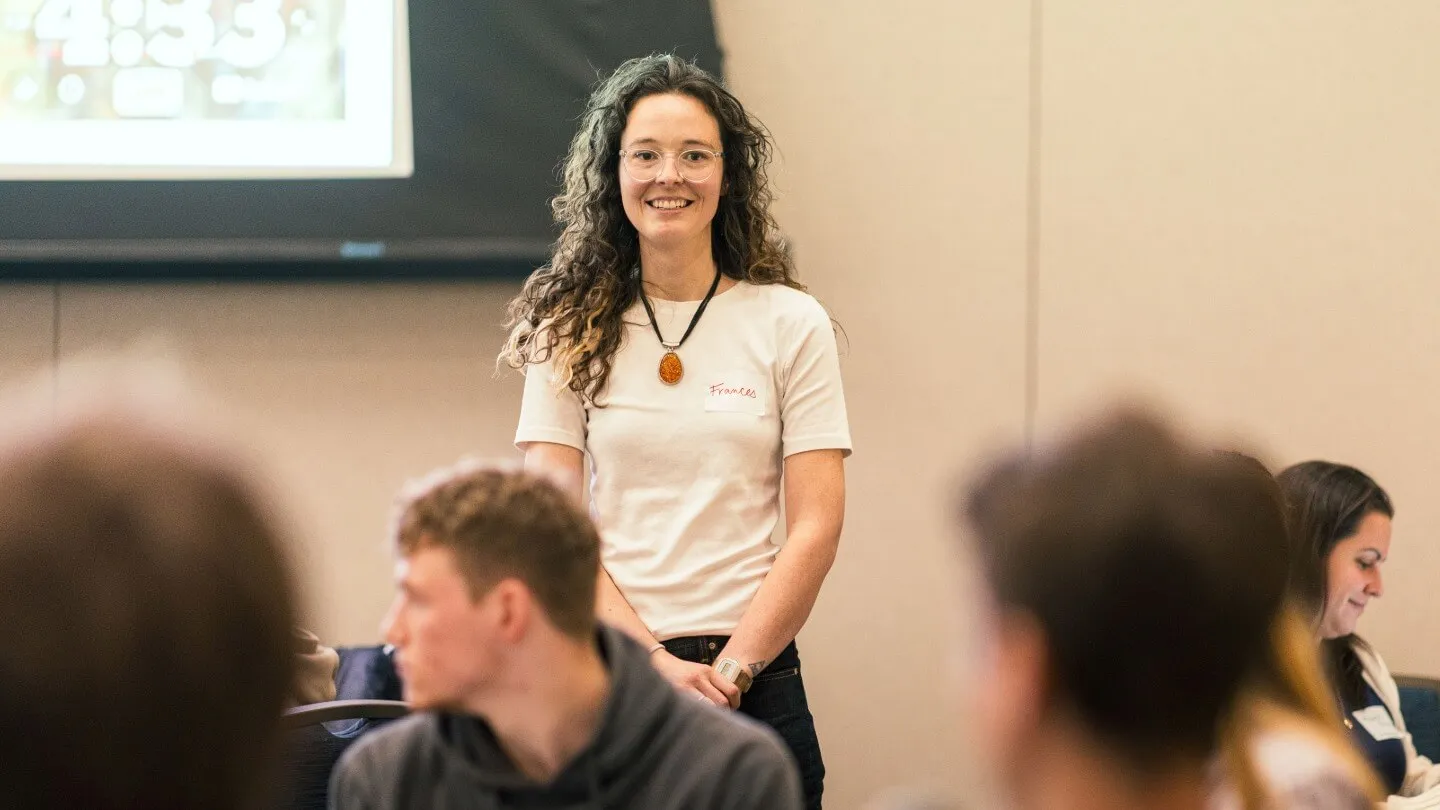
Silent, unblinking, and complex, artificial intelligence invites serpentine allusions. The sinuous connection of networks especially inhabits the ancient metaphor’s most menacing device: temptation. With easy answers, automated emails, credible synopses, and passable prose, AI, as it continues its full-scale constriction around each branch of contemporary life, entices the outsourcing of human effort. But implicit in its bait is a beckoning to better know the medium as well as its message, and at UVM, Frances Starn is biting.
A second-year PhD student in CESS’ Social, Emotional, and Behavioral Health and Inclusive Education Ph.D. program (SHIE), Starn had been planning to study nature-based learning before AI claimed her attention.
“I realized that ed tech and the descent of AI onto our society and onto public schools was a very big issue,” Starn says. “I felt like we needed more minds on the problem to make sense of the future and the future of our students.”
In 2025, she joined UVM’s AI Taskforce, a campus-wide team dedicated to advancing AI research and application. Starn noticed a lack of shared wisdom for how the UVM community was engaging with the technology.
“I was feeling like AI was a shadow thing,” she says. “Kind of on the periphery of everywhere.”
And so Starn set out to build cohesion. In 2026, she and Rigo Melgar, a Ph.D. student in the Rubenstein School of Environment and Natural Resources and Gund Institute for Environment graduate fellow, received a $10,000 grant from UVM’s AI Innovation Fund to host interdisciplinary conversations around AI.
The first Community Forum on Artificial Intelligence happened on a recent Friday afternoon with a packed partitioned ballroom of students, faculty, staff, and community members. The three featured speakers included Julia Zimmerman, a postdoctoral researcher at the Vermont Complex Systems Institute, Rep. Brian Cina, a community organizer and activist representing the Chittenden-15 district in the Vermont state legislature, and Melgar.
Starn opened the event with a call-and-response mantra from the late Baba Chuck Davis, a dancer and choreographer who shares with Starn the home state of North Carolina.
“Peace, love, and respect for everybody,” Starn declared, and the room declared it back.
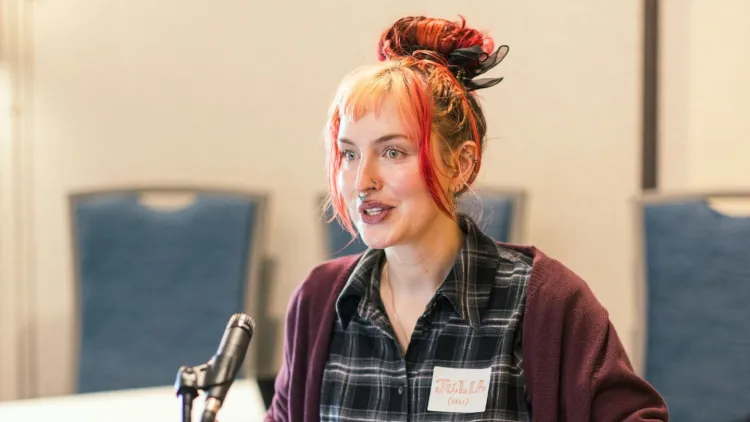
Despite the subject matter, Starn says she wanted to keep the forum “really low tech.” Laptops and phones were discouraged, graduate student facilitators provided markers and sticky notes, and the two slide decks were virtually analog, with Zimmerman’s presentation embellished by her own tactile drawings and punk rock lettering.
“I realized that ed tech and the descent of AI onto our society and onto public schools was a very big issue. I felt like we needed more minds on the problem to make sense of the future and the future of our students.” — Frances Starn
Zimmerman discussed large language models (LLMs) and the way these systems work toward meaning.
“Language functions for us by making meaning portable,” Zimmerman said. “LLMs learn from the traces of human meaning…They can recover meaningful structure from those traces and produce useful output without sharing the human processes that actually produced language in the first place.”
What this does, Zimmerman said, is disrupt the relationship we have between language and meaning.
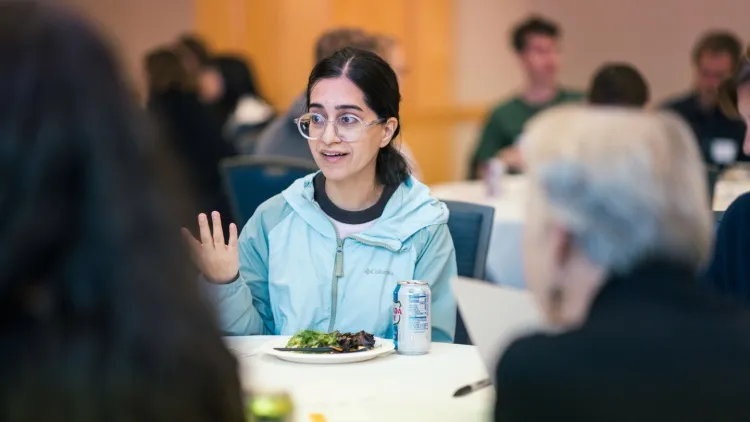
Following her presentation, each table deliberated over the decisions people need to make about AI and whether they have enough information to make those decisions. One table consisted of a longtime Howe Library staff member, a graduate research assistant from the Larner School of Medicine’s Psychiatry Department, a CESS graduate student in clinical mental health, and an adjunct lecturer in the College of Agriculture and Life Sciences. The diverse range of participants from across the university generally agreed that AI is being implemented faster than society can understand it.
This concern underpinned Cina’s expounding on official AI policy in Vermont, which he helped catalyze with an unlikely proposal to the legislature.
“I suggested that Vermont explore ways to protect the rights of machines once they become conscious,” he said.
At the time, a chorus of critics balked at Cina’s proposal, but the representative later met with an OpenAI committee that he said told him “You’re on the right track, but you have to cut out the sci-fi stuff. Go back to your legislature and focus on what’s practical now.”
Cina did. He helped create a task force that traveled the state to hear from experts in labor, education, economics, and other sectors. Their findings informed legislation, and with Act 132, passed in 2022, Vermont was among the first states to establish an AI division providing oversight and guidance for AI use across state government. He noted how other states are now looking to the Vermont model of AI governance.
“Every time Vermont does something like this, other places follow.” — Rep. Brian Cina
The full-forum conversation that followed included a range of responses to Starn’s final prompt: “When you think about AI policy, what should it aim to do?”
One attendee argued that policy should not just protect people from AI, but should also prepare them to understand the technology through AI literacy training integrated into K-12 education. Another person questioned the corporate incentives driving AI, while a third participant suggested that those most affected by AI should shape the policies governing it, including teachers, health care workers, and other service professionals.
“Every time Vermont does something like this, other places follow.” — Rep. Brian Cina
Melgar closed the event with an interactive “iceberg” exercise that focused on the deeper systems and economics below the surface of what we now see. At the tip, the collective forum identified AI developments ranging from promising to troubling, including advances in mathematics, surveillance, and the energy demands of data centers. Just below the surface, Melgar pointed to an ecological-economics perspective, highlighting how increasing investments and the physical resources necessary for AI to operate should be part of how society evaluates the technology. Going deeper, Melgar considered the current mental models behind the AI boom, such as “AI is inevitable,” “AI increases efficiency,” and “economic growth is always good,” among other familiar arguments.
“I think one of the deep-seated assumptions is that we need to do things fast food style,” Melgar said. “And we’re in Vermont, so I think we can agree that slow food is better.”
Starn feels good about how the inaugural forum unfurled.
“We did a pretty good job of pulling people from different disciplines,” she reflects, but adds that she hopes more undergraduates will attend the next one, scheduled for February of 2027, with the exact date and speaker lineup still in the works. Starn says a third event may take shape as a more focused summit.
Justin Garwood, Starn’s advisor on the innovation grant, sees enormous value in Starn’s work harnessing the university’s collective brainpower to consider AI.
“AI raises questions that no single discipline can answer alone,” he says. “Bringing students and faculty together across UVM helps us connect the dots between AI’s impacts on teaching, research, society, and the environment, and think critically about what responsible use looks like for our university.” Specific to CESS, he says, “these conversations offer a chance to learn from perspectives we might otherwise miss, connecting ecological economics with the lived experiences of students and faculty. That exchange can help us move beyond abstract debates about AI and develop practical, mission-driven ideas for how UVM should respond.”
Good or evil, our future is already entangled with AI. But with students like Starn creating opportunities to share resources as a community, call out deception, and carefully consider the rewards, the consequences are yet to be determined. We are, this work reminds us, still in the beginning.