Laurent Hébert-Dufresne Wins 2026 Erdős–Rényi Prize
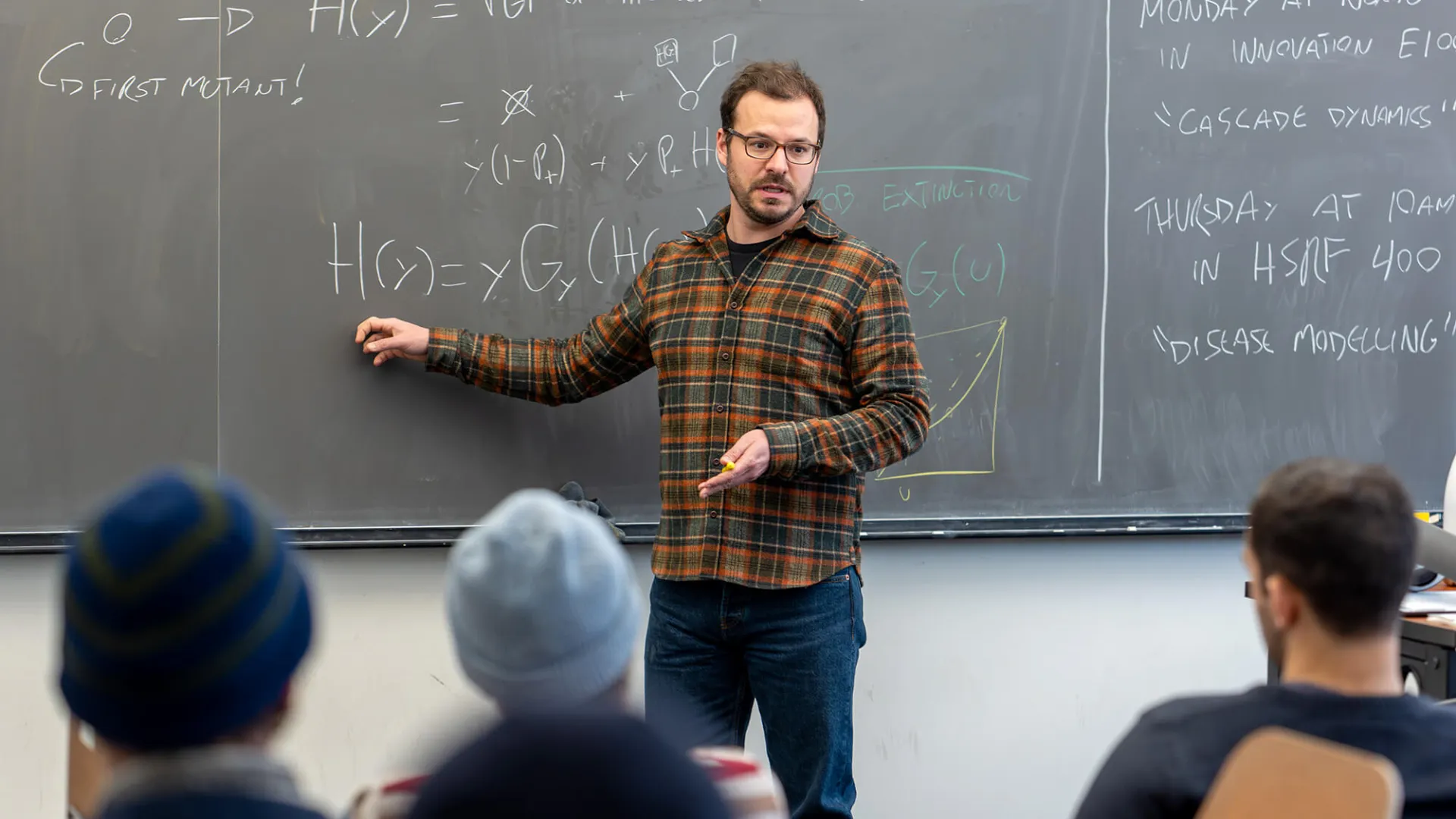
Laurent Hébert-Dufresne, a core faculty member of the Vermont Complex Systems Institute and a professor of Computer Science in the College of Engineering and Mathematical Sciences (CEMS), has been awarded the 2026 Erdős–Rényi Prize by the Network Science Society (NetSci).
Widely regarded as the field’s top honor for early-career researchers, the Erdős–Rényi Prize is awarded annually to a young scientist for “outstanding achievements in network science and contributions to the interdisciplinary development of the field.”
The Network Science Society recognized Hébert-Dufresne for his “foundational contributions to the theory of contagion on complex networks, illuminating how network structure, higher-order interactions, and nonlinear transmission mechanisms shape the spread of diseases, behaviors, and ideas.”
Founded to advance the study of connected systems across disciplines ranging from physics and computer science to biology and the social sciences, the Network Science Society brings together researchers worldwide to better understand the behavior of complex networks and interconnected phenomena. The award will be presented to Hébert-Dufresne during the Network Science Society awards ceremony at the NetSci 2026 Conference in Boston this early June.
“This recognition reflects the deeply collaborative nature of complex systems research,” Hébert-Dufresne said. “The most exciting questions in network science happen at the intersections—between disciplines, between theory and application, and between people with very different perspectives.”
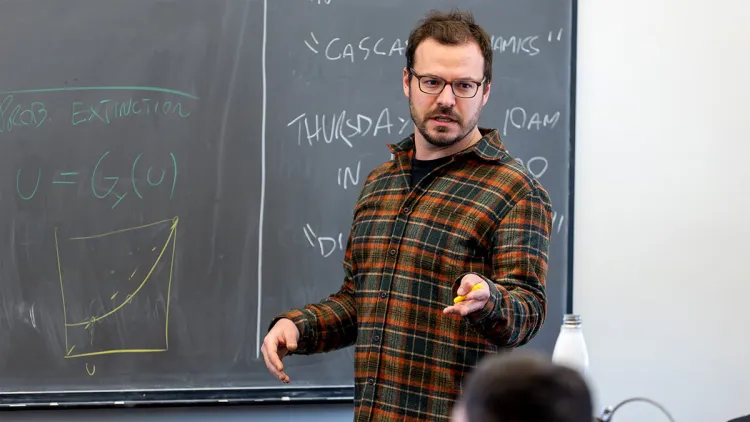
Hébert-Dufresne’s research focuses on understanding how structure and dynamics coevolve in complex systems. His work spans the spread of infectious diseases and ideas through social networks, sustainable agriculture and pollinator systems, online interactions between hate and counterspeech, and learning dynamics in multidisciplinary teams.
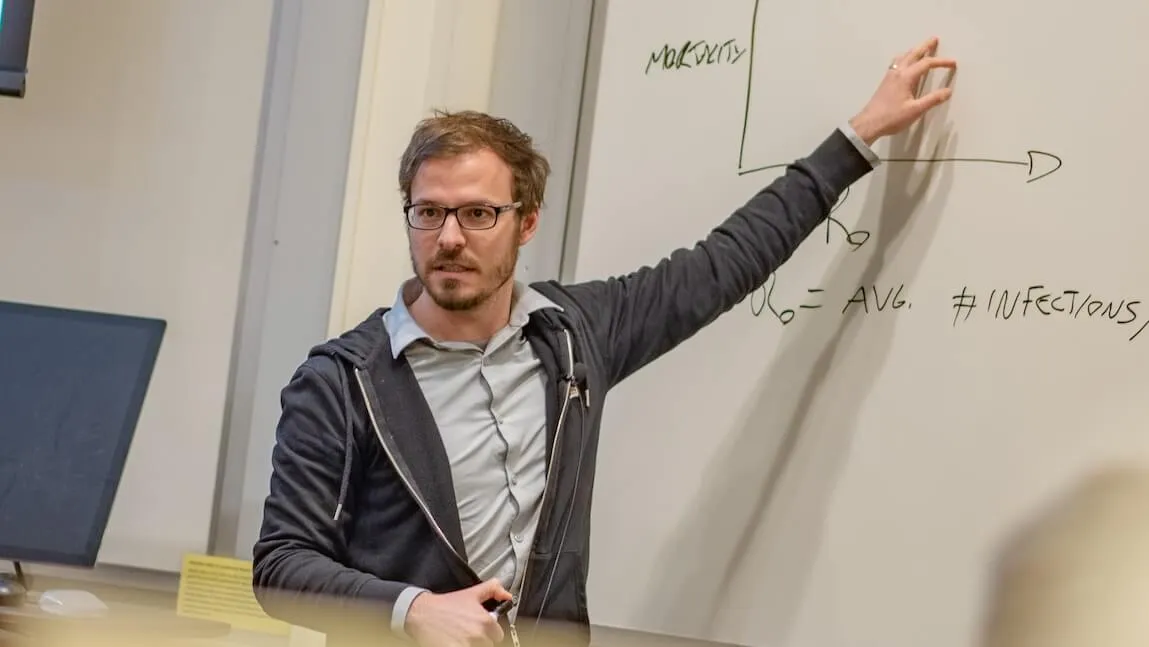
After earning his PhD in physics from Université Laval, Hébert-Dufresne pursued research in ecology and complex systems as a James S. McDonnell Foundation Fellow at the Santa Fe Institute before joining the Institute for Disease Modeling. At UVM, he now co-leads the modeling arm of the Joint Lab at the Vermont Complex Systems Institute.
In addition to his faculty role at UVM, Hébert-Dufresne serves as director of the Mathematical and Computational Predictive Modeling (MCP) Core of the Translational Global Infectious Disease Research Center at UVM’s Larner College of Medicine, where he provides computational modeling support to dozens of research projects. He is also an external faculty member at the Santa Fe Institute in New Mexico and at the Complexity Science Hub in Austria.
Hébert-Dufresne has also helped shape the future of interdisciplinary scholarship through scientific publishing. As inaugural editor-in-chief of npj Complexity, launched in 2024 as a partner journal to Nature, he helped establish a new venue dedicated to research that transcends traditional disciplinary boundaries.
The Erdős–Rényi Prize marks another major international recognition for Hébert-Dufresne, who earlier this year received the German Physical Society’s 2026 Young Scientist Award for Socio- and Econophysics. Nominated by his longtime colleague and postdoctoral mentor, Professor Sidney Redner of the Santa Fe Institute, the award recognizes “outstanding original contributions that use physical methods to develop a better understanding of socio-economic problems.”