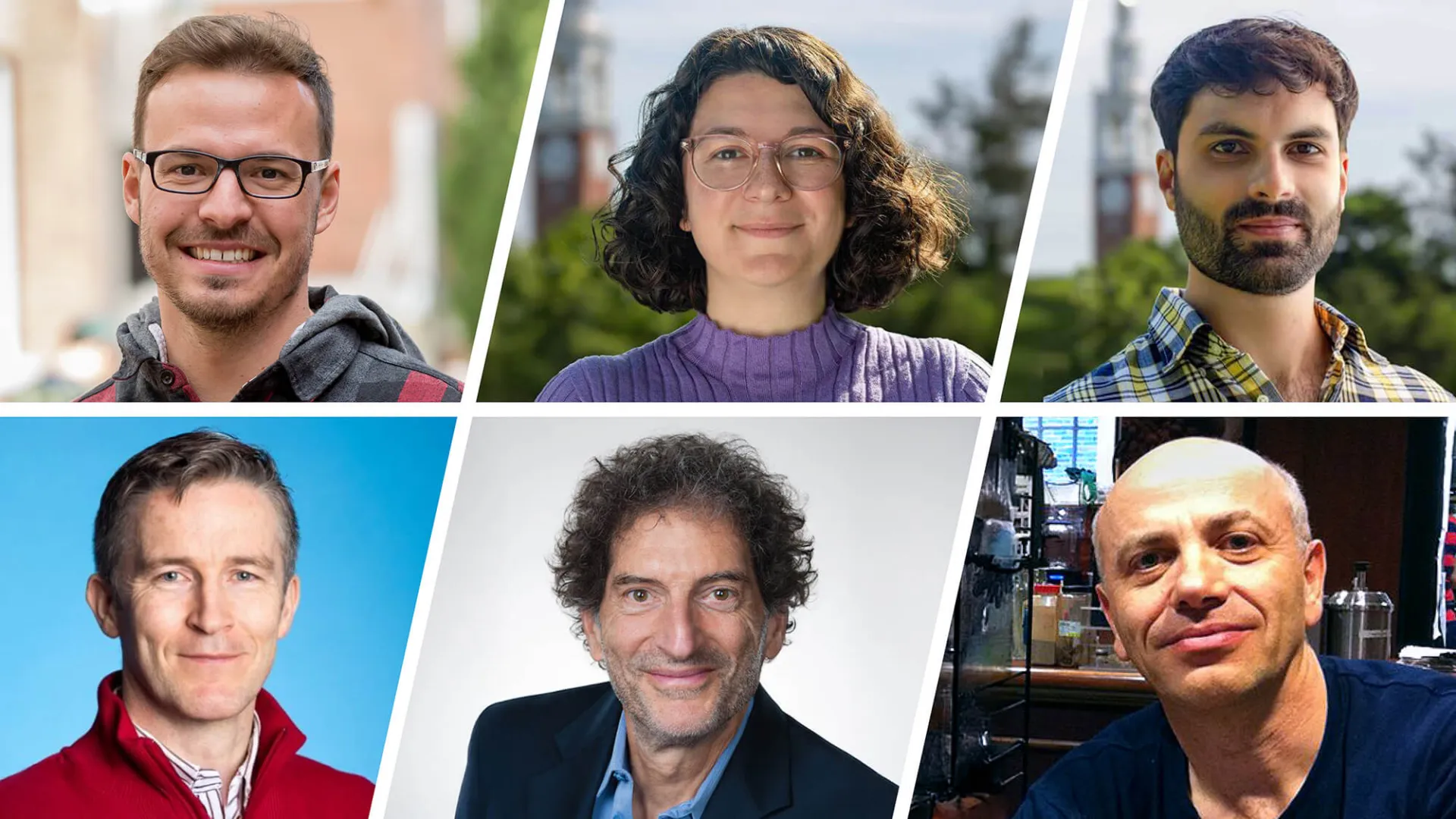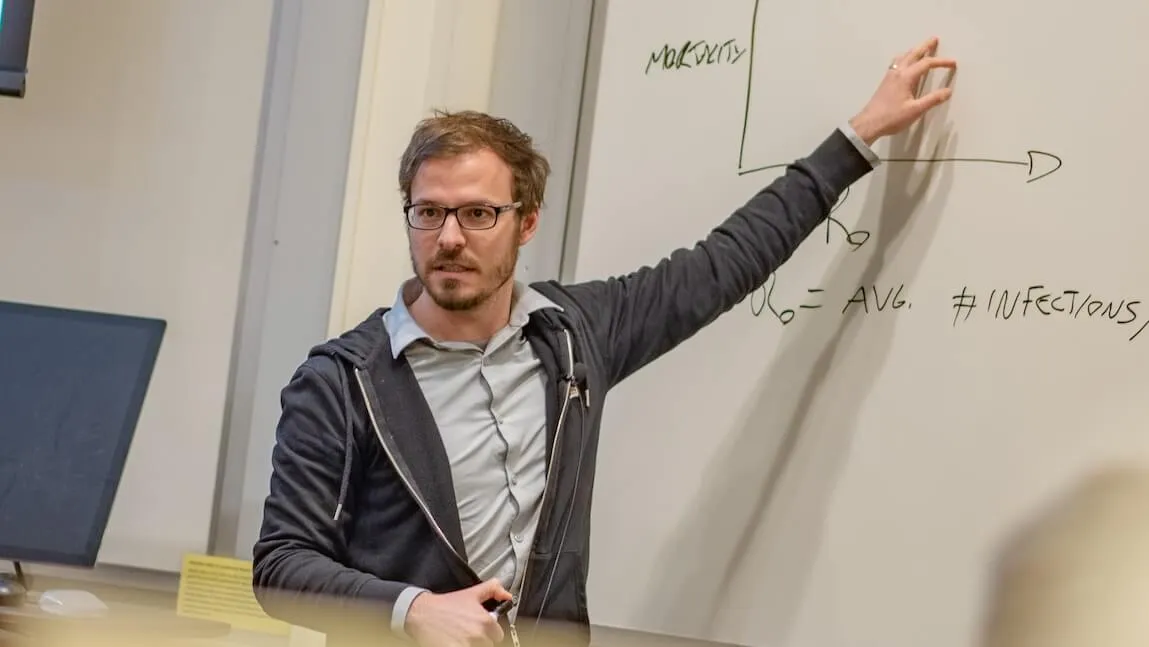
With only a cursory glance at UVM Professor of Computer Science Laurent Hébert-Dufresne's research interests over the past decade, it might prove difficult to pinpoint his field. He has published extensively on infectious diseases, network science, forest fires, honeybee colonies, and sociotechnical systems, among many other topics.
Like his research itself, the answer emerges from the nexus of these interdisciplinary interests: how do things spread?
A core faculty member of UVM’s Vermont Complex Systems Institute (VCSI) and an external faculty member of the world’s leading complex systems think tank, the Santa Fe Institute, Hébert-Dufresne’s research eschews a traditionally siloed approach to engage in transdisciplinary collaborations to build new frameworks for understanding contagion—whether biological, ecological, or social.
His impact is reflected in a wide range of appointments and accomplishments. As the director of the Mathematical and Computational Predictive Modeling (MCP) Core of the Translational Global Infectious Disease Research Center at UVM’s Larner College of Medicine, Hébert-Dufresne provides computational modeling support to dozens of researchers and projects. He is also an affiliate of the Département de Physique at his alma mater, Université Laval in Québec, and an external faculty member of the Complexity Science Hub in Vienna, Austria.
“Complex systems are opposed not to simple systems, but to separable systems. And often different parts of these systems have different natures that we study with different disciplines. By their nature, we need to study them with tools from different disciplines and with dialogues across different expertise.”
— Laurent Hébert-Dufresne
UVM Professor of Computer Science
As the inaugural editor-in-chief, Hébert-Dufresne helped launch the online science journal npj Complexity in 2024 as a partner journal to the world's foremost international weekly scientific journal, Nature, and as a “home for research that transcends disciplines.”
Making his achievements all the more remarkable, Hébert-Dufresne only turns 39 this March—a milestone he will celebrate as the 2026 recipient of the German Physical Society’s Young Scientist Award for Socio- and Econophysics.
Awarded annually to a scientist under the age of 40, the honor recognizes “outstanding original contributions that use physical methods to develop a better understanding of socio-economic problems.”
Hébert-Dufresne was nominated by his longtime colleague and postdoctoral mentor, Professor Sidney Redner of the Santa Fe Institute, where Hébert-Dufresne held the James S. McDonnell Foundation Postdoctoral Fellowship in Complex Systems.
In his nomination letter, Redner praised Hébert-Dufresne’s “incisiveness in formulating and solving new models of complex contagions that incorporate the interplay between structure and dynamics, nonlinear spreading mechanisms, and self-reinforcement.”
“Laurent knows what to do; he is very opportunistic, but in the most positive sense, he's very aware, creative, and enthusiastic. He sees problems and assimilates new information quickly,” Redner said in a recent interview. “It’s hard to quantify what it means to be a successful physicist, but Laurent has that quality of being self-sufficient, self-driven, and able to identify interesting problems before others and dive into them.”
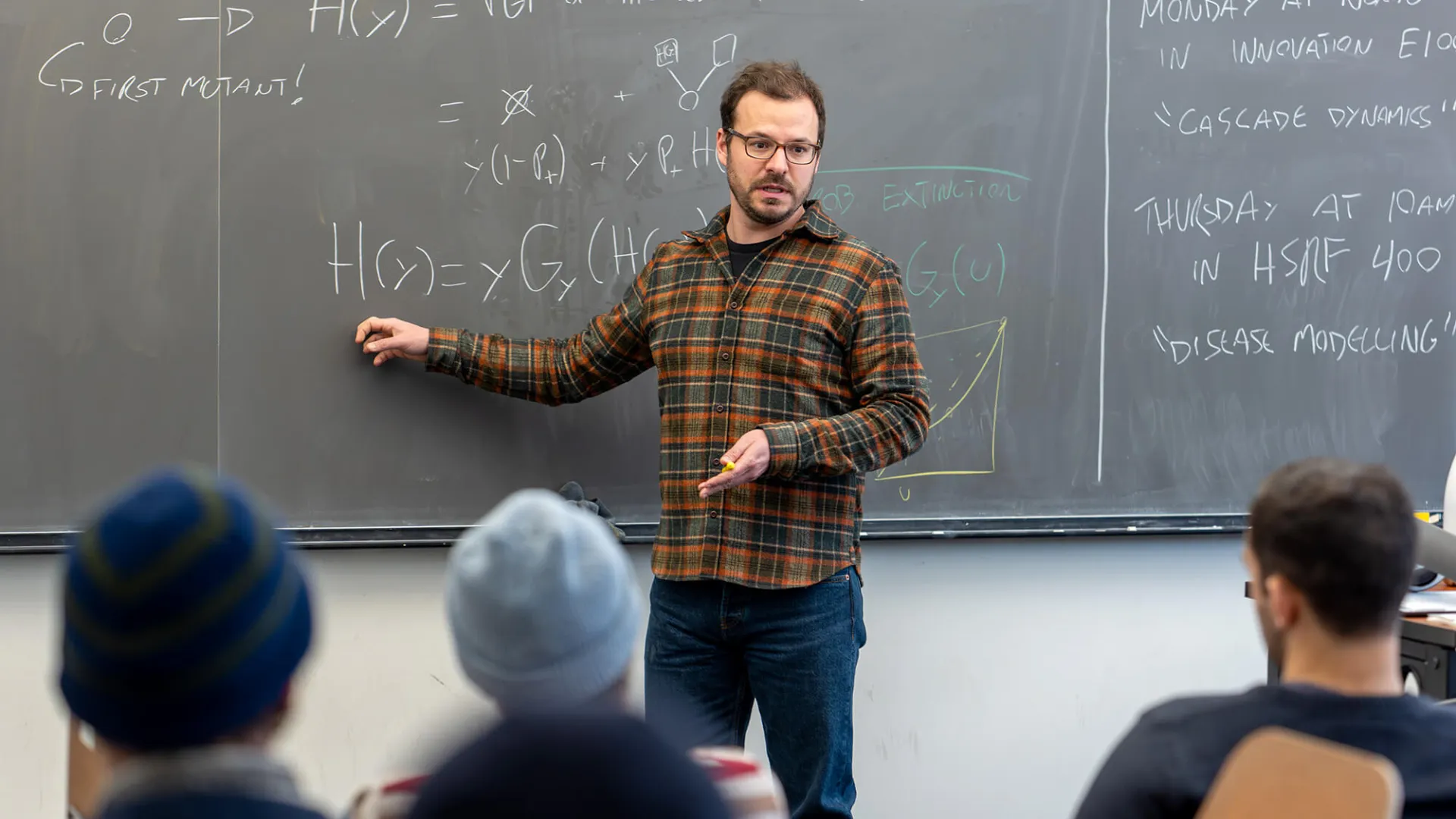
Redner’s nomination cited Hébert-Dufresne’s recent research published in Physical Review Letters. The study, co-authored with Redner; UVM Assistant Professor Juniper Lovato; former UVM Postdoctoral Associate Giulio Burgio; Professor James P. Gleeson of the University of Limerick; and Research Associate Professor Paul Kapivsky of Boston University, introduces a mathematical model for “self-reinforcing cascades”—processes where the thing being spread, whether a fire, belief, or virus, evolves in real time and gains strength as it spreads.
“It’s like me telling you a joke,” Hébert-Dufresne explained. “You might repeat it, but it has this mechanism that we often don't explicitly model in disease, which is that, as a joke spreads, people can make it funnier, or they can also make it less funny. If you're a better joke teller, when you tell it to new people, it's going to be even funnier and that variability will actually help the joke spread further.”
The work reflects Hébert-Dufresne’s broader focus on the interplay between structure and dynamics in complex systems. His research group, the Laboratory for Structure and Dynamics (LSD), is housed in The Joint Lab at VCSI which is co-led with Assistant Professor of Mathematics and Statistics Jean-Gabriel Young.
The Young Scientist Award for Socio- and Econophysics will be presented at the 2026 German Physical Society’s annual meeting this March in Dresden.