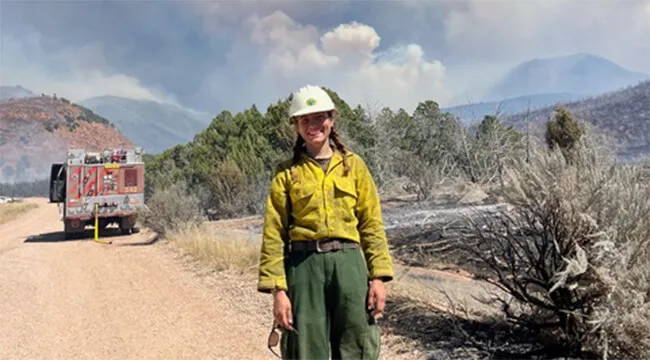
When Nina Furlong ’24 signed on to be a wildland firefighter with the Snake River Hotshots, she didn’t know exactly what a wildland firefighter did or what a hotshot was. But what she did know is that she had a passion for emergency management and disaster relief, sparked by her time in the UVM College of Arts and Sciences as a global studies major and sociology minor, and as an intern with UVM’s Department of Emergency Management.
After Furlong applied to be a wildland firefighter at the suggestion of a friend, Snake River Hotshots, a wildland firefighting crew based in Pocatello, Idaho, reached out to her. “I had already accepted the job before I knew what it was,” she says. “I read a book on hotshots right before I started. But it worked out. I really enjoy it.”
A hotshot crew comprises around 18 to 25 people who are specialized in hiking into an area and establishing a place to start fighting a fire by stopping its spread. They’re on the front lines in places that a fire engine can’t get to because there are no roads, or a bulldozer can’t go through because it’s too steep or too rocky.
During fire season, which generally runs from May to October, Furlong’s crew works 14-day shifts with three days off in between. Although based in Idaho, the Snake River Hotshots have recently been called to work on wildfires as far away as Utah and Big Sur in California. “We don’t know where we’re going next until the night before, because a fire could pop up overnight,” Furlong says. “One of my boss’s favorite sayings is that fire is dynamic, which is so true. Like everything we do, it could change at any moment.”
Furlong was introduced to the field of emergency management during her first year at UVM, in Professor Alice Fothergill’s Sociology of Disaster class. Around the same time, she started ski patrolling at Jay Peak, where she saw the first-responder side of disaster relief. Later, Furlong learned the behind-the-scenes aspects of disaster relief in a Geographic Information System (GIS) class, where she did a project on flood-zone mapping.
In Furlong’s last year at UVM, she signed up for another of Professor Fothergill’s classes, this time a sociology internship course in which students can choose the internship they want to pursue. Fothergill introduced Furlong to John Marcus, UVM’s Emergency Management Director, and Barry Simays, UVM’s Fire Marshal and Deputy Emergency Manager.
Along with another UVM student, Joe Harris ’25, Furlong worked with Marcus and Simays to create an emergency management internship. “It was definitely the best thing to happen to me at UVM,” she says. “I learned so much from Barry and John. I had an active role, but some opportunities allowed me to just witness them working their magic.”
“From the beginning, Nina was curious, engaged, and an absolute pleasure to work with every week,” Simays says. “She approached every regular weekly meeting, community partner visit, activity, and major event with energy and enthusiasm, and her background as a sociology minor afforded us a new perspective on the work we do on campus every day.”
On the Snake River Hotshots crew (which also includes UVM alums Gavin Houghtaling ’25 and Charlie Bernicke ’22), Furlong’s day usually begins at 6 a.m., when the crew drives as close as they can get to the section of the fire they’ve been assigned. “We camp every night, and our bosses go to the morning briefing to learn what the fire did overnight and what plans are for the day.”
The crew then splits into two groups, a saw team and a dig team. The saws go first along the edge of the fire, cutting out strips of brush or timber about 5 to 15 feet wide on either side. Then the dig team comes in and digs a trench in the soil right along the edge to create a barrier for the fire.
After the fire has burned itself out, the dig team does cold trailing. “We just run our hands along the edge and feel for anything hot,” Furlong says. “If we find something, then we’ll dig a section around that area to keep it contained.”
The hike in from the campsite to where they’ll be working can take anywhere from 30 to 90 minutes, and it’s not just themselves the crew has to haul over often rough terrain. They also carry 35 to 45 pounds of line gear, which includes tools, a fire shelter, and six liters of water, among other items. Furlong says the physical part of the job is difficult, but she’s always been active and likes challenging herself both physically and mentally.
The fact that firefighting has long been a male-dominated field turned out to be no barrier for Furlong. “We have four amazing women on the crew, and they have a lot of experience and are really great role models,” she says. Having grown up with capable female role models of her own in her mom and aunts also contributed to Furlong’s positive attitude. “I never felt I needed to do something just to prove that a girl could do it, because they showed me that, of course, we could do it.”
Furlong plans to continue to work in the field of emergency management and disaster relief. She admits that she sometimes gets so caught up in what she’s doing that it can be hard to see the big picture. But recently, while driving through the town at the end of a particularly challenging assignment, the Hotshots saw people waving at them and holding ‘Thank you, firefighters!’ signs. “I was already emotional from the physically taxing weeks, but that really makes it all worth it, knowing that you’re supporting those people in some way,” Furlong says. “I don’t really have any concrete plans for the future, but I like where it’s taking me.”