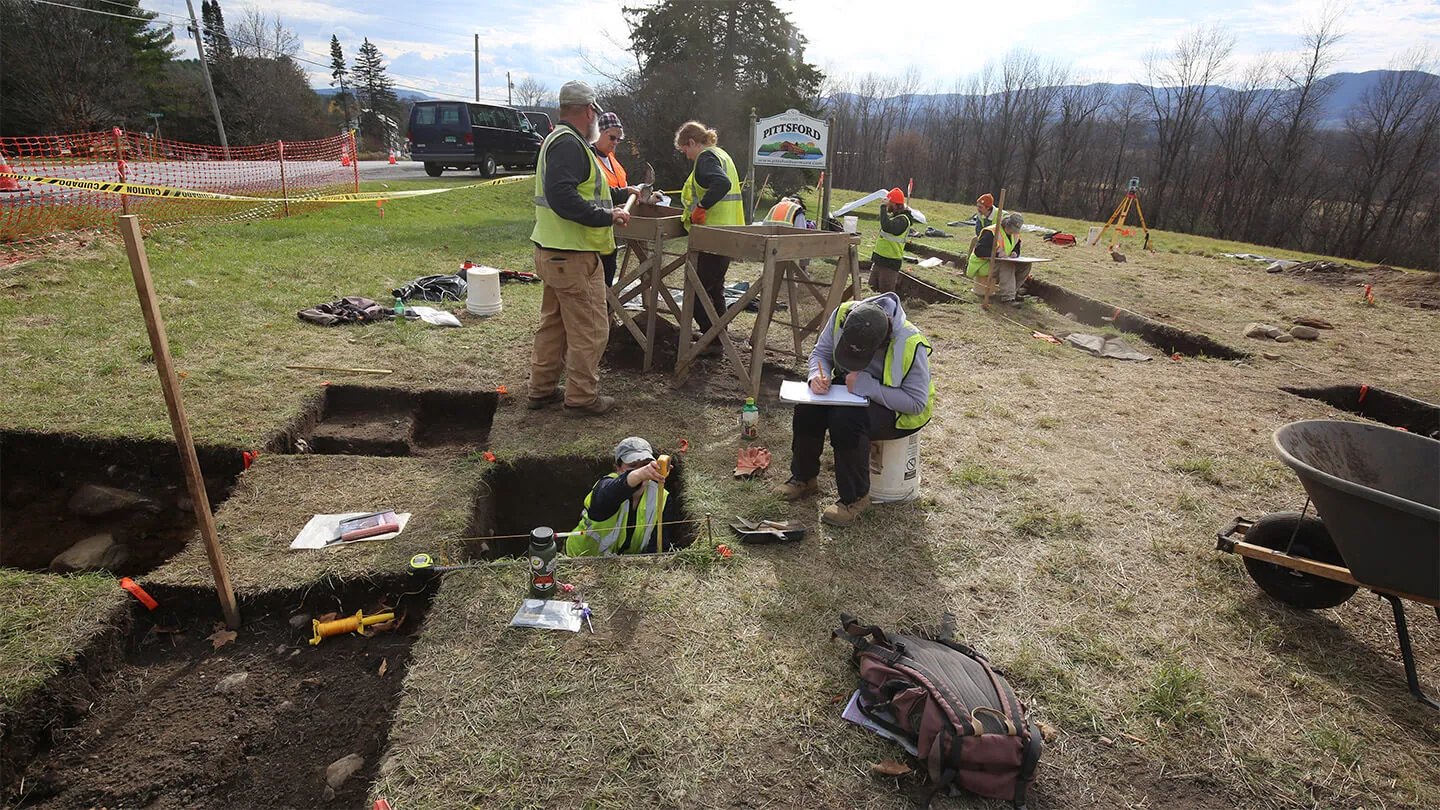
Unearthing Native American campsites that date back 12,000 years or rediscovering early-19th-century structures makes for an amazing day—but not an unusual one—for the Consulting Archaeology Program (CAP), located within UVM’s College of Arts and Sciences (CAS). By conducting field and lab work for archaeological and historic preservation projects, CAP aims to help preserve the past while aiding progress toward the future.
Alumni Offer Expertise, Gain Experience
Helping CAP meet its goal are two faculty and nine staff members, including six alumni, five of whom were once student volunteers or interns for CAP and are now employed by the program as field and lab technicians. The team is led by John Crock ’89, associate professor of anthropology and himself a UVM alum, who has served as the director of CAP since 2000. Undergrads have opportunities to help out, too, through internships offered throughout the year and volunteer or employment opportunities in the summer.
Rose Pool ’23, a psychology major, got involved with CAP a few months after graduating. “I took our assistant director Jorge Garcia’s forensic anthropology course my last semester and loved it, so I asked him if there were any internships or work available for people who were graduating,” she says. “I volunteered with CAP for a month or so before being hired on as a temp and then eventually becoming a full-time employee.” Pool continues to be interested in forensic anthropology and feels she is gaining invaluable experience, skills, and connections that will help her down the line as her career path progresses.
A double-major in anthropology and Spanish, Fiona Haverland ’23 volunteered with CAP a couple times as an undergrad. “I was interested in working with them because their program was a combination of cultural resource management projects and academic archaeology,” they say. Haverland joined the team as a field and lab technician in the fall of 2024. “Working at CAP has given me an opportunity to learn more about a very broad time range in the history of New England and Vermont. I’ve also found opportunities to develop various research and analysis skills through report writing and independent research projects.”
Jillian Eller ’20 double-majored in anthropology and classical civilizations. She learned of CAP in 2018 while enrolled in Crock’s summer archaeological field school. Following graduation, Eller worked several seasons with the program before ultimately being hired full-time. She hopes to gain more experience in leadership and project management as well as lab-based aspects like the Geographic Information System (GIS) and report writing.
Current Projects Reveal Hidden Treasures
When the Vermont Agency of Transportation recently decided to widen Route 7 in Pittsford, Vermont, CAP was asked to help. “Part of the widening will impact what’s believed to be part of Fort Vengeance, a Revolutionary War fort established by the state of Vermont to protect farmers during the time of the American Revolution, around 1780,” Crock says.
CAP was established in 1978 to conduct studies required by state and federal regulations under the National Historic Preservation Act. These reviews determine potential impacts to sites, such as the one in Pittsford, so that organizations can obtain necessary permits or avoid certain sites altogether. While also contributing to the understanding of the human past in northeastern North America and providing experiential learning opportunities for students and alumni, CAP continues its main mission of conducting these types of studies to this day.
“We found a Native American site at Sand Bar State Park in Milton, VT that dates to the late pre-contact era, just before Europeans arrived,” Crock says. CAP uncovered this site while conducting an archaeological survey at the Sand Bar for the Department of Forests, Parks, and Recreation, part of the Vermont Agency of Natural Resources. The park had received funding through the National Park Service to improve facilities, make the entry road safer, and improve parking.
“The Native American site at Sand Bar includes an occupation that is about 500 or 600 years old,” Crock says. "It would have been right at the mouth of the Lamoille River going into Lake Champlain, a prime location for Indigenous people. We also found some beautifully decorated Native American pottery at the site, which was really exciting.”
Most recently, CAP tackled a project to help the city of Burlington, which was dredging at Perkins Pier on Lake Champlain. “The dredging turned up a number of timbers associated with the original Burlington Wharf construction,” Crock says. The timbers appear to be from around 1820, when the wharf was rebuilt. CAP is analyzing those wood samplings and sharing results with the city and the Army Corps of Engineers.
A couple of solar projects are also on CAP’s plate right now. Vermont requires utility projects to obtain a certificate of public good, and “in many cases, they’re developing farm fields adjacent to streams and other sensitive areas, often near Native American campsites dating back as far as 12,500 years ago,” Crock says.
CAP Continues Its Mission
This year, CAP will finish work on the Fort Vengeance project in Pittsford and participate in a collaborative project at Fort Ticonderoga in New York State, among others. “Some of these locations are pristine sites that were occupied thousands of years ago by native people, and you can understand why they selected them,” Crock says, referring to their access to resources and proximity to waterways. “We have some amazing days, particularly in the summer and fall, when you wouldn’t rather be anywhere else than on some of these locations.”
“We feel very lucky to be here at UVM,” Crock says. He adds that it has been wonderful to have so many UVM students and alumni volunteer or come back to work full-time for CAP. “I realized a while back that one of our roles was to not only serve undergraduates by providing hands-on opportunities but also to provide career-building opportunities for recent graduates. This has helped create a great mentoring environment for current students and, selfishly, has allowed us to spend more time with some of our best students after graduation.”