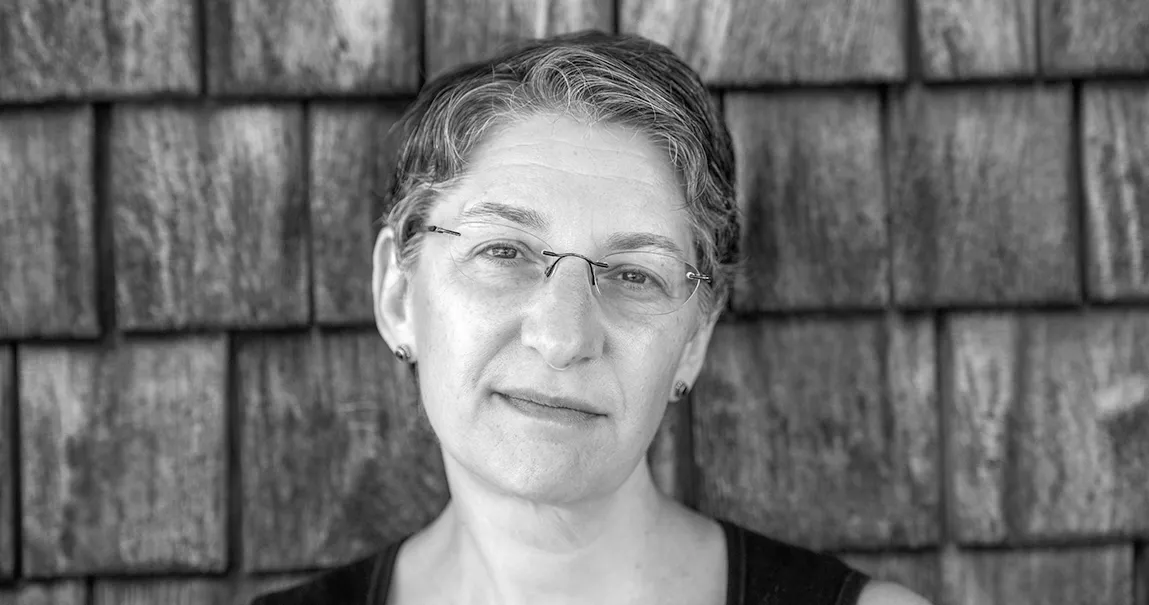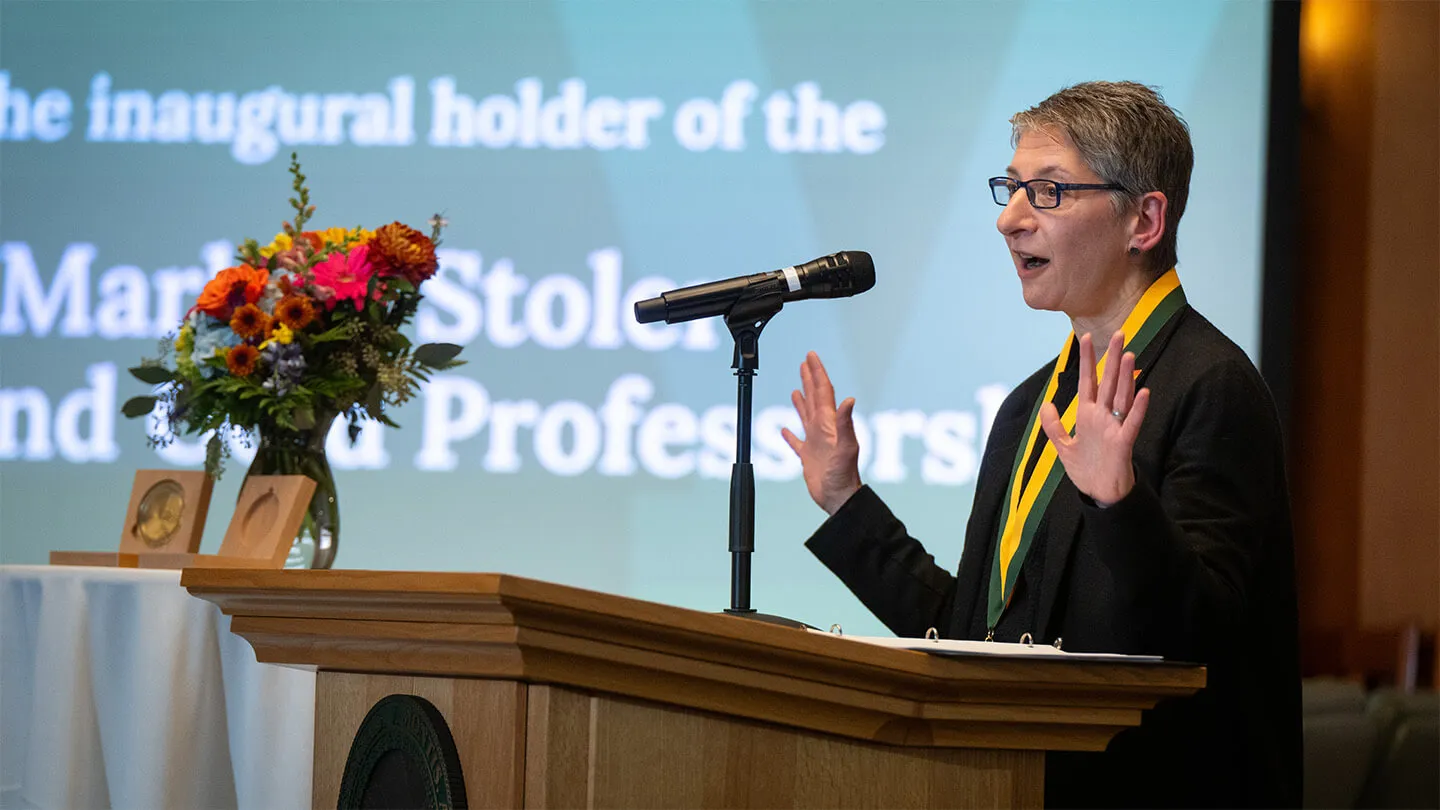
Felicia Kornbluh, Ph.D., professor in the Department of History, has been invested as the inaugural Mark A. Stoler Green and Gold Professor at the University of Vermont (UVM). UVM leadership and special guests, including founding donor Adam P. Strochak and Mark A. Stoler, in whose honor the professorship was established, gathered on campus in Memorial Lounge in the Waterman Building for the formal ceremony on October 27, 2026.
Strochak, who graduated with a B.A. in political science from UVM in 1987 and a J.D. degree, with honors, from the George Washington University Law School in 1993, established the Mark A. Stoler Green and Gold Professorship to honor UVM Professor Emeritus Mark A. Stoler. It is presented to a faculty member of the Department of History in the College of Arts and Sciences who has academic distinction in American history and/or international relations. Sixty-four donors contribute to the fund.
“The most enduring facet of my UVM education has been an appreciation for the commitment to teaching, scholarship, and support among the faculty community,” Strochak said. “I’m proud to join with many others in giving back to the university in a way that ensures current students and future generations have the benefits of an academic community filled with excellent teachers and scholars like Felicia Kornbluh.”
Mark A. Stoler earned his B.A. at the City College of New York in 1966 and his Ph.D. at the University of Wisconsin-Madison in 1971. He joined the UVM Department of History faculty in 1970 and proceeded to teach for 37 years before becoming Professor Emeritus in 2007. Stoler’s areas of special expertise are U.S. diplomatic and military history and World War II. A well-respected scholar, he wrote and edited many publications during his time at UVM and received the Dean’s Lecture Award in 1992 and University Scholar Award in 1993. He also earned several teaching awards, including the George V. Kidder Outstanding Faculty Award in 1984 and the Kroepsch-Maurice Excellence in Teaching Award in 2006. Stoler has served as a visiting professor at several distinguished institutions, including the U.S. Military Academy at West Point and the U.S. Naval War College, and is a former president of the Society for Historians of American Foreign Relations and a former trustee of the Society for Military History.
“The professorship we celebrate today honors sustained achievement at the highest level. It recognizes a scholar whose work has changed the way we understand the past and whose contributions will continue to shape scholarship and public discourse for years to come,” said Thomas Macias, Associate Dean for Faculty Affairs in the College of Arts and Sciences. “Today, we acknowledge Felicia Kornbluh, a scholar whose work has transformed our understanding of social justice, legal history, gender and sexuality, and the struggles of ordinary people to expand the promises of American democracy.”
“Appointment to an endowed position is among the highest academic honors the University of Vermont can bestow on a faculty member, allowing the University to recognize and celebrate academic achievement, and to further encourage scholarly and service excellence,” said Interim Provost and Senior Vice President Linda Schadler. “We are proud to recognize Professor Felicia Kornbluh as an outstanding faculty member and to welcome her to the growing ranks of UVM endowed professors and chairs.”
Professor Felicia Kornbluh teaches in the Department of History and is affiliated faculty in the Gender, Sexuality, and Women’s Studies Program and Jewish Studies. She specializes in the histories of feminism, gender, social welfare, disability, law, Jews in the United States, and reproductive politics. A prolific writer, she is the author or co-author of three books, including The New York Times-reviewed A Woman’s Life Is a Human Life: My Mother, Our Neighbor, and the Journey from Reproductive Rights to Reproductive Justice (Grove Press, 2023). She also writes regularly for several highly regarded publications, including Feminist Studies, The American Prospect, and The Washington Post.
“The main focus of my solo research is a book-length work that explores the history of modern movements for LGBTQ+ and disability rights through a pivotally important court case from the 1980s-1990s, the Sharon Kowalski case,” Kornbluh said. In addition, she recently signed a contract with Cambridge University Press to co-edit a collection of essays on queer legal history in the United States and has co-launched an archive project on queer U.S. Jewish history.
Kornbluh earned her B.A. in social studies from Harvard-Radcliffe College, and both her M.A. and Ph.D. from the Princeton University Department of History. She began her academic career teaching history at Duke University before she came to the University of Vermont in 2009 as an associate professor of history and director of the Gender, Sexuality, and Women’s Studies Program, the latter a position she held through 2015. She was promoted to full professor in 2019.
Kornbluh’s expertise has earned her a prominent place in her field. She has been a visiting scholar at Duke University, UC-Berkeley Boalt Hall School of Law, McGill University, and Princeton University, and received residency rewards from New York University and the Organization of American Historians in Tübingen, Germany. Her many other prestigious awards include, most recently, the Mellon-Schlesinger Summer Research Grant from the Radcliffe Institute for Advanced Study at Harvard University and a research fellowship from the Program in Law and Public Affairs at Princeton University,
“This endowed professorship is a recognition of the work I have done as a researcher, writer, and teacher of U.S. history, in the 30 years since I began my career,” said Kornbluh. “In addition, it recognizes the institutions that have supported my scholarship, including the College of Arts and Sciences, UVM Department of History, Program in Gender, Sexuality, and Women's Studies, and Programs in Law and Society and Jewish Studies. Finally, this professorship honors the co-writers, co-editors, and collaborators with whom I have been privileged to work and from whom I have learned a great deal.”