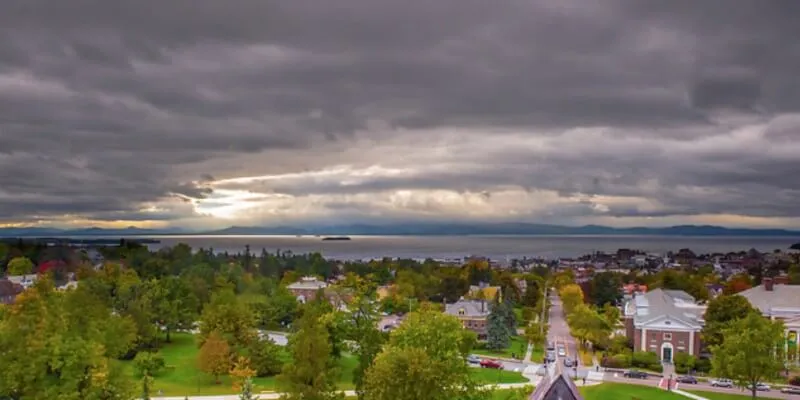
Burlington will be the nexus for geologists across the northeast March 18-20 as the Northeast Section of the Geological Society of America (GSA) holds its 53rd annual meeting at the DoubleTree by Hilton.
Geoscientists from the region will discuss hot-topic science, expand on current findings, and explore the region's unique geologic features. The event is expected to draw more than 1000 attendees from a variety of geoscience and environmental disciplines. Highlights include a talk on the use of drone technology to address geoscience and environmental issues.
“This is the most important meeting for people who do geology for a living, not just those of us in academia, but also for professionals who work in the government and business sectors,” said Professor Andrea Lini, chair of the geology department and UVM. He is co-chair of the GSA conference committee with Professor Charlotte Mehrtens.
“Having the meeting in Burlington also presents a unique opportunity for our students, who are exposed to cutting-edge research in the field,” Lini said.
Topics include water quality monitoring in lakes in New York and New England, groundwater contamination, and geologic hazards. Vermont state geologist Marjie Gale notes the significance of the conference for Vermont and the state’s residents.
“This conference brings together scientists from government, universities, and private industry to share latest research, solutions, and the new technology that impacts the work we do in the geosciences. Geology touches everything and builds the 3D framework that helps us understand issues such as PFOA contamination of groundwater, landslides and rockfalls in Smuggler’s Notch or Elm Street in Montpelier, and river restoration efforts in Northfield. This framework directly applies to development of future public water supplies, identification of public health issues, hazard mitigation and avoidance, land acquisition, and is a base for regional and town planning.”
Dr. Jarlath O’Neil-Dunne, director of UVM’s Spatial Analysis Laboratory, is the featured speaker for the conference. His lecture title is “The Drones are Coming.” O’Neil-Dunne's Unmanned Aircraft Ststems Team uses lightweight, high-tech drones to create mapping-grade imagery of the landscape.
Sessions led by UVM geologists include “New Perspectives on the Evolution of Brittle and Ductile Fault Zones: A Session Honoring the Work of Robert D. Jacobi,” presented by professor Keith Klepeis, along with Jom Kim, Vermont Geological Survey, and Jean Crespi, of the University of Connecticut.
The Geological Society of America has a membership of more than 26,000 professionals in 115 countries. GSA unites thousands of earth scientists from around the world in a common purpose to study the mysteries of our planet (and beyond) and share scientific findings.