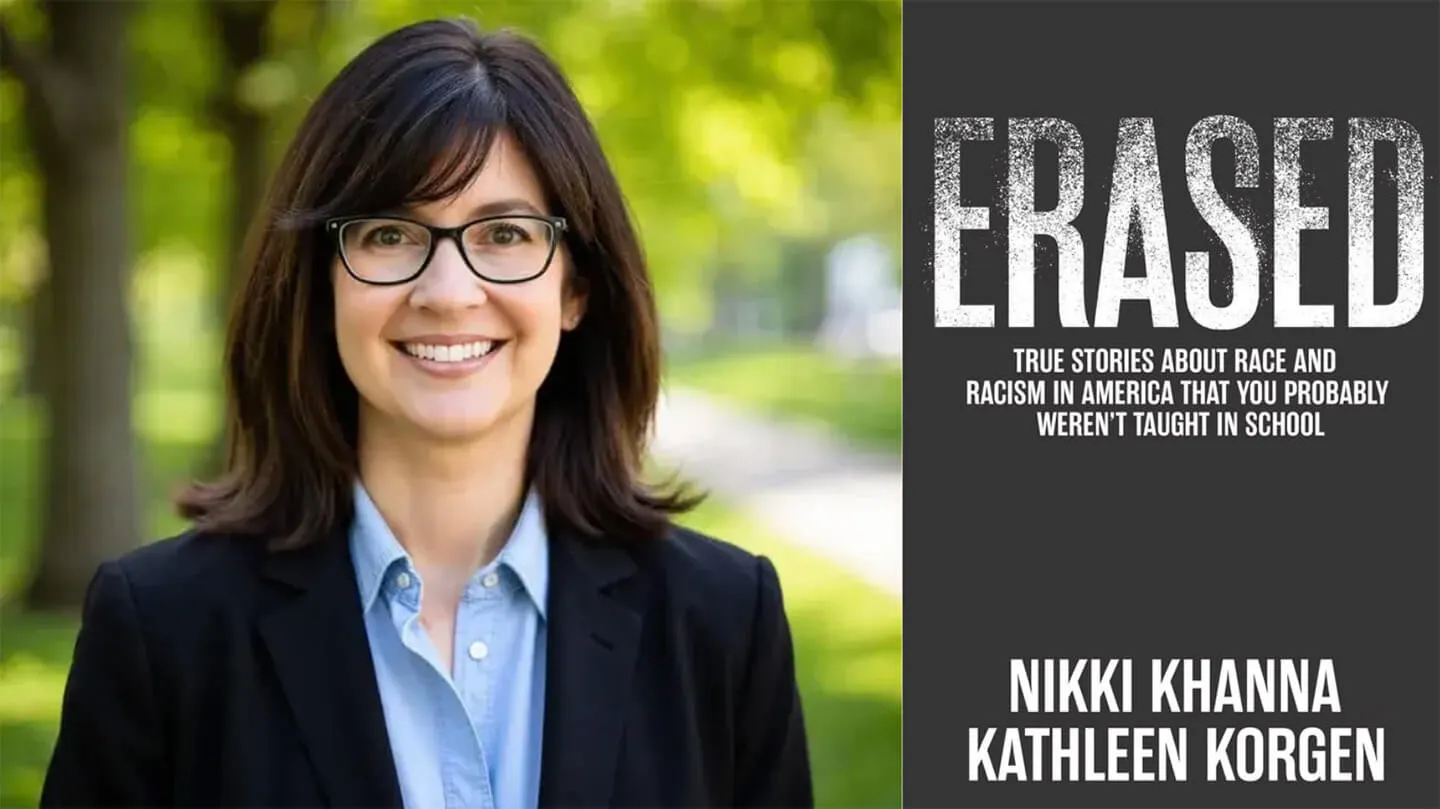
Every semester, UVM sociology professor Nikki Khanna encounters the same astonished faces when she tells stories of race and racism in America that her students have never heard before, stories that have been forgotten or deliberately buried. With their new book, Erased: True Stories About Race and Racism in America That You Probably Weren’t Taught in School, Khanna and co-author Kathleen Korgen, professor emerita of sociology at William Paterson University, are working to bring 38 of those stories back into the light.
We sat down with Professor Khanna to talk about the kinds of stories that get left out of the history books and why their absence matters.
College of Arts and Sciences: What inspired you to write Erased, and why did this feel like an important book to write now?
Nikki Khanna: It's a book my co-author [Kathleen Korgen] and I have been thinking about for a long time. Most of the classes I teach in the sociology department center on race and racial inequality, and I teach a lot of history in those classes as well. Every semester, I’m shocked by the limited information and misinformation that students come into the classroom with regarding US history. When I teach some of this information, many students say to me, “Why wasn’t this part of my education?” So, that's one of the reasons.
But also, right now, this book is more important than ever. There have certainly been recent battles over how U.S. history is taught, with restrictions in some states, like Florida, on what can be taught about racism in public school. There are also book bans happening in school libraries across the country. Many of the books being pulled from shelves have to do with topics like racial inequality, slavery, and segregation. We’ve also seen attacks on our nation's museums and national parks. So, this book feels really pressing right now.
CAS: The book examines 38 stories that are often missing from traditional accounts of U.S. history. How did you and your co-author decide which stories to include?
NK: It was very difficult, and my co-author Kathleen and I had a lot of very spirited debates about what would and wouldn’t be included! Ultimately, we decided to include the stories we felt were the most surprising, not only to the students in our classes but also to us. When we were younger, we did not know most of these stories ourselves.
CAS: How does approaching these stories with a sociological lens change the way we understand them and their connection to the present?
NK: The courses I teach at UVM have to do with racial inequality, so I teach a lot of history in those courses, but I always try to bring the history back to what's happening today. Of course, not every story will tie back to what's going on now, but there are policies, laws, and events that have happened in American history that can help us better explain the inequality we see today. So, my hope for readers—including my students—is that they understand that the past isn't always just the past. Some parts of our history have had long-term generational effects that we can see today.
CAS: How has teaching and talking with students influenced the way you think about the histories you explore in Erased?
NK: The conversations I have with my students inspired me. I thought, I need to put these stories in one place so they’re accessible for my students and for other people, too. So, they inspired Kathleen and me to write these stories down in one place.
CAS: What information did you encounter while writing Erased that had the biggest effect on the way you think about U.S. history?
NK: I grew up in Atlanta, and I learned a lot about racism in the South, but I did not really have a full picture of how anti-Blackness and racism was a national issue. Sometimes I knew something about a topic, but when I did more research, I discovered things I didn’t know. For example, at one time there were several states that used their state laws and constitutions to actively try to prevent Black people from settling within their borders. Oregon entered the union of the United States with an exclusion ban on Black people, and if you were Black and settled there, they could force you into work. Several Midwestern states—Missouri, Indiana, and Illinois—punished Black people who tried to settle in their states with whipping, exorbitant fines, arrests, even fines for the white people who might have helped them enter the state.
CAS: What do you hope readers will do differently after reading Erased?
NK: I hope people have a fuller picture of American history. Some stories are just forgotten over time, but others are intentionally erased. Take the Tulsa race massacre, for example. This massacre seems to have entered more into the public consciousness in the last 10 years, but for generations, the state of Oklahoma didn't even teach that it had ever happened. For a very long time, kids who grew up in Tulsa, Oklahoma, didn’t learn that history.
So, my hope is that some of the stories we tell are brought a little bit more into the mainstream, that people share them with their family, their friends, and their own students, and that teachers share them, to the extent they can, depending upon what state they teach in and what restrictions they face in the classroom.
I want to say, too, that the book isn’t all negative—there are some really amazing stories that I wish I’d learned when I was younger. There’s one about Henry Brown, who was a man who literally mailed himself to freedom. He was enslaved in Virginia, and his wife and kids had been sold away from him. He was in despair. So, he devised a plan to ship himself some 350 miles from Richmond, Virginia to Philadelphia, Pennsylvania. This 200-pound man put himself in a crate with some holes and mailed himself. It took 27 hours, but he was able to gain his freedom that way.
If I had heard that story as a middle school or high school student, it would have blown my mind. Look what he was willing to risk! To understand these stories of what people were willing to do to escape slavery would have taught me a lot about slavery itself. Just think: At what point would you shove yourself in a box and mail yourself anywhere? How bad would things have to be? It’s one thing to tell students that slavery was really bad, but to hear these incredible stories of resistance communicates that so much more effectively.