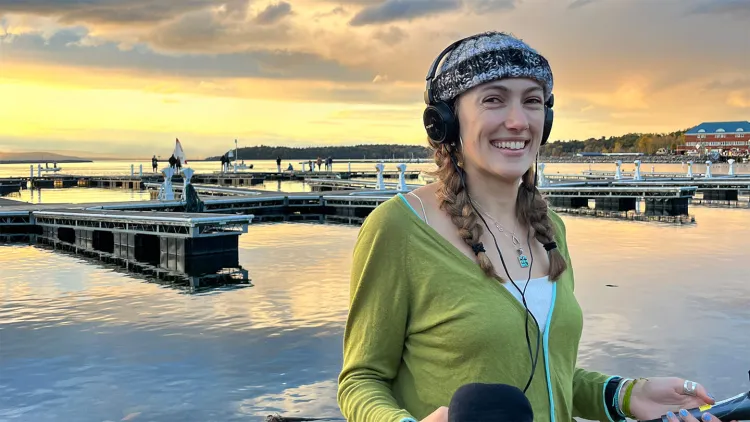
Crouching in her parents’ dark bedroom closet, Charlotte King holds the microphone close, then clicks record and starts to hum. First a low pitch, then a higher one. More notes, a random collection. Satisfied, she heads downstairs to the family piano, settles herself onto the bench, and presses hard on the damper pedal. Plays a few arbitrary notes, holds them, lets them linger.
King, a sophomore English major at the University of Vermont (UVM)’s College of Arts and Sciences (CAS), is not a trained musician, but she needed to underscore the podcast she was creating. So, she Macgyvered it, layering pitches and then repeating, repeating, repeating. “Everything’s a little offkey, but I think that’s fine,” she says. “It fits with the piece.”
That piece is “Dear Panda,” an audio story that has earned her a spot as one of 10 Finalists, chosen from hundreds of entries, in the 2025 NPR College Podcast Challenge. (Three other UVM CAS students received Honorable Mentions; see more on them below.) King’s is a beautifully told tale that weaves a childhood memory of a family outing with her late uncle with narratives from local strangers who share their own experiences of grief and coping.
King created the piece in response to an assignment in an audio storytelling class taught by veteran audio producer and radio journalist Kelsey Tolchin-Kupferer. “The classes I teach are all about exploring ways of helping a listener enter someone else’s world using sound,” Tolchin-Kupferer says. “We listen to a lot of different audio stories, and the goal is for the students to start developing their own tastes.” She also uses the class time to teach students how to accomplish the many tasks involved in creating the kinds of stories they’re drawn to, like using professional recording equipment and audio editing software.
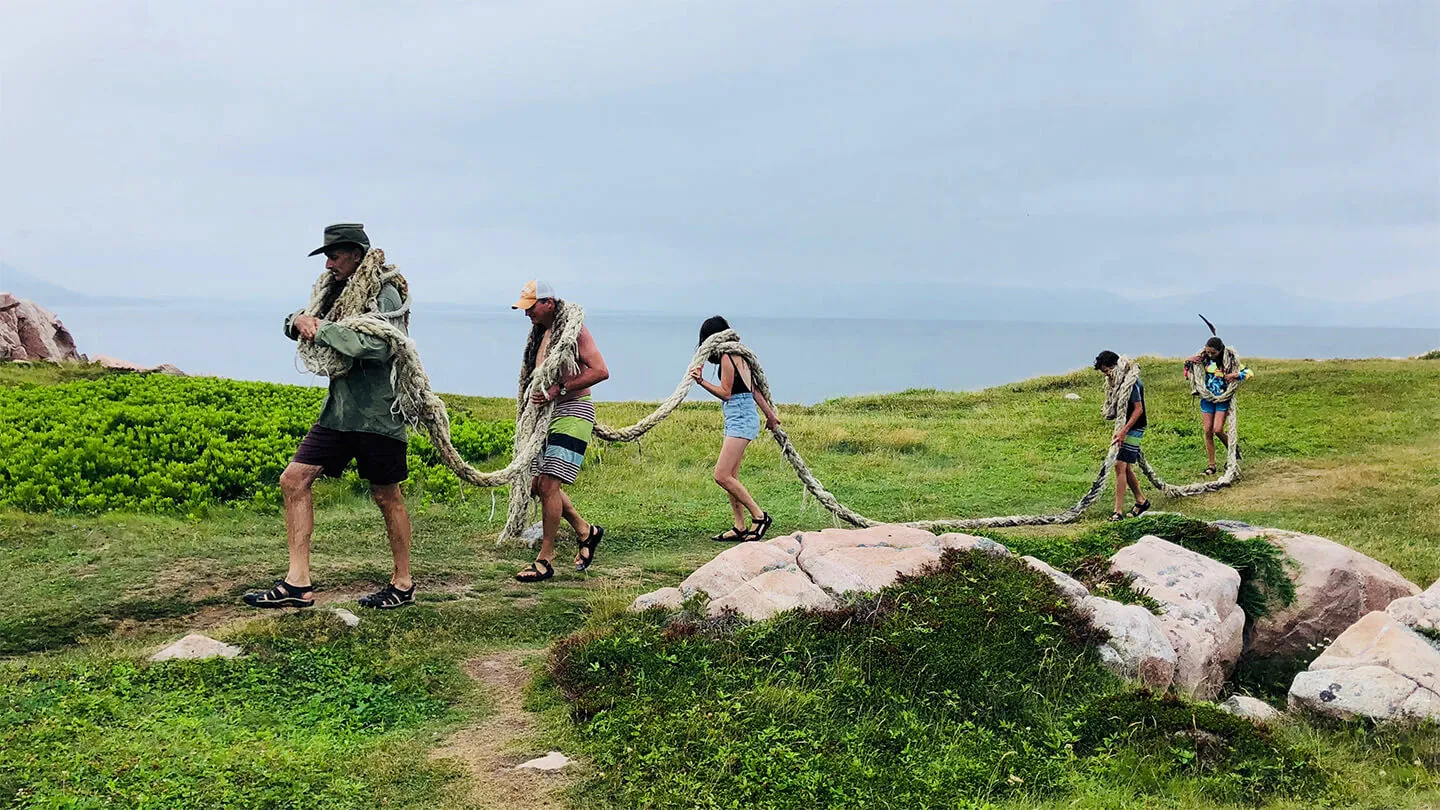
“One of the cool things about the NPR College Podcast Challenge is that students are encouraged to only use sounds they’ve recorded themselves,” Tolchin-Kupferer says. “Charlotte did such a beautiful job creating her soundscape. She went down to the lakefront to get the water sounds. She pulled a bunch of heavy stuff around in her backyard to get the sound of a heavy rope being dragged. But the best part was how she made the music.”
For King, who came into the class with some radio journalism experience under her belt, one of the most rewarding parts of making her piece was talking with complete strangers on the street about their own experiences with loss. “I think one of the most beautiful, amazing things about journalism, especially audio, is that you get to connect with someone you would normally never meet and tell their story,” she says. “In Kelsey’s class, we talked a lot about making people feel comfortable in interviews and then letting their quotes speak for themselves.”
King is hoping to keep making those connections and telling those stories for many years to come, including after she graduates in 2028. “If NPR’s reading this, I want to work for you,” she says with a smile.
A Trio of Honorable Mentions
In addition to the finalists, NPR chose 35 Honorable Mentions, including three talented students and alumni from CAS. Tolchin-Kupferer notes that every one of them (including King) treated their interviewees with great care. “The students did everything they could to share [the interviewees’] stories accurately and give them all the information they needed to feel good about being a part of this,” she says. “That’s the most important thing that you can do as a media maker, and these students approached this work with care for the people in their stories at the forefront.”
“Imagine what it would be like if all media makers gave more than they took, and their work was generative to a community instead of extractive. That’s even more important than making a good story,” Tolchin-Kupferer says. “These students did both. They were compassionate and they made really good stories. They used audio so well, and I’m extremely proud of them.”
Marissa “Wren” Dumais ’25
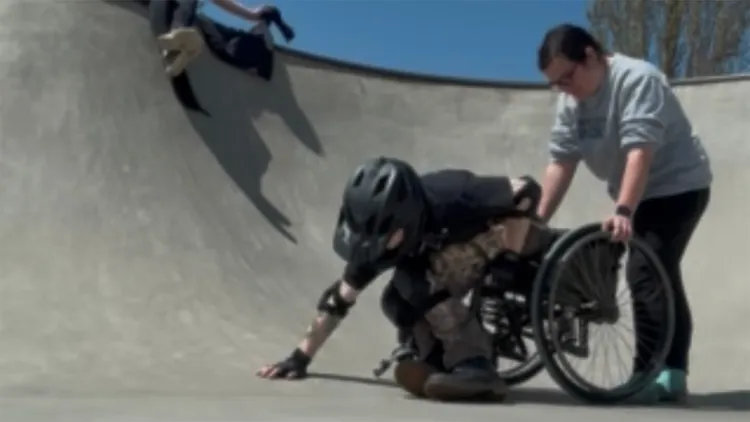
Marissa “Wren” Dumais didn’t have to look far for the inspiration for her audio story. In “Dropping In with Mo,” she visits a local skate park with her then-roommate, Mo O’Neill, an adaptive athlete and WCMX skater. “Mo is really passionate about finding things they enjoy doing and adapting them, and I saw an opportunity to share it,” says Dumais, a theatre major and 2025 graduate who now teaches middle school drama.
In Tolchin-Kupferer’s audio storytelling class, she says, they talked a lot about going out in public, asking people questions, and getting comfortable with the equipment. “Practicing that in class and understanding that people do this in the real world made it less weird to go to a skate park with a microphone,” she says. Her biggest challenge? “Getting good sound quality from a skate park for the undertone—you just get as close as you can without getting hit.”
Even though they’ve both graduated, Dumais and O’Neill are still close friends. “I didn’t think a school project would turn into this huge thing, but it really means a lot,” she says. “Getting to share Mo’s story in this way is unexpected and very cool.”
Dylan Moody A’ness ’26
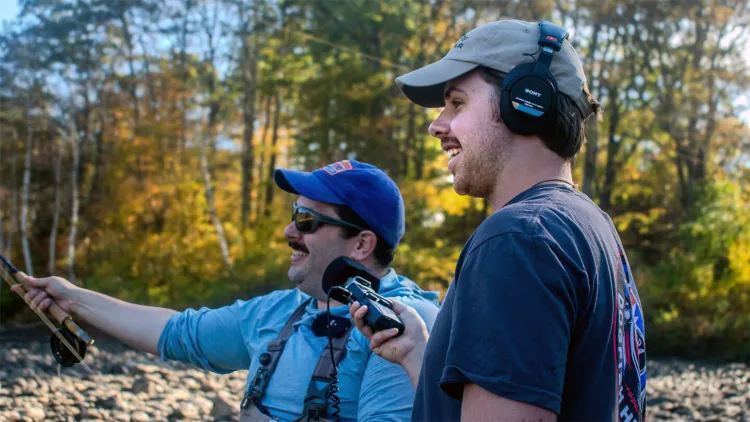
Normally, Dylan Moody A’ness doesn’t spend much time with rod and reel in hand. But when Tolchin-Kupferer showed him a Facebook posting from someone looking to form a group of serenity-seeking fisherfolk, he was, well, hooked. He arranged to meet with that person, local chef Andrew Wyslotsky, early one fall morning at the Winooski River to begin recording what became his audio story, “A Winooski Chef Finds Peace in Fly Fishing.” “We were in the water by 7:30 AM and it was super peaceful,” Moody A’ness says. “It puts Andrew in a really good mental place for the rest of the day.”
While he admits that he was a little nervous before meeting Wyslotsky, Moody A’ness, a senior English major, says both his natural love of conversation and the training he received from Tolchin-Kupferer carried him through. “Kelsey’s curiosity and wonder are infectious,” he says. “They trickle down from her to us to the people we’re talking to, and it just makes the whole process easier.”
This won’t be the end of audio storytelling for Moody A’ness, who plans to become an English teacher. “I’d love to have it be part of my teaching,” he says. “Wherever and whatever classroom I’m in, I want to keep the storytelling aspect of myself alive.”
Cate MacDonald ’25
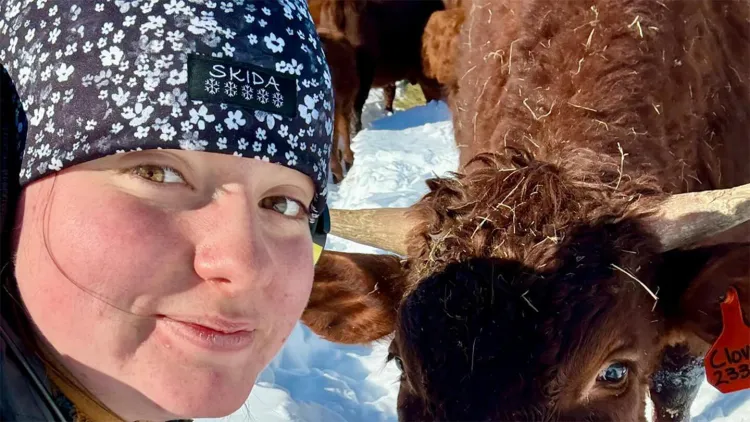
Last spring, Cate MacDonald was working at Bread & Butter Farm in Shelburne, VT when she received an assignment in her audio storytelling class to create a non-narrated piece. “I immediately knew I wanted to do a story about the farm,” she says. MacDonald had interviewed farmer/teacher Bekah Gordon for a previous project, and “she totally transformed my perspective on food systems and what it means to be connected to both a community and a place,” she says.
MacDonald, who graduated last spring with a double-major in geography and global studies, drew her inspiration for the format of “Bread & Butter Farm: A Place to Belong” from a piece she’d heard in class that contained a lot of effective repetition and creative transitions. “Bekah is someone who likes to play and be messy and run around,” she says, “and it think the story really captures her energy in the way it’s told.”
“I’m excited that my story now has a platform to be heard beyond my community,” says MacDonald, who now works as an educator for Shelburne Farms. “Although it’s framed around a small farm in my town, it’s about so much more. It is about the ways any place can be understood, cared for, and interacted with, whether it’s a backyard garden, a park, or a corner store. Everyone has places they feel connected to and can reflect on in a deeper way.”