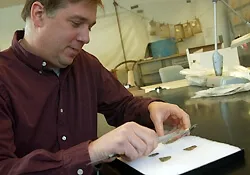
John Crock, assistant research professor in anthropology, describes archaeology as a never-ending puzzle; new pieces are added with every discovery. A significant piece to the Vermont puzzle, and consequently the larger world archaeological edition, was recently uncovered by the UVM Consulting Archaeology Program at Okemo Mountain Resort.
An 11,000-year-old Paleoindian site, originally found in 1999 by CAP while conducting an archeological survey for Okemo for the proposed Jackson-Gore ski area expansion, is the oldest site ever found in the state and offers new insight into the area’s first inhabitants. Dozens of tools and three fluted points — a hallmark of the earliest North American people often used for hunting — were excavated by CAP staff and students and appear to be made from materials from as far away as Pennsylvania.
The site is also unique because the fluted points and other tools were found at a relatively high elevation (1,086 feet) in the Southern Green Mountains of the town of Ludlow (as opposed to the sea level of Chittenden County where most sites are uncovered due to heavier development). Adding to the intrigue of the site was a separate discovery of three colonial era farmhouses.
“These (flutes) are significant in and of themselves, but to find them in place and below the plow line is incredible because it gives us a bigger picture of the time,” says Crock, director of CAP. "There are only a handful of sites even close to this old in Vermont. These are the first ever people to lay eyes on the Green Mountains. You never stop looking for the oldest people; it’s always a focus.”
Working together to preserve history
Work at the original site where the artifacts were found in 1999 was postponed due to a change in design plans by Okemo. It came back into play in the spring of 2007 when the continued development of the Jackson-Gore resort called for the site (23.5 square meters) to be located within a fairway of a golf course. This is the point where the developer has to weigh its options based on the demands of the regulating body (in this case the State of Vermont) and the cost of paying for it. In the case of Jackson-Gore, a portion was excavated and a large part was preserved.
CAP’s position in this scenario lies somewhere in the middle. Not having the funds to pay for most excavations, the program and its eager archaeologists are obviously ecstatic to discover new sites in areas of construction where the cost usually falls to the less ecstatic developer. Crock says Okemo has been committed to helping the state protect, preserve and understand its past. “This is a good example of UVM collaborating with a state agency and a private developer while at the same time conducting important research. Okemo should definitely promote what they have done for the historic preservation of the state.”
Ted Reeves, vice president of development and real estate at Okemo, says owners Tim and Diane Mueller embraced the idea to promote the historical aspect of the resort and plan to include it in some of Okemo’s amenities package literature. He says it can be difficult for developers not to look at state regulations as impediments, but that in this case, the end result was win-win for everyone.
“I’d like to say we were 100 percent altruistic in our goals, but in the end it really made sense to highlight the work and showcase the people who lived here thousands of years ago," says Reeves. “I don’t think it will sell more lift tickets, but it’s a way to educate our guests by saying ‘yeah we’re a resort, but check out what we’ve got going on over here.' There isn’t another resort in New England that does that.”
Building social networks among the Paleoindians
Crock and Jess Robinson, an archaeological field technician working on his doctorate, presented their findings at the 74th annual Eastern States Archaeological federation Conference in Nov. of 2007. They now believe that Jackson-Gore, part of a rare natural east-west corridor, was part of a seasonally traveled triangle of New York’s Hudson Valley to the west; parts of Maine to the east; and Pennsylvania to the south.
The Paleoindians appeared to have traveled this route throughout the year to pick up stone (often the good stuff from Pennsylvania) for tools and other goods and more importantly, to follow big game. “They had to move with the resources,” says Robinson. Crock believes that social networks were built up as the different groups traveled the route and developed relationships over time. Along this route, ancient tool kits have been found that were buried in a way that suggests someone intended to come back for them later in the year.
The absence of some artifacts such as formal endscrapers — a small, rounded flint tool often used to scrape hides by Northeastern Paleoindians where hunting is prevalent — also offers insight into the culture. It’s possible that there some are there but were located outside the excavation zone. For now, CAP’s role is done — at least until another development sprouts up.
“We’d like to do more at Jackson-Gore, but our goal is always to preserve as much as possible,” says Crock. “Archaeology itself is a destructive process. As technology progresses it will be less destructive and more things will be safely uncovered. It’s all for the public good.”
See more photos of the excavation and artifacts on the view's Flickr page.