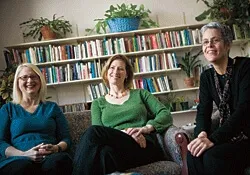
Where previous anthologies have focused on canonical texts — the staples of the college English classroom — and supplemented with works by global writers and women of color, Women's Worlds strives to go beyond that model and truly redraw the landscape of women’s writing. Kete, Schnell and Warhol-Down recently sat down with the view to talk about women’s writing and their new anthology.
the view: How did this project begin?
Warhol-Down: An acquisitions editor at McGraw-Hill (where Warhol-Down had published before) came to me. That was a while ago, in 1999, and she said, "McGraw-Hill wants the women's literature book that will knock the Sandra Gilbert and Susan Gubar Norton anthology (long the standard) out of the market. We want to be the competition — there's no book that is." She knew Lisa, she liked working with Lisa, and she asked me if I could put a team together that could cover the ground of all women's writing. Also, could I come up with a really distinctive approach that would really be different enough from the Norton so we could say, "OK, this is the thing to use instead." So I Went to Mary Lou, because she's the idea person. We brainstormed: "What does the Norton anthology not do that a better book would do?"
Kete: So when Robyn came to me, I said, "But I don't use anthologies." I'll only do it if it could be an anthology that I could actually use. Then what we came up with was what I considered an outrageous —
Warhol-Down: It was radical.
Kete: Very radical.
Warhol-Down: Why was it radical? The book has many, many more women who are writing in English around the world: in Africa, in India, in Sri Lanka, in Australia, in New Zealand, in Scotland. It's much more global. The traditional anthology always places the white British and American woman at the center and has other authors as supplements on the margins, but we wanted it to be a better picture of what the English speaking world actually is.
Schnell: In the fourteenth through seventeenth centuries, women are writing in English in England and a little bit in America. But, by the time you get even to the end of the eighteenth century, that's really branched out with colonialism. This book gives you those global angles and voices. That's what really distinguishes this anthology, I think, especially for faculty teaching nineteenth- and twentieth-century stuff. So I'm really proud of that. I hope it gives the Norton a good run for its money.
Tell me about the approach you used for the anthology, the critical assumptions you were making as you organized the book.
Kete: We wanted to focus on cultural studies (the critical theory that examines its subject in light of the political, economic, and cultural conditions in which it was created). These are all women writing under material conditions. This is the controversial thing with the press, although they loved it, too. Throughout (the anthology) we have these sections called "Cultural Coordinates" where we often consider very material factors that women during a particular time might be dealing with. Like their underwear. (The group laughs.) No, seriously. Robyn has a great question that she asks: "Why do heroines faint?"
Warhol-Down: Yeah, that's the name of it. Why do heroines faint all the time, like in Charlotte Temple?
Kete: And it's on corsets. Because they can't breathe!
Warhol-Down: Because we, ourselves, work in cultural studies perspectives on our research; this is what we've always brought to our classroom when we're teaching women's literature. I always talk about clothes, for example. So, the idea with this anthology is let's include the insights of cultural studies that many faculty are bringing into their classrooms. Let’s give them some material to work with on that.
In a project of this size, how do you begin to decide what to include?
Schnell: You have to walk this balance between using enough of what's already widely anthologized. And it's not just the Norton. For me (Schnell's section focused on the fourteenth through seventeenth centuries), it's what's been anthologized in the early modern anthologies. So what are people used to teaching? And where can you start moving some extra stuff in? Where are your openings? One of the things we definitely wanted to do was expand that fourteenth through seventeenth centuries section. So I had a lot more pages than, say, the Norton had.
Warhol-Down: We have literary and cultural criticism as well, so it's not just poetry, fiction, and drama. And we also have some other weird things in there. The favorite thing that I included was The Book of Household Management by Isabella Beeton from the middle of the nineteenth century. I've got recipes in there and advice on how to handle servants. I mean, it's an amazing thing. And we have a lot of song lyrics. Diane (Price Herndl, a co-editor from Iowa State University) did a section of blues lyrics, and I did one on nineteenth-century hymns that were written by women. So we were very interested both in broadening the definition of what women means and in broadening what writing means. And we have a piece of Alison Bechdel's Fun Home in there. As far as I know, we're the only literature anthology that has a piece of graphic narrative in it so far.
What about excerpting? How do you decide which parts of longer works to include?
Schnell: I excerpted diaries. I really wanted to get a lot of women's life voices in, especially because we had this cultural bias in the anthology. That's how you sort of climb in and find out about women's lives. You know, when we read Ann Clifford's diary from 1616 in my class every year, my students always talk about how formal it is. It's a diary, but she's really formal. She's not letting it all hang out. A lot of these women are aristocrats. So there's this whole decorum; you're not getting quite under the surface. But every once in a while, one of them will just break out. Especially these young girls who are sixteen, and their dad won't let them marry the guy they want to marry. And there's incredible drama. He's coming to the door in the middle of the night to see her, but the servant thinks he's an intruder and nearly kills him. Then he's lying on the ground bleeding, and she's screaming. I really wanted to get that stuff in. I would just try to choose the bits that I thought got the deepest into their lives. That was one of my major foci of the whole section: I really wanted to get their real voices in there. Who were they? What kind of lives were they living?
How else does the anthology differ from others on the market?
Warhol-Down: It transforms the category of American women writing, too. Because, again, the traditional anthology has women of color writers as supplements to the core. But, we have many more women of color from the United States in our anthology because you come to understand writing in English in a different way when, instead of thinking, "Here's what everybody always wants to read, and here's some other things they should read," you think, "Well, what's there?" and then, "Let's really recognize that."
Kete: Which will allow people to use it in a way that most of us look at using it, too — we might look at genre. We don't organize it by genre, ours is organized chronologically. But you're able to see that there are African American women writing memoirs; there are Australian women writing memoirs, you know, British emigrants to Australia writing memoirs; there are Native America women writing memoirs.