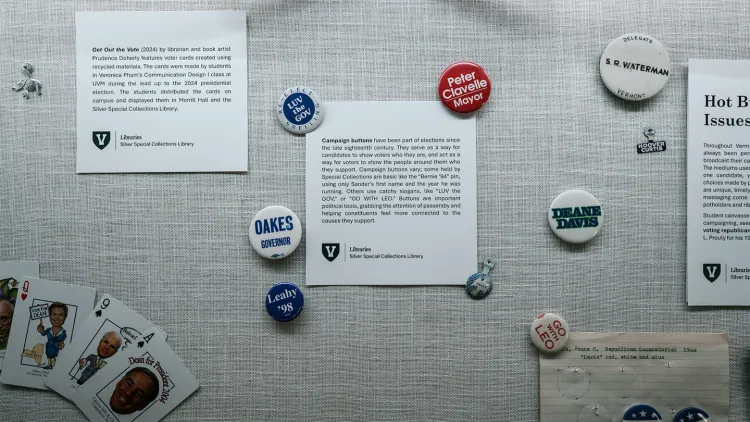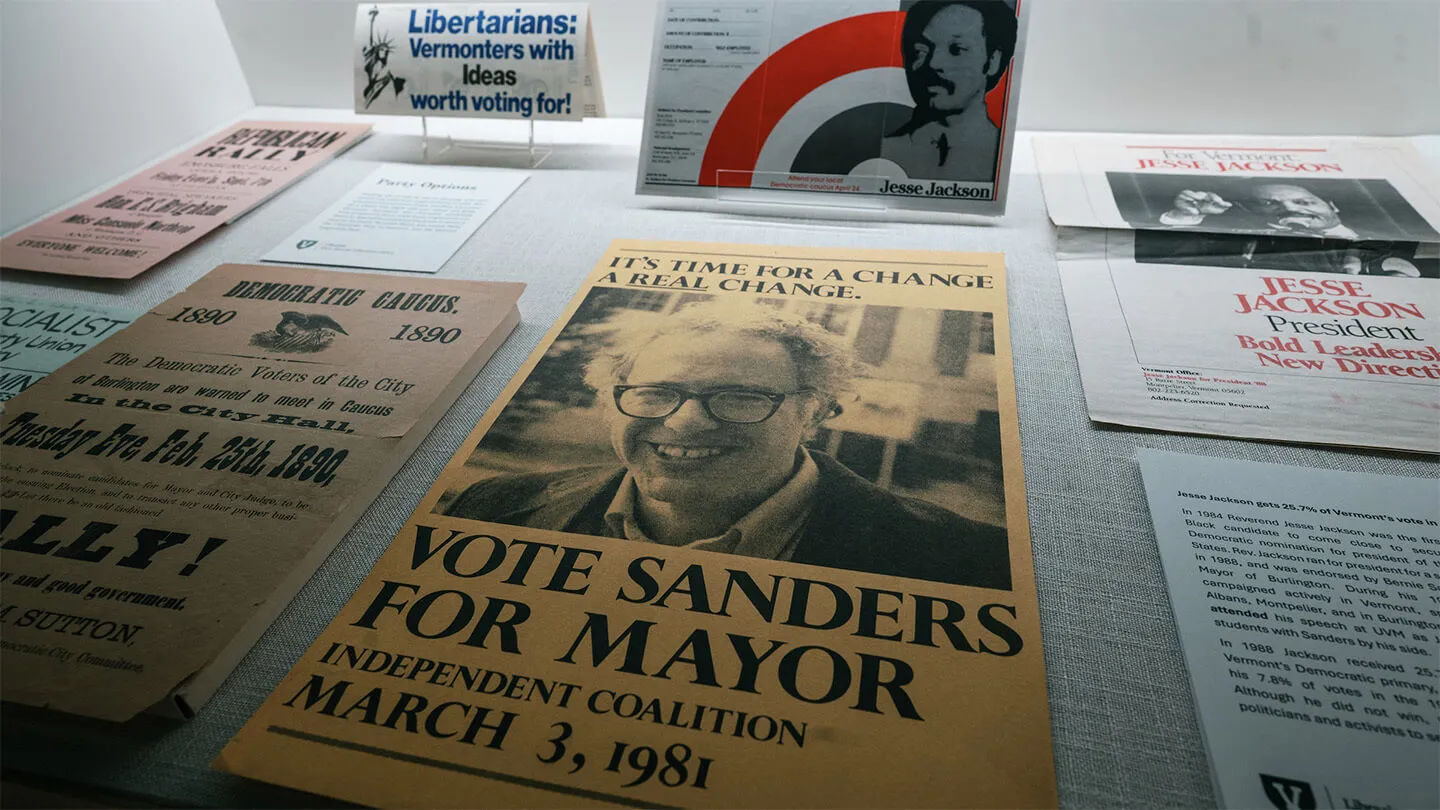
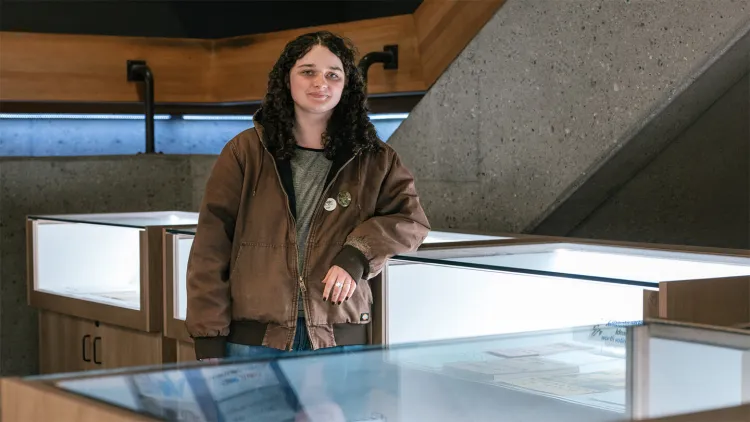
The 2026 elections may be over, but if your interest in the long and storied history of voting in the Green Mountain State remains, you’ll want to make a rewarding detour to the University of Vermont (UVM)’s Howe Library for the exhibit, “Vermont Votes: Buttons, Ballots, and Booklets,” on display through November 15, 2026. Curated by Sid Gullikson ’28, a studio art major and history minor who is currently interning in the Silver Special Collections Library, the exhibit features campaign literature, voter guides, and other ephemera from more than a century of voting in Vermont.
“I like to think about how design, visual art, and history combine,” says Gullikson, who will begin the UVM Historic Preservation Accelerated Master’s Program next year. “I think of myself as a political person who’s pretty well informed, but I still learned a lot doing this project.”
So, what goes into transforming a massive archive of historical materials into a compelling, cohesive exhibit? We asked Gullikson to take us behind the scenes.
What first drew you to the idea for this exhibit?
Special Collections had already planned to do a voting-related exhibit, so I took that general idea and decided what to focus on. I knew the exhibit would be in Howe Library and that hundreds or even thousands of students and community members walk through there every day. So, I wanted to create something that would lend itself to that environment. I thought a lot about first-year students, especially those from out-of-state, and how they might not be familiar with Vermont history or Vermont politics. I also wanted something that would be accessible to people who’ve been in the area for a while but would appreciate a deeper understanding of those topics. It was important to me to find the best way to create something that could be for everyone, no matter what their level of knowledge.
How did you decide which pieces from the Silver Special Collections Library to include?
I had never curated an exhibit before, so there was definitely a learning curve, especially since Special Collections is so expansive. There was so much stuff to go through that it felt kind of overwhelming, and there were a lot of hard decisions. There were some things that obviously needed to be included, like [historian and former state representative] Lillian Baker Carlisle’s potholder, which she used during her campaign to draw people in. Then there were other things, particularly related to women voters and women politicians, that contributed to the story I wanted to tell. Having that story to build around was important because it helped guide what I was pulling and connect a lot of different pieces.
Was making those choices your biggest challenge in curating the exhibit?
Yes, it was. Also, piecing things together was hard because some things make sense together and some things just don't. There were certain things I wanted to include that, at the end of the day, just didn’t fit or seem like they would draw people in.
What item in the exhibit do you find most intriguing?
It's hard to choose, but the buttons—the kind you pin on—were really fun. As people, we love to decorate ourselves in a way that signals what we believe in and what we support. But my favorites were the items where you don't exactly know what to make of them at first. One of the best examples is a deck of cards produced by Howard Dean, who had a presidential run. The cards are satirical caricatures of pop culture people and politicians. When I first looked at the deck, I thought, why these people? What about them was so important at the time that they had to be included? It drew me in and made me wonder, why does this exist? And I think that's such a great jumping off point for research, to question something and ask, why?
What do you think visitors, especially students voting in their first election, can learn from seeing how political campaigns and voter outreach in Vermont have evolved over time?
Vermont 100 years ago looked quite different from what we see—and how the state is seen—today. In some ways, the issues Vermonters are interested in have really changed, and in other ways, they’ve stayed the same. I think a lot of people come to UVM without a super expansive understanding of Vermont's political history. And Vermont is really such an anomaly in politics. For example, we've had a third-party senator for almost 20 years, and that's uncommon. We’re a state that primarily votes blue, but we’ve had a Republican governor for nearly a decade. It's a pretty unique place, and I want visitors to see a diverse representation of Vermont's political history.
I’m also hoping students will look at the exhibit and think, this place I live and like has a really interesting history, and I want to be a part of that. I want them to take an interest in that kind of personal way where they see these political decisions throughout the century and think, wow, I can be involved in that.