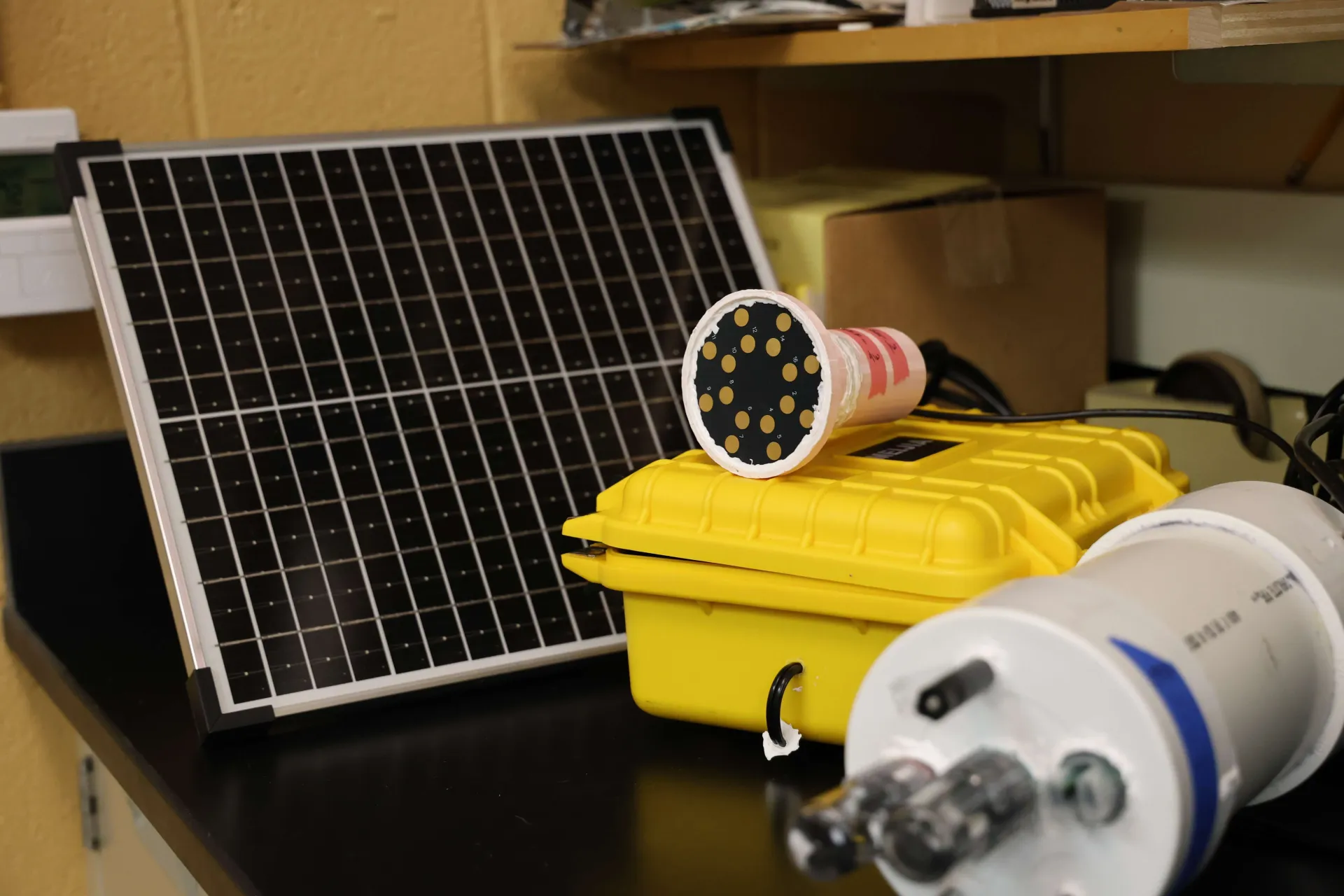
Across states and water bodies, Dr. Tian Xia is advancing the next generation of water sensing technology. A professor at the University of Vermont's Department of Electrical and Biomedical Engineering, Xia specializes in wireless sensor research and development, creating tools that allow researchers to monitor changing water conditions in real time.
Xia’s work is guided by one central question: how can we make monitoring more efficient? Traditional approaches often require researchers to travel to different locations, collect water samples, and bring them back to the laboratory for analysis. This process can take considerable time and manpower, limiting how often researchers can collect data and how many locations they can monitor. Xia and his team are transforming these methods by developing wireless sensors that collect measurements remotely and transmit data in real time.
"Our sensors allow for real-time monitoring, and paired with a drone, they can reach different locations and improve efficiency," Xia explains.
Sensing from the sky
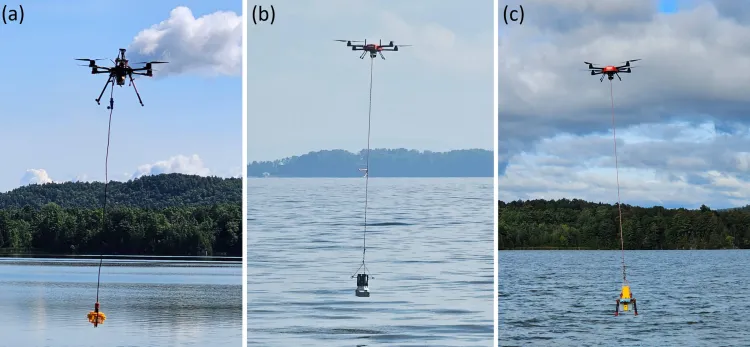
One of Xia’s developments includes two drone-based systems designed to monitor harmful algal blooms (System 1; System 2). These drones carry sensors that can be deployed into the water to measure conditions, such as conductivity, turbidity, pH, and temperature. A built-in camera also captures water surface conditions, helping researchers identify algae growth and monitor its distribution.
The drone can travel to multiple locations and collect multiple samples in a single flight. Once transported back to the lab, the samples can be analyzed for a wider range of water-quality parameters. This approach makes it easier to access locations that are difficult to reach and reduces the need for researchers to enter potentially contaminated water to retrieve samples.
"We wanted to understand what drives the algae, including nutrients, runoff, and fertilizers," explains Soheyl Faghir Hagh, a fourth-year Ph.D. student in UVM's Department of Electrical Engineering and a member of Xia's lab. "With this technology, we can collect water samples from a lake, send them to the lab, and analyze around 20 different parameters, like nitrates, nitrides, calcium, and heavy metals, while simultaneously sensing lake parameters in real-time."
Hagh focuses on wireless sensing and communication, developing the technology that allows deployed sensors to transmit information over long distances. This work helps researchers understand how nutrients, runoff, and other environmental conditions influence algal blooms by generating maps from the water body.
The team has tested the drone-based technology in Vermont and deployed it in Lake Erie in collaboration with the Cleveland Water Alliance. Xia’s lab also works with Oregon State University researchers who use machine learning and computer vision to identify algal hotspots. This system complements their visualizations to target where water samples should be collected to develop fully autonomous systems where the drone decides where and how to collect samples or sense any parameters.
Making monitoring more affordable
Beyond algae detection, Xia is developing sensors to support research across UVM, including the work of Dr. Raju Badireddy and his ALCHEMIST Lab. The lab needed low-cost sensors to track both the physical and chemical components of waterways. However, commercial monitoring systems can cost upwards of $20,000, making it difficult to purchase enough equipment to establish a distributed network of sensors across multiple locations.
"It's not easy to afford these systems in academia," explains Parmida Amngostar, a fifth-year Ph.D. student in Electrical Engineering. "We figured we could address this challenge and develop them ourselves."
Amngostar’s background is in circuit design, electronics, and developing printed circuit boards. This expertise was key in designing the hardware behind several of the lab’s water monitoring technologies.
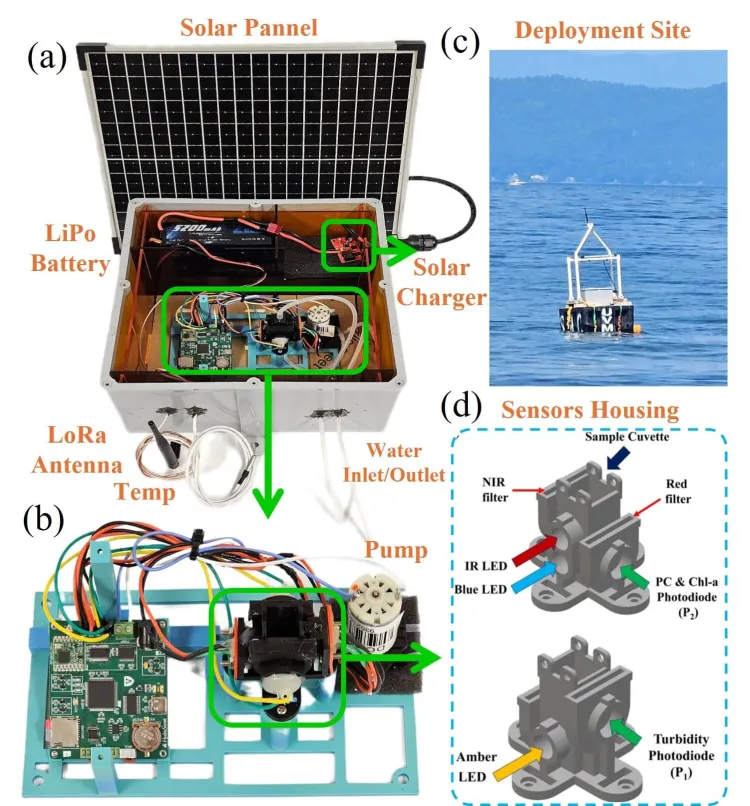
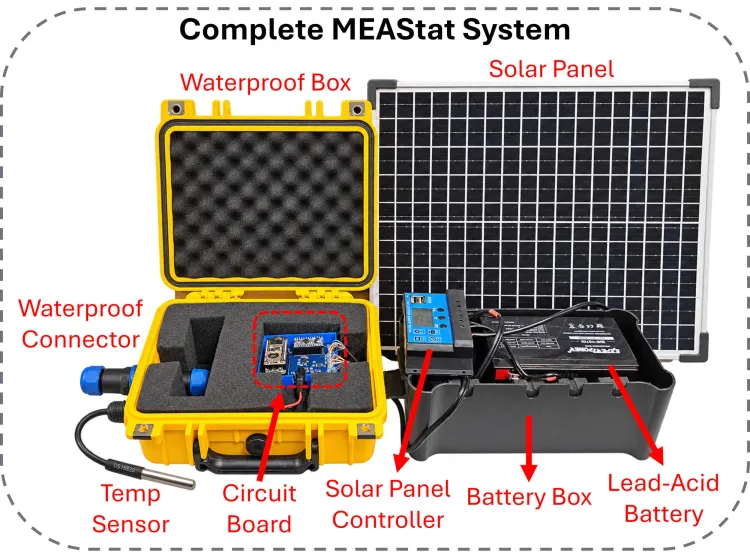
Working with Xia, the team designed a low-cost circuit and multiple wireless potentiostats, known as LoRaStat. These devices are integrated with a submersible sensor platform containing various physical water-quality sensors that measure parameters such as temperature, pH, and conductivity. The system is solar-powered, allowing for long-term deployment and continuous environmental monitoring. At approximately $200 a sensor, they offer a more affordable alternative to commercial systems.
While Xia’s team develops the sensor hardware, the ALCHEMIST team creates chemical sensing materials that selectively bind to specific contaminants. The researchers are working toward deployments in Vermont's Hungerford Brook and Potash Brook to monitor nutrients including phosphate, nitrate, and ammonium.
Expanding collaborations
Xia's work extends beyond UVM. Just down the road, Professor Clayton Williams at St. Michael’s College has deployed three of Xia’s sensors at Burlington's Leddy Park. In partnership with the University of Maine, Xia and his team have also deployed probes in a Maine river to measure conductivity, temperature, and depth. Meanwhile, collaborations with Oregon State University and the Cleveland Water Alliance are advancing the drone-based monitoring approach.
Looking ahead, Xia plans to work with Badireddy and UVM Professor Dryver Huston to explore lower-cost approaches to PFAS monitoring.
For Amngostar and Hagh, these projects have offered an opportunity to apply their electrical and electronics engineering backgrounds to a diverse range of autonomous environmental monitoring and remote sensing projects. They are helping develop precision instruments that make water-quality monitoring more accessible and efficient.
"The goal of our work is to combine circuit technologies with water quality monitoring to make it easier, faster, and more affordable for people, while also protecting our water and creating a safer environment,” says Amngostar.
As Xia and his team continue to develop these technologies and build new partnerships, their work is advancing new water monitoring techniques and creating a more efficient workflow for researchers.