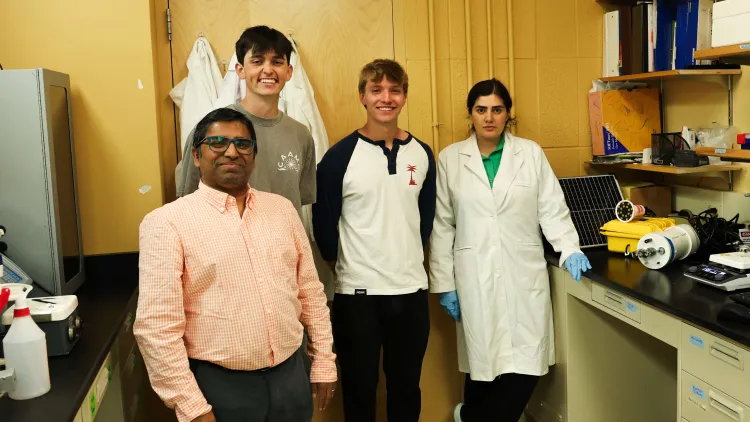
At first glance, the work happening inside Dr. Badireddy’s lab can seem like modern-day magic.
“The lab is named ALCHEMIST,” explains the Associate Professor in the Department of Civil and Environmental Engineering at the University of Vermont. “We transform things.”
The name is fitting. While his students may not be literally turning ions into gold, that’s certainly what it feels like. ALCHEMIST, the Advanced Laboratory for Contaminant and Hydro-Environmental Management using Innovative Sustainable Technologies, focuses on advancing the health of water resources and ecosystems by bridging scientific innovation, sustainable stewardship, and community resilience.
Through interdisciplinary research that spans engineering, environmental science, medicine, business, and data science, the lab is tackling some of society's most pressing water and environmental challenges.
Turning Wastewater into Resources
One of the lab's primary areas of research is resource recovery, which extracts valuable materials from wastewater that would otherwise be discarded.
Working with Essex municipal wastewater treatment facilities, the team
has developed a technology called “Pe-Phlo” that extracts elements from wastewater. The process extracts phosphorus and ammonium in the form of struvite, a mineral composed of magnesium, ammonium, and phosphate. Once recovered, the material can be used as a fertilizer on agricultural fields.
While struvite recovery is not a new concept, it is typically a commercial process. The ALCHEMIST team has focused on making the technology scalable and affordable, allowing rural communities and small water treatment facilities to properly recover phosphorus.
Their work is already having an impact across the state. The Essex Junction Water Resource Recovery Facility is now able to recover struvite using the technology, with the South Burlington Wastewater Treatment Plant expected to follow.
UVM graduate student, Kehinde Ojasanya, is optimizing the system to improve its performance.
"Wastewater is often viewed as a disposal problem, but I see it as an untapped resource stream,” explains Ojasanya. “The future of water treatment lies not just in removing contaminants, but in recovering valuable resources that can support a more sustainable and circular economy. What excites me most about my research is the opportunity to rethink wastewater entirely."
A Saline Solution
The lab is also applying its expertise to a very different challenge: the scarcity of medical-grade fluids in rural healthcare systems.
Through a collaboration with the UVM Health Network and researchers across UVM's College of Engineering and Mathematical Sciences, Larner College of Medicine, and Grossman School of Business, the team is developing a medical-grade saline generator that can recycle wastewater directly within hospitals.
The project, known as RECLAIM (Real-Time Medical-Grade Fluid Recycling System to Support Rural Vermont Hospitals), aims to convert medical wastewater into high-quality saline and irrigation fluids. By reclaiming and sterilizing local water, these fluids can be repurposed for surgeries and emergency medical care.
Sterile saline is consumed in large volumes and is essential for various procedures, yet the U.S. surgical-saline supply chain is centralized and fragile. RECLAIM bypasses this supply chain through on-site generation and regeneration, enabling a resilient and sustainable path forward.
Developed in partnership with the Vermont Manufacturing Extension Center and supported by a $250,000 grant from the Leahy Institute for Rural Partnerships, the technology could provide a reliable source of critical medical fluids, particularly during supply-chain disruptions and natural disasters.
Fighting Biofilms with Nanoscale Technology
The lab’s research even extends beyond Earth’s reaches.
In space stations, microbial biofilms can colonize water systems and equipment, creating operational challenges. Traditional disinfectants, such as iodine and chlorine, have limitations and transporting supplies to space is costly.
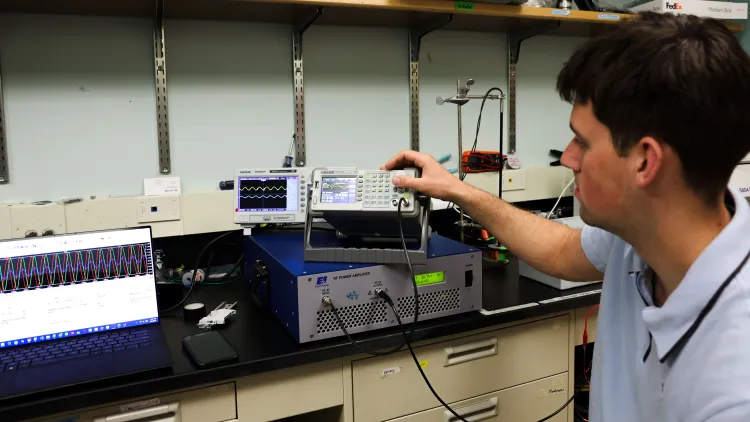
To address this problem, ALCHEMIST researchers are developing non-chemical disinfection methods that use nanoparticles and magnetic fields to remove or mitigate biofilms.
Environmental engineering graduate student, Cooper Petrie, helped develop a technology that exposes bacteria to magnetic nanoparticles. When activated, the particles are heated to an extreme temperature, disrupting the biofilm structure and reducing their viscosity.
This technology may have applications far beyond space. Petrie notes, “it is designed to be easily implemented anywhere where drinking water needs to be disinfected, like rural communities and disaster relief sites.”
The heated nanoparticles could capture and degrade contaminants such as PFAS, pesticides, and other pollutants in water systems.
The Power of Tiny Bubbles
The team is working on another project funded by UVM's Casella Center for Circular Economy and Sustainability, with a focus on removing PFAS, or "forever chemicals,” from landfills.
Wastewater treatment plants need to decrease the concentration of PFAS in the leachate, the wastewater generated from landfills, to properly handle and treat it. According to Sajjad Eftekhari, a second-year PhD candidate working on the project, separating PFAS from leachate is one of the biggest challenges for landfill managers and wastewater treatment plants.
The team produces high concentrations of nanoscale bubbles that can capture a minimum of 70% of ultra-short chain PFAS and close to 100% medium to long-chain PFAS from the leachate. This reduces contaminant concentrations before the wastewater reaches municipal treatment systems.
“The produced foam, as a high concentrated (100 to1000 times) low volume stream of PFAS, is undergoing a novel destruction process for mineralization as the next step of this research,” explains Eftekhari.
The approach is a step-up from current methods, which are only capturing 15% of ultra-short chain PFAS, offering a promising pathway for communities seeking contaminant treatment options.
Interdisciplinary Sensor Development
Beyond treatment technologies, the ALCHEMIST Lab is helping build the next generation of water-quality monitoring systems through AQUACLIME, a National Science Foundation EPSCoR-funded initiative.
The project brings together researchers from multiple universities and disciplines to develop sensor networks capable of detecting various contaminants in real time. The sensors can monitor and transmit various concentrations in the water, such as nitrogen, ammonium, nitrate, phosphate, arsenic, lead, mercury, uranium, microplastics, and PFAS.
Researchers in UVM's Electrical Engineering Department, led by Dr. Tian Xia, develop the sensor hardware, while the ALCHEMIST team creates the chemical sensing materials that selectively bind to specific contaminants. The team has already deployed robust sensors in Vermont's Hungerford Brook and Potash Brook for phosphate, nitrate, and ammonium.
Now, they are developing a second generation of sensor boxes and chemical formulations capable of wirelessly transmitting data through cellular networks.
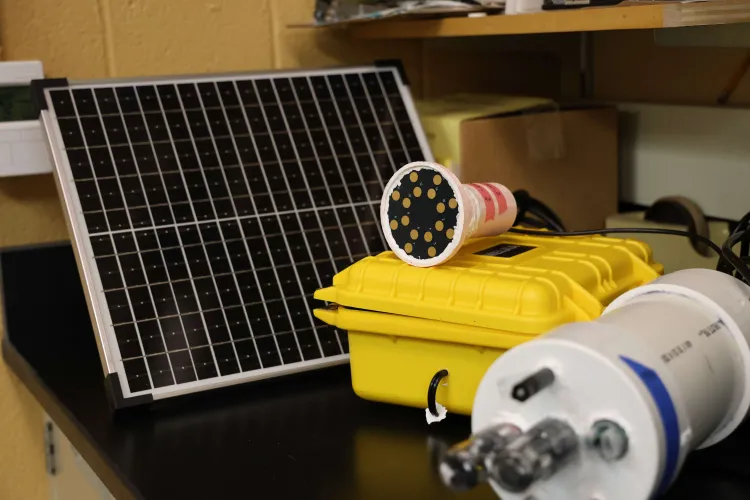
"One of the key challenges in water monitoring is the ability to simultaneously monitor both physical water-quality parameters and chemical analyte concentrations in real time," explains Parmida Amngostar, the primary research assistant working on the project. "To address this challenge, we developed multiple wireless potentiostats, known as LoRaStat, and integrated them with a submersible sensor platform containing various physical water-quality sensors. This system enables simultaneous measurement of chemical analyte concentrations and physical water-quality parameters. It also incorporates LoRaWAN wireless communication for remote, real-time data transmission and monitoring, including in locations where cellular connectivity may be limited. The system is solar-powered, allowing for long-term deployment and continuous environmental monitoring."
Collaborators from Norwich University are involved in the workforce development of the project, while researchers at the South Dakota School of Mines and Technology are developing artificial intelligence tools and anti-fouling coatings, or nano-guard, that prevents bacteria growth from interfering with sensor performance. New Mexico State University partners contribute climate resilience modeling expertise.
The project also includes partnerships with Vermont farmers and Native American tribes to ensure that the monitoring technologies are responsive to community needs.
This converging research is uncovering the impacts of climate change on water quality, as well as informing the transport and fate of different contaminants.
“Ideally, we want some kind of early warning system,” says Dr. Badireddy. “When something enters the water systems, a spike happens, and we immediately receive a warning about it. Then we can take intervention actions to address that issue.”
From recovering fertilizer and producing medical-grade saline to removing PFAS and building sensor networks, the researchers in ALCHEMIST are finding new ways to transform challenges into solutions, one unique idea at a time.