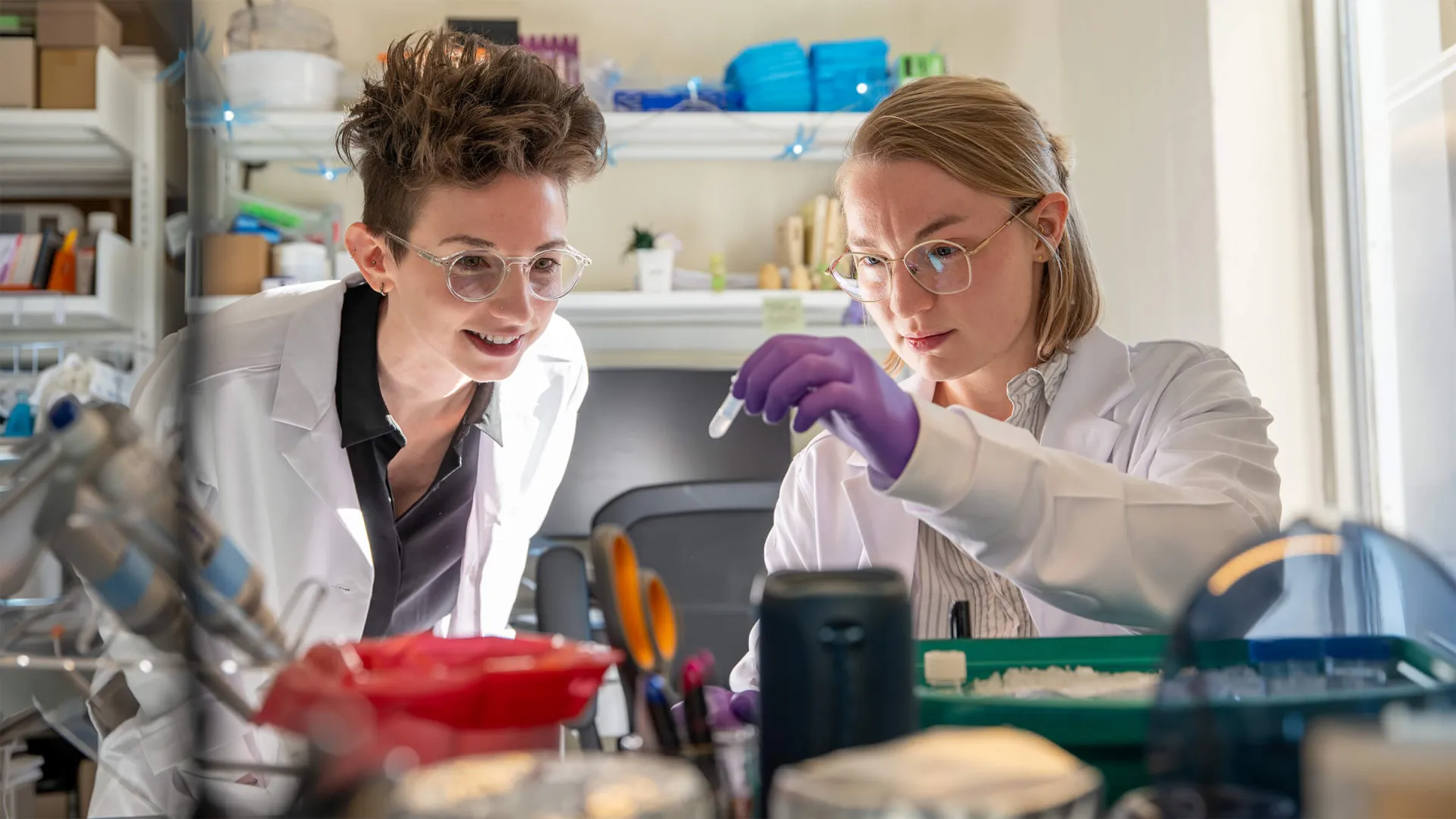
Tucked away in a corner of venerable Votey Hall, biomedical engineering Professor Kaitlin McCreery’s Multiscale Bioengineering Lab opens to a modern, sunlit space full of possibility and promise.
Like the biomedical engineering department itself, McCreery’s lab functions as an interdisciplinary hub, bringing together student and faculty researchers from across campus. To best leverage this confluence of expertise, the lab integrates advanced technologies and research approaches.
The lab combines quantitative approaches from engineering, physics, and molecular biology to investigate how cells sense, respond to, and remember changes in their physical environment. Its mission is “to do good science, to investigate important mechanisms in disease and regeneration, and to design solutions that will help people.”
To meet this ambition, McCreery and her team aim to better understand tissue assembly and regeneration by focusing on how physical forces and the mechanical properties of cells and tissues shape biological functions, development, and disease.
While classical cellular research has focused primarily on biochemical and genetic mechanisms, mechanobiology adds a physical dimension to study how forces and mechanical properties influence living cells, tissues, and organisms.
“We want to understand how physical forces influence cell behavior and identity, and why some of those changes persist even after the original stimulus is gone. Understanding these processes could help explain why some tissues regenerate after injury while others develop lasting fibrosis,” McCreery said.
An Ideal Background
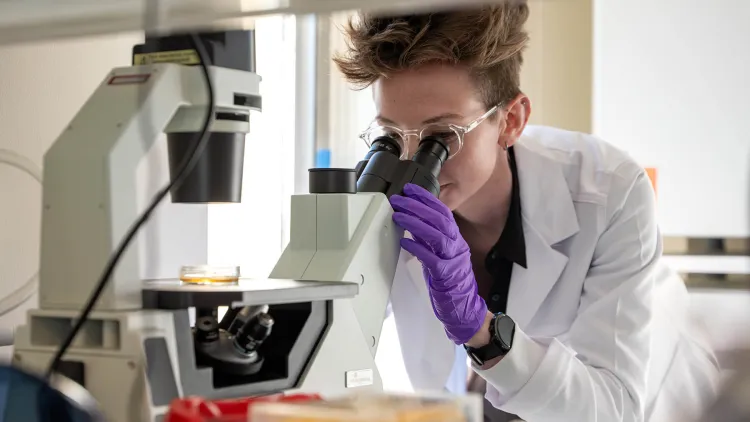
McCreery’s multidisciplinary lab naturally reflects her uniquely multidisciplinary background. After earning a degree in Physics from Duke University, McCreery received her master’s in mechanical engineering followed by a PhD in Biomedical Engineering from the University of Colorado Boulder.
She completed her postdoctoral training in stem cell biology at the Max Planck Institute for Molecular Biomedicine in Germany before joining UVM’s Biomedical Engineering program in January of last year.
While relatively new to campus, McCreery is off to an impressive start. This past month, the Allen Institute named McCreery as one of eight Next Generation Leaders for 2026. In this prestigious and competitive appointment, McCreery and her cohort were selected from an international field and will each serve a three-year term, with ongoing opportunities to engage with research in brain science, cell science, immunology, synthetic biology, and AI biodesign.
“Our Next Generation Leaders are a vital part of the Allen Institute community. Their extraordinary creativity and scientific excellence inspire our programs and help shape current and future research directions,” said Julie Harris, the Allen Institute’s vice president for science initiatives in a recent press release.
Integral to the institute’s mission is a focus on "team science"—bringing together multidisciplinary groups of researchers to tackle challenging biological questions. A defining feature of their approach is a commitment to open science, releasing all data, software tools, models, and references it creates freely to the global scientific community.
“The biomedical engineering program at UVM has grown significantly over the past several years with close connections to the Larner College of Medicine. It’s the caliber of faculty researchers such as Professor McCreery that are helping to advance our interdisciplinary research capabilities through collaborative models like the one embraced in the Multiscale Bioengineering Lab. We couldn’t be more proud of Dr. McCreery being named a Next Generation Leader by the Allen Institute – it is well deserved!”
– Dr. Marilyn Cipolla, Professor and Chair
Department of Electrical & Biomedical Engineering
Unique Perspectives
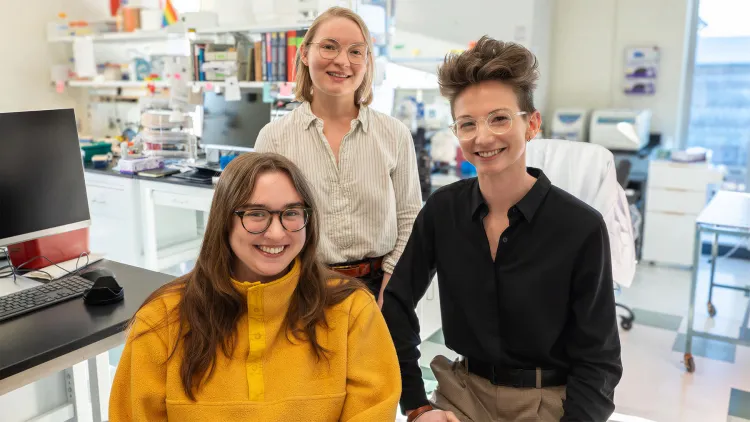
In keeping with all things interdisciplinary, McCreery has assembled a student team whose individual research interests and backgrounds intersect with the lab’s methodology and unique capabilities.
Libby Murphy, a PhD student in UVM’s Cellular, Molecular and Biomedical Sciences (CMB) Program, found an ideal space in McCreery’s Lab to pursue her research in Fibrosis and cell-matrix mechanisms. Commonly associated with respiratory diseases, fibrosis is the formation of excess scar tissue in response to injury, chronic inflammation, or disease, and it can occur in almost any organ system.
For Murphy, whose interests centered on a less-explored aspect of fibrosis—specifically, how fibrotic tissue affects the behavior of the cells sitting on it—the Multiscale Bioengineering Lab offers both the equipment and expertise to support her research.
“What was really exciting to me about this lab is that we're looking at fibrosis through an angle that I've never really seen anybody else do before; that was a big motivator for me to join this brand-new lab,” said Murphy. “I said to Professor McCreery, you can't get rid of me. I don't care. I will get anything up and running in exchange for the opportunity to pursue these questions.”
At a workbench across from Murphy’s, PhD student Audrey Clay-Streib, also in UVM’s CMB program, explores her research interests in the emergent behaviors of cell collectives. “The thing that really fascinated me and led me here to this lab is this idea that cells don't exist in isolation. They're part of the grand organization and structure and there's a level of coordination on different scales. I realized the importance of studying cell behavior with the perspective of understanding it in its broader context,” said Clay-Streib.
Also working in McCreery’s lab is biomedical engineering PhD student Chaoran Yang, whose transition into biomedical research from a physics background mirrors McCreery's academic journey. Yang investigates how collagen, a major structural component of tissues, assembles into complex networks with distinct physical properties.
The mechanical properties of the extracellular environment can profoundly influence how cells behave. McCreery's team is investigating how cells respond to these physical signals and how such responses can become persistent, potentially influencing whether tissues regenerate or develop fibrosis. “While it probably sounds like research in three completely disparate areas, I think that what really unites us is the actual physical mechanics of the cell environment. I think that's the unifying factor,” said Murphy.
Outfitted for Cutting-edge Research
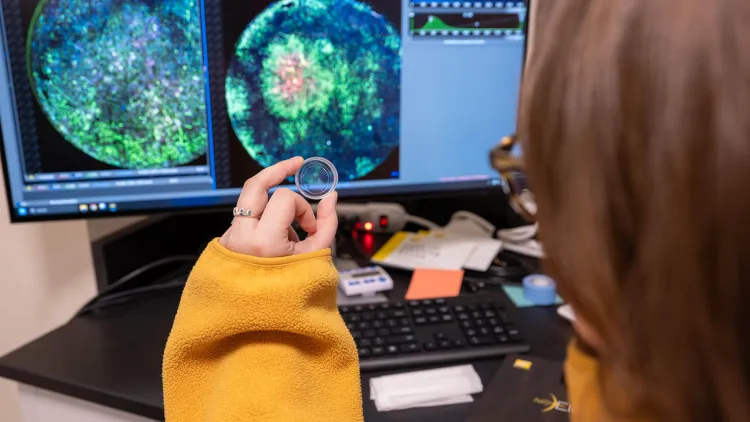
In pursuit of their research, McCreery and her team will share several tools whose advanced capabilities would have bordered on science fiction not too many years ago.
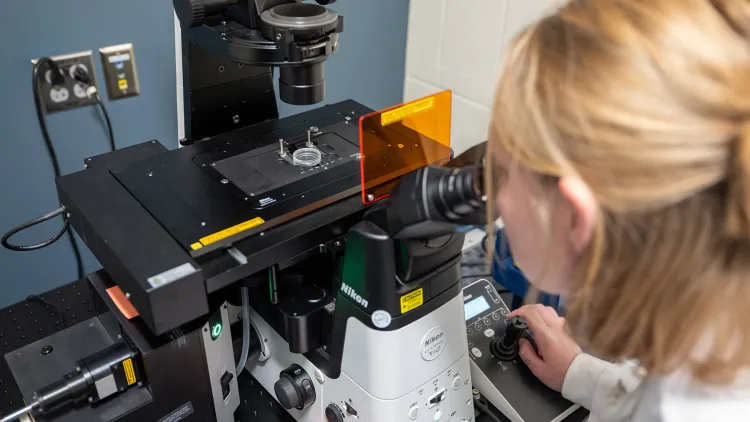
The lab's advanced imaging and mechanical characterization instruments allow researchers to visualize dynamic cellular processes and measure the physical properties of cells and their surrounding environments. . One is an ultra-fast spinning disc microscope that can record fluorescence images of dynamic cell processes with low phototoxicity, so researchers can study short-term cellular mechanisms that steer cell behavior.
Another is an atomic force microscope, which uses an extraordinarily sensitive mechanical probe to map surface topography and measure local mechanical properties of cells and their surrounding environments. By applying precisely controlled forces and measuring how materials respond, researchers can investigate physical properties at microscopic scales that would otherwise be difficult to quantify.
As a result, atomic force microscopy is an essential tool for McCreery and her team in their research involving mechanotransduction—how cells sense and convert mechanical stimuli into biochemical signals—because it can simultaneously apply precise forces and measure cellular mechanical responses in real time.
“We get so much information about our world from physical touch, and now we can do that at the cellular and atomic level. And I think that's a whole new level of almost sensory information that we can get excited about,” said Clay-Streib.
Looking Ahead
Despite having only recently emerged as one of UVM’s newest research labs, the Multiscale Bioengineering Lab is already collaborating on a diverse range of research projects with partners across campus.
The team is working with the Vermont Center for Cardiovascular and Brain Health (VCCBH) at the Larner College of Medicine on research to better understand how heart attacks can cause lasting changes in cells that lead to fibrosis. An established project at the UVM Cancer Center is researching cancer-host interactions to explore how cancer cells survive physical stress. Within the College of Engineering and Mathematical Sciences, the lab is contributing to a NASA-funded project with the Vermont Space Grant Consortium, studying how heart tissues respond to microgravity.
Across these projects, McCreery and her team are working toward a common goal: understanding how the physical environment shapes cellular identity, and how that knowledge might eventually help researchers develop new approaches to prevent disease and promote tissue regeneration.