What does sustainability actually mean to a farmer? The term has long guided conversations about agriculture and food systems and various models have helped define goals and limits, but what happens when those frameworks collide with the realities of farming?
A new paper “The Sustainability Paradox: Experiences of farmers in Vermont” published in The Journal of Agriculture, Food Systems, and Community Development by UVM researchers explores the realities of what sustainability really means to farmers.
Based on in-depth conversations with Vermont farms, the research reveals a stark disconnect: while sustainability remains a deeply held value, many farmers say they are not experiencing it in practice. Instead, they describe a growing sense of precarity, driven not by individual choices, but by broader economic, social, environmental and policy pressures.
The transdisciplinary team - Josiah Taylor, Shiva Soroushnia, Claire Whitehouse, PI David Conner, Lisa Chase, and Vermont farmers Mari Omland and Jon Cohen – are part of the Food Systems Research Institute's Sustainability Metrics project, a multi-year transdisciplinary collaborative initiative to assess how to measure sustainable food systems in the Northeast. Soroushnia, and Taylor are also affiliated with the Gund Institute for the Environment.
In this Q&A, Taylor reflects on what the team calls the “sustainability paradox,” the limits of measuring sustainability at the farm level, and what farmers are telling researchers that the public rarely hears. The conversation raises questions about responsibility, well-being, and how food systems research and policy must evolve in a rapidly changing world.
---
QUESTION: Your project, as part of the Sustainability Metrics Project, aims to design metrics to measure what sustainability means in agriculture. How do you go about doing that?
TAYLOR: We set out to measure sustainability by working with individual small farmers, specifically consumer facing farms, which means that they have direct connections to their consumers through farmers markets, farm stands, agritourism, farm stays, education, things like that. The idea was that we would basically provide them with a scorecard at the end of the research rating their sustainability as an individual farm, and part of the idea behind that was that it would help the farm assess what their strengths are, and then also maybe what things they could change to be more resilient or sustainable.
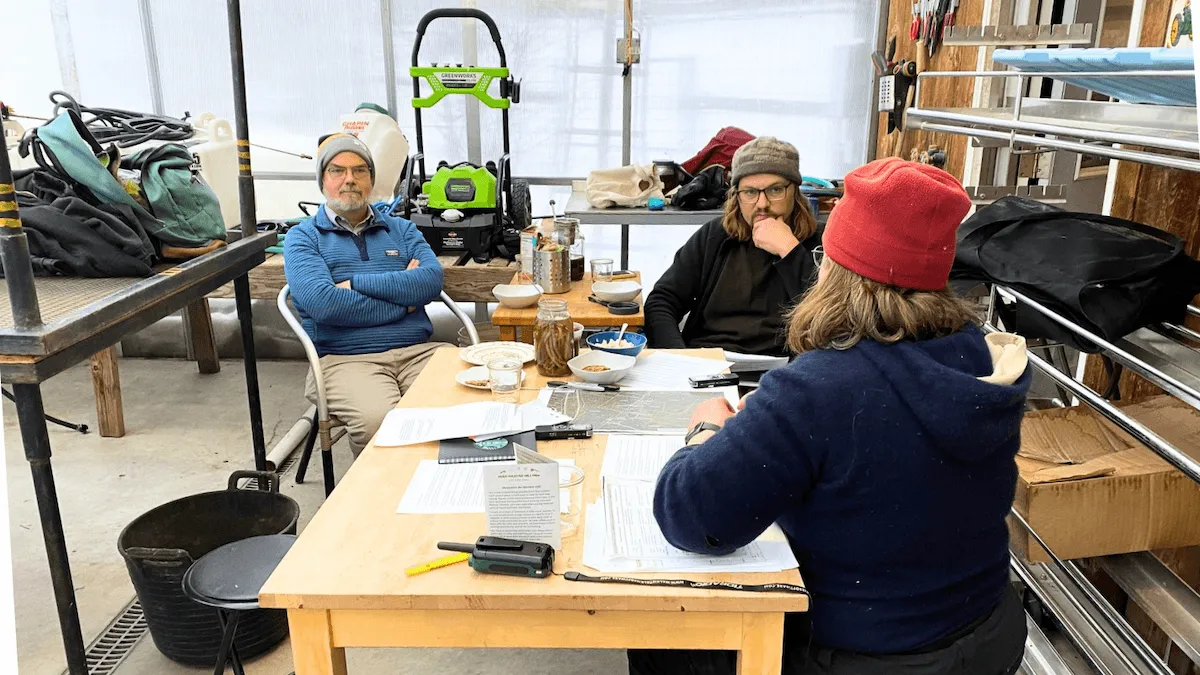
We talked to the farmers through the in-depth interviews asking how they view sustainability, and what their experience of sustainability is in three categories: social, ecological, and economic. But the farmers questioned our very concept of sustainability and said that they were experiencing more precarity than sustainability. They told us they weren't really experiencing sustainability across all those dimensions; at best they were experiencing sustainability in maybe one category.
We said, “This is crazy. How does it make sense that we're trying to rate their sustainability when they're not experiencing it?” And furthermore, we realized that it was problematic to rate sustainability of an individual farm when they're generally doing the best they can, and their lack of sustainability isn't due to their own farming methods or their business management. It's due to factors that are external to their farm and that are primarily caused by society and policies.
We realized that it was unfair, to say the least, and misdirecting to put the burden of sustainability on the individual farmer when it's primarily regional, national and global issues that are affecting their sustainability.
QUESTION: Is that what you mean by the "sustainability paradox"?
TAYLOR: We are trying to measure something that we already know is fleeting. We're trying to measure something that is rapidly changing to the point that it's disappearing. So, the paradox is that we're measuring something that's not there anymore.
And you know, if we look at planetary boundaries [for environmental danger], like we've already crossed seven of nine of them. That's just happened over barely more than a decade of constructing those planetary boundaries and theorizing them. We’ve already surpassed what's sustainable.
QUESTION: Your research centers farmers' voices. What are farmers telling you that the public rarely hears?
TAYLOR: At the outset of the interview, we asked farmers what sustainability means to them and how they measure it or experience it across the different dimensions. And one of the farmers said, “Sustainability is such a new fad word.” Another farmer said, “Sustainability means that we as humans have the capabilities to continue. Doing the work and the scale that we are doing and living a dignified life where we feel satisfied.” The farmers are mostly saying that's not what they're experiencing.
These farmers are just really laying it out there in very, very clear language that sustainability isn't something that they're experiencing, even if it's something that is one of their most closely held values.
QUESTION: What is well-being for farmers? Are they experiencing it?
TAYLOR: Farmer well-being is, in general, the same as human well-being. They want and need their basic needs met, including having a stable and somewhat predictable life and livelihood.
Specifically for a farmer, I think well-being means being able to farm. And that vocation, which they're so philosophically connected to, is not just a livelihood. Wellbeing partly means being supported by society to do that essential work. But so often they're working a full-time job and not getting compensated for it, not earning a living wage, not being able to pay themselves and then being self-employed and not having social safety nets for providing things like healthcare or health insurance. Well-being means being able to pay the bills and feed your family and see a future that's economically viable as well as ecologically sustainable and socially supported.
QUESTION: You have farming experience as well as a background in anthropology. How does that shape the trust with farmers who might be skeptical of researchers?
TAYLOR: During my master’s program, I got to work with Wolastoqiyik First Nations elders primarily based their ancestral territory which includes New Brunswick and Quebec in Canada and the state of Maine. I had the privilege of being invited into elders' homes and sitting with them in their living rooms and recording their stories. In that mode of research, which has a lot of basis in methods like participatory action research and community-based research, I really worked to just be a very present, compassionate listener. Mostly I just work to listen deeply to them and hear their stories and value their knowledge through that deep listening. I think that's something that our farmer research partners and our interviewees really appreciated. There's a long, long legacy of parachute researchers dropping in, pulling their data and getting out of there. Some of the farmers had had that experience and it didn't necessarily make them feel that engaged with research. They shared deep appreciation of the way we spent time with them and listened to their stories and experiences.
Then we started to analyze the data and ask them for their opinions on our analyses and themes. Two farmers joined our speaking tour at multiple conferences and several classes. They are really engaged and enthusiastic about the concepts of the sustainability paradox and how their voices were being represented. It was really amazing and so important to have them involved in helping craft the presentations. It's been a really, really wonderful experience having the deeper engagement that we have had through this collaboration.
QUESTION: This paper is part of the larger Sustainability Metrics project. Could you talk a little bit about the project and working on a transdisciplinary team?
TAYLOR: It's definitely been really interesting working with the Sustainability Metrics Project. It's a very friendly and tight community of food systems related-people. Many of the people on the teams are transdisciplinary researchers themselves. There are soil scientists, maple specialists, plant geneticists, sociologists... it's an incredible mix. That really enriches the perspectives, and it also makes the research really complicated and messy because we come from different perspectives, citing different literature, and having different methods.
That's been a challenge that we've continued working on through the whole project.
QUESTION: What are your takeaways from this project and what it could mean for researchers and policymakers going forward?
TAYLOR: We're very rapidly going into times of socio-ecological precarity. What does that mean for the time scales of our research if we're trying to study and ultimately bolster sustainable food systems in the long term? What's going to be the state of our society, ecology, and food systems in 20 or 30 years, let alone five years, if we keep going at the rate where we've had these historic floods and droughts basically every year?
How much of our research is based on past concepts of sustainability and what an ecosystem used to be able to provide for humans? It leaves me with a lot of questions of like, “What's the value of long-term research when we clearly and urgently need to apply what we already know to enact practical and high-level change?”
It does make me wonder if at least 30% of our work as researchers in academia should be very, very firmly applied and grounded in actual projects, which I think can be hard. I think grants are often not necessarily supporting really applied projects that are oriented toward positive change or just transformations, though my colleagues and I are working in that direction. We invite all those interested in this work to reach out to us, we’re always interested in more academic, agricultural, and community partners.
Note: This interview has been edited for length and clarity.
---
About the Food Systems Research Institute:
The Food Systems Research Institute (FSRI) at the University of Vermont (UVM) funds collaborative research that puts people and the planet first, unites disciplines and communities, and answers complex questions about food systems.
The FSRI gives researchers the freedom, resources, and time to engage community stakeholders, including decision-makers, farmers, and food systems actors, about issues and opportunities across our food system. This results in relevant, widely disseminated research that informs policies, practices, and programs locally and regionally for a more resilient and accessible food future for all.