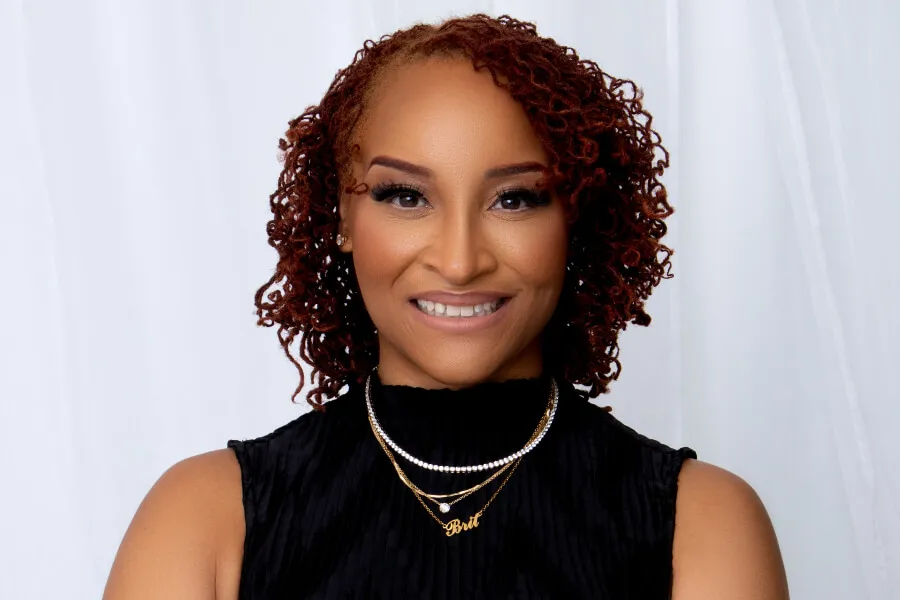
Researcher, Teacher, Student: Dr. Brit Williams Brings Her Public Health Studies Full Circle
Brit Williams, Associate Professor of Higher Education and Student Affairs Administration and Associate Professor of Public Health Sciences, is an interdisciplinary researcher committed to using education to transform lives. Dr. Williams's research focuses on workplace bullying, workplace stress, cancer, and HIV/AIDS. Though she is first and foremost a researcher and a teacher, she is also, right now, a student.
While taking Public Health Advocacy in the Larner College of Medicine's Public Health program, Dr. Williams wrote extensively about HIV education and the importance of preserving minors’ rights to privacy. Around the same time, she attended a national convening focused on Black women's initiatives for HIV/AIDS prevention. Between the course and the meeting, she began to map out a strategy for a new book.
That course became the seed of her emerging book. Early on, she realized that some of what she had written, about recentering sexual health in U.S. public discourse and about barriers to HIV prevention for young people, would help readers understand persistent gaps in biomedical HIV prevention. One of the key arguments she developed in her course assignments, and later carried into her forthcoming edited book, concerns the inadvertent ways minors' patient privacy rights are often treated as secondary to parents' rights to an explanation of insurance coverage. Young people worried about their parents finding out about their sexual behavior may forgo or reduce HIV and STI testing out of fear of retribution, a problem Dr. Williams argues is especially urgent in the age of biomedical HIV prevention, since insurers and providers alike have the capacity to better protect and serve minors while still fairly explaining costs to parents. Her work also examines the many dimensions of advocacy and care needed to advance biomedical HIV intervention, from schools and community organizations to social media campaigns, all threads that run through the book.
That book, Black American Women and the Fight for PrEP: All We Got Is We and Us, was co-edited by Dr. Williams and Dr. Marissa Robinson of Real Health Impact. Together they assembled a cadre of scholars, providers, community leaders, and policy advocates to offer insight into, and trace the history of, Black women's relationship with PrEP, while contributing new and emerging research and data. The editors intentionally structured the volume to let Black women on the ground share their own stories, in their own words and on their own terms. In doing so, the book highlights how stigma, medical mistrust, racism, and social determinants of health have shaped a PrEP landscape in which Black women remain disproportionately under-prescribed and undereducated. The volume centers on cisgender Black women and girls, given their disproportionate burden of HIV; while honoring and acknowledging Black trans women, the editors believe trans women are best positioned to tell their own stories within the HIV/AIDS prevention landscape. The book's aim, as its subtitle suggests, is to amplify Black women's long history of educating, centering, and saving themselves, offering the stories within as roadmaps, institutional memory, and action-planning guidance that readers can use to build partnerships, forge new approaches, and develop a collaborative, culturally sensitive understanding of where to go from here, at a moment when Black women are being rapidly pushed out of the public health landscape.
As a student in the public health program, Dr. Williams has been combining prior knowledge with new learning to sharpen her understanding of the social and behavioral dynamics that shape individual decision-making, as well as the health systems and legal and medical regulatory norms that surround them. The experience has also changed how she shows up as a teacher. She says she now thinks more critically about the full dimensions of her students' experiences, not just in the classroom and on campus, but in how outside forces reshape their connections to learning. Continuing her education through the MPH program while serving as faculty, she says, has left her better prepared to teach a wider range of courses, on a wider range of topics, in a wider range of modalities.
"All of the assignments and courses that focused on public health communications have truly changed the ways I amplify my scholarship beyond academe," Dr. Williams said. "I think more intentionally about how to reframe my research for varying audiences while remaining honest and true to the spirit of the work. This isn't a matter of simple verbiage accessibility but truly thinking more about how to distill the work down to the portions that are most important and significant based on the communities I'm speaking with, while also giving them the flexibility and freedom to demand more of me and the work."