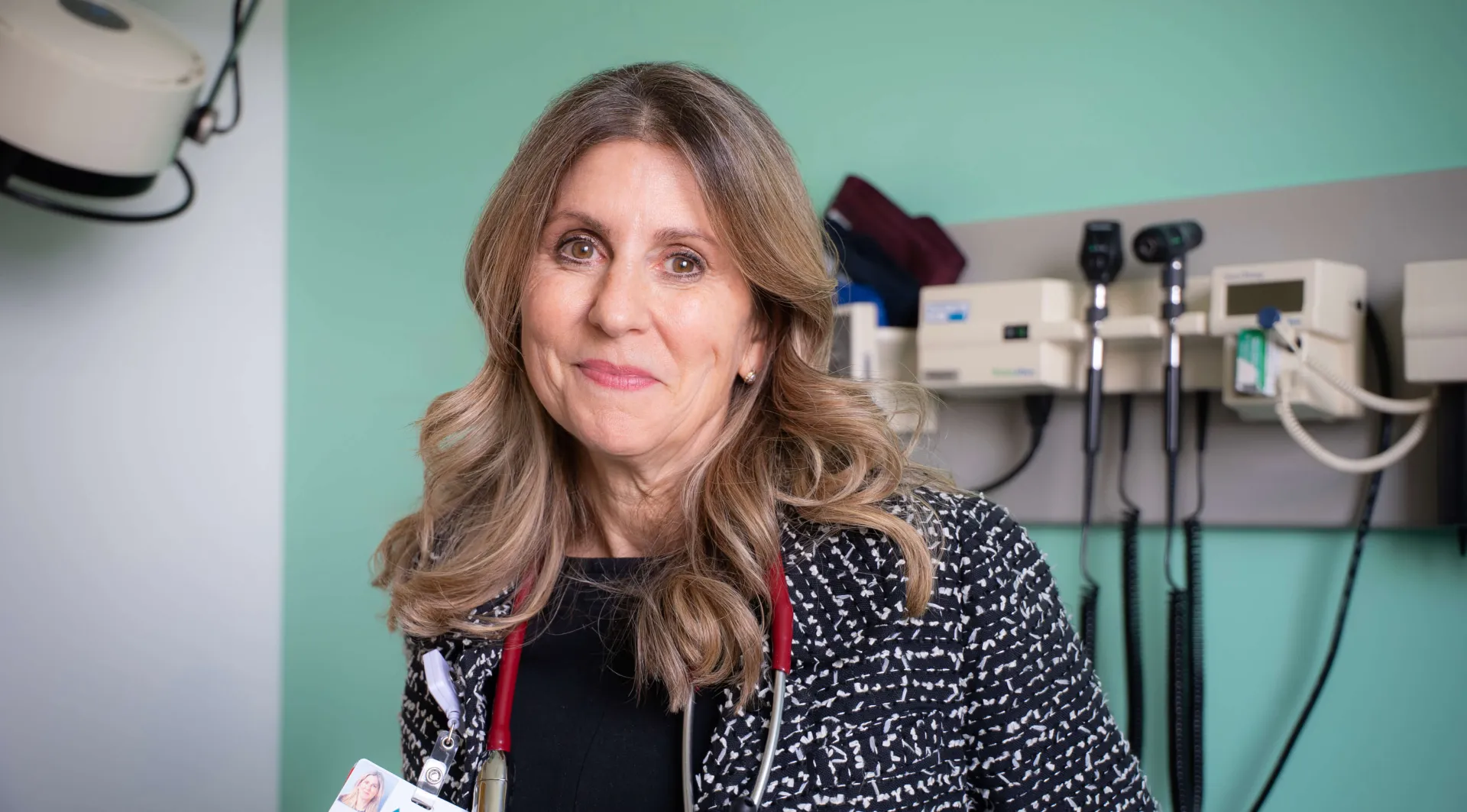
Judy Schaechter, M.D., M.B.A., joined UVM Health and the Robert Larner, M.D. College of Medicine at the University of Vermont on July 1, 2026, as chair of the Department of Pediatrics and chief of pediatrics at Golisano Children’s Hospital at UVM Health. She succeeds Lewis First, M.D., M.S., and will lead the department’s clinical, research, educational, and advocacy missions.
A nationally recognized pediatrician and health care leader, Dr. Schaechter most recently served as director of the Centers for Disease Control and Prevention Division of Violence Prevention. Her career has included leadership roles at the American Board of Pediatrics and the University of Miami Miller School of Medicine. She also spent a year as a Robert Wood Johnson Foundation Health Policy Fellow, participating in the legislative process with the United States Senate Health, Education, Labor, and Pensions Committee, Subcommittee on Children and Families.
We sat down with Dr. Schaechter to learn more about her background, what inspired her career in pediatrics, and what excites her most about joining the Larner College of Medicine and UVM Health.
You have seen health care through a national lens, and you worked in a densely populated, urban area. How does that inform the work you want to do here in Vermont and Northern New York, and what are some of the common themes that you feel carry over to our rural health care environment?
JS: So much of my career has been focused on prevention, and that’s the bread and butter of pediatrics. We are concerned about the future health of our patients, minimizing the negative and optimizing the positive childhood experiences that support their growth, development, and emotional, social, and academic health. We focus on reducing the risks to children, such as injuries from car accidents or burns or violence. That’s a national lens applicable at the very local level, through partnerships and community-based initiatives.
One of the things that I love about Vermont is that medical professionals here understand the intersection between individual health and public health. My predecessor, Dr. First, talked about the “hospital without walls,” and what that means to me is that we are all part of taking care of children and families. We have a responsibility that is not only at the medical center, not only in the exam room, but also connected with those who provide services to children—teachers, early childcare providers, dentists, community organizations, and, of course, families—everyone who makes decisions that affect children and the people who love and take care of them.
You started making connections with people in our region long before your official start date of July 1. Whom have you met and what have you been learning?
JS: Yes, I started connecting with people here about five weeks before I stepped into the role of chair, and it’s been really fun! It has given me a chance to listen and learn, to better understand what’s happening across the university and the health network in our shared missions for education, research, clinical care for children, and for advocacy.
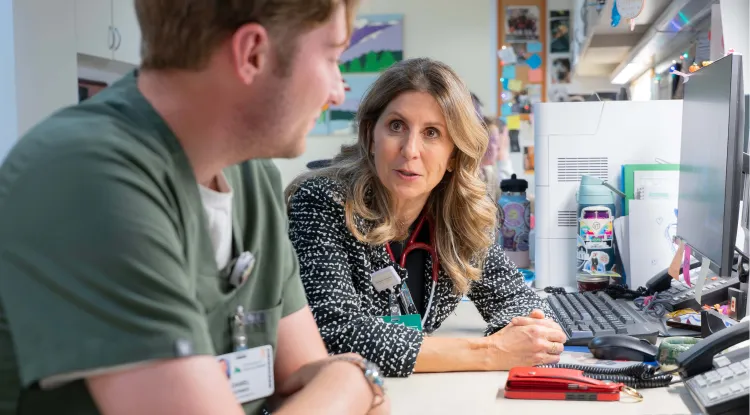
What I hold most dear is that it’s given me the chance to connect with so many people who care for and about children—nurses, mental health workers, lactation support professionals, our learners, child-life specialists who advocate for children, our therapy dogs and their caregivers. We had a picnic with pediatrics residents, and I got to know them and their families. I’ve started connecting with other pediatricians, visiting their practices. These experiences have confirmed more deeply what I could see with admiration long before I got here: that Vermont’s child health providers here care about children together—and see that as a shared responsibility.
“I recognized there was something special about the faculty here at the University of Vermont, and that it was a culture of problem-solving through collaboration.” — Judy Schaechter, M.D., M.B.A.
Here at UVM Medical Center, I visited the NICU, the PICU, inpatient pediatrics, labor and delivery, and the mother-baby unit, meeting with multidisciplinary practitioner teams and integrated patient-family advocates. I traveled with Dr. First and some of the UVM Health staff to visit our partner institutions and the pediatric practices of Central Vermont and upstate New York. I met the pediatrics teams at Champlain Valley Physicians Hospital, Alice Hyde Medical Center, Porter Medical Center, and Central Vermont’s Berlin Pediatrics. I visited with some of the local practices in and around Burlington—Essex Pediatrics, Lakeside Pediatrics, Timberlane Pediatrics, and Pediatric Medicine. They were kind enough to allow me to tour their facilities and meet with their providers and nursing staff. I also went to St. Albans to meet pediatricians and staff from Monarch Maple, including one of our own recent resident graduates, who is just starting there. They are all doing great work to give the best care to the patients throughout our region.
I’m looking forward to meeting with the educators around the state, including the early childhood community, K–12, and the folks who do after school programs.
Health care in rural regions presents a lot of challenges, and our health system is currently experiencing those challenges. What do you want families to know about pediatric health care in our region today, and in the future?
JS: Every rural hospital in America is under duress right now, and that has been happening nationwide for a while. What I most want people to know is that our children’s hospital is committed to taking care of our children, and we want children and families to have access to the best pediatric care in their community, close to home. We practice at a high-quality level of excellence that we measure and that is nationally recognized. We follow our metrics and use best practices, and we work on continuous improvement every day.
The Golisano Children’s Alliance found us because we are reaching children across this region and bringing families and patients into the conversation so that we get continuously better. The Golisano funds help mitigate some of the financial strain, but it’s really meant to help us go further as an academic child health center rooted in this community. We will continue to focus on ways we can be more efficient and increase access to provide for everyone. We are expanding care for children with chronic disease and medical complexity, to support families first, as well as their primary care doctors and specialists. We are bringing in, for the first time, a dedicated pediatric allergist, because there’s an increasing need in terms of environmental and food allergies. Our subspecialists in pulmonology and gastroenterology are aiming to expand their practice sites. We just welcomed a new pediatric neurologist. We really do want to make sure that we’re addressing all the needs of all our children. No child should slip through the cracks in this community.
I love that our health network is focused on working with the state to figure out how we do this very complex thing that no one in the United States has really figured out, of providing the highest quality comprehensive care in the most compassionate way, with dignity to all our patients, and to do so with innovation and efficiency. In partnership with the Larner College of Medicine, we are educating the next generation to carry that vision forward.
What inspired you to move to Vermont, and what are you most excited about in your new role and life here?
JS: It’s that sense of collaboration, the caring about one another, generously and authentically. I’ve always deeply believed that all children are our children. I am so excited to be in a community where that sentiment is truly shared. There is a sense that we must pull together and do the right thing for everyone. That it is our collective responsibility. I love that!
I got to know Lewis First because we were both pediatrics chairs. I started paying attention to what Vermont was doing, and I visited about 10 years ago to try to get a feel for the culture here and I liked what I saw—and felt. And then, four years ago, UVM invited me here for the McKay Visiting Professorship [a lectureship that hosts distinguished pediatric experts for grand rounds and faculty/student mentoring], and that opened doors for me to speak with faculty, students, and residents. I was delighted by the passion across the community, where all join to improve things for children across the region.
I recognized there was something special about the faculty here at the University of Vermont, and that it was a culture of problem-solving through collaboration. Things like the Vermont Oxford Network [a worldwide collaboration of hospitals sharing data to improve care for infants], which started here and is global. People around the world trust Vermont with their data and collaborate to improve their own sites and therefore the lives of children. ImproveCareNow [an international collaborative community focused on children and youth with Crohn’s disease and ulcerative colitis] also started here. Vermont Child Health Improvement Program [VCHIP, which uses collaborative measurement-based information to strengthen child health practices and influence policy] is a model around the country.
What is the value of a children’s hospital being part of an academic health system?
JS: Academics means we’re constantly aiming to improve health care, education, and we are constantly pushing the envelope in terms of discovery.
The concept of the physician-scientist is important in pediatrics because we need research informed by clinical care, and clinical care needs science to improve health. We’ve had amazing advances in, for example, childhood cancer treatments, care of premature infants, and congenital cardiac disease. That kind of bidirectional inspiration and operationalization only happens in an academic health system, such as Larner College of Medicine and UVM Health.
Education of medical students, residents, and fellows similarly thrives in that context, where learners benefit from an environment that is at the cutting edge, that seeks to do better every day. And we, as the educators, are challenged by their minds, their questioning.
Academic medical centers such as ours feel a deep responsibility to ensure the future will have the trained workforce we need. Our faculty are teaching the next generation of medical providers the facts of medicine, the inquiry and interpretation of science, and the art of doctoring—what it means to be a good communicator, a caring physician. I am eager to join that effort, teaching in public health and in clinical pediatrics.
“I love pediatrics—yes, because I get to take care of kids and work with families, but also because I get to work with pediatricians.” — Judy Schaechter, M.D., M.B.A.
Just this week I met with a group of medical students starting their pediatrics clerkship. It was a wonderfully diverse group and they were brave to speak to me about their own stories. Each of them went into medicine because of some experience that pushed them to say, “I want to be part of making this better in the future.” Our faculty will educate them, shape them to become skilled physicians, and we will also be shaped by them. That’s one of the gifts of teaching and mentorship.
What issue in child health care worries you the most?
JS: Gun violence. It is the single largest cause of death for children and has been for almost 10 years now, and it’s totally preventable. Gun violence is America’s most preventable disease. It doesn’t just kill and injure; it takes away dreams. Both fatal and non-fatal gun injury destroys families and communities. This isn’t a problem children can fix for themselves. We as adults have to change environments to protect children, to truly care for and about them.
Was there a moment when you decided to become a pediatrician? What is your ‘why’?
JS: When I was in medical school, we took every fourth night on call and we worked 36-hour shifts. We stayed at the hospital as long as we needed to, often working 100-hour weeks. There was a particular night-into-day-into-night, when I was up all night with very sick patients, and then after morning rounds I went to clinic for the day. About midday, I had a 7-year-old patient who was complaining of ear pain. She had a lot of wax in her ear, which I couldn’t clear to see inside the canal, so I had to flush that out with water. I know now you should do that with warm water, because if you use cold water, well you know what happens? With cold water being pushed into her ear, she did what most of us would do—she threw up all over me! My dress, my shoes. Fortunately, I was able to change into scrubs and I finished the day. I went back to my car and tossed my smelly clothes in the trunk and realized it was 7:00 p.m. I had worked more than 30 hours and been thrown up on, and I was smiling to myself! I was really happy despite all that! In that moment, I realized that pediatrics was for me.
I love pediatrics—yes, because I get to take care of kids and work with families—but also because I get to work with pediatricians. We’re sometimes a little quirky, but my colleagues are all really nice people. We’re doing the right things for the right reasons. And all of our patients are cute. I just love the field, and I love the people I work with who share in the care.
How do you and your family connect and have fun?
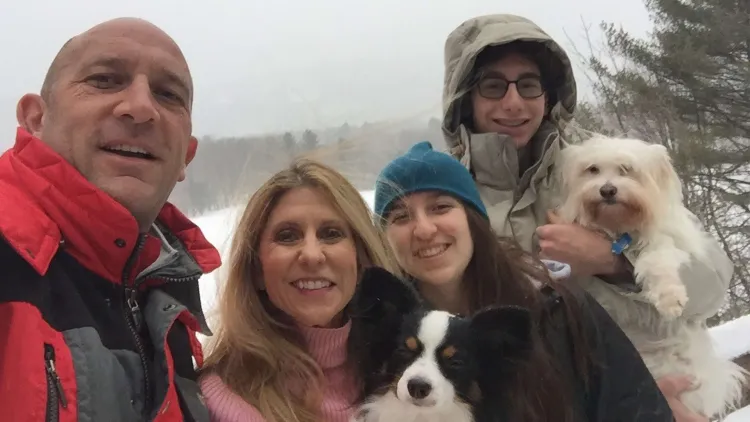
JS: I run, I read a lot, and I have great friends. My husband, Roberto, and I dance salsa and swing, both traditional and West Coast. Our kids are now young adults. Our daughter is an environmental attorney in Washington, D.C., and our son is an environmental engineering-AI researcher at Rice University in Houston.
And I live with the sweetest little dog, Archibald.