- Finding and Approaching Mentors
- Handling Conflicts, Power Dynamics, and Bias
- Inclusive and Culturally Aware Mentoring
- Maintaining and Nurturing Your Mentoring Relationships
- Mentoring Map
- Setting Expectations
- Understanding Faculty Roles
- Value of Peer Mentoring
- What is Mentorship and Why Does it Matter?
- Final Word
What is Mentorship and Why Does It Matter?
Mentoring relationships play a key role in your success as a Ph.D. student. This document outlines mentorship roles, discusses the benefits of a mentoring network, and offers guidance on how to find mentors and leverage them to support your academic, professional, and personal aspirations.1
The goal of a Ph.D. program is to help you become an independent researcher and contribute to human knowledge in your field. This journey typically requires close and sustained mentorship from mentors who support your growth. Effective mentoring can not only support your2 research and professional development, but also connect you to opportunities, help you navigate challenges, and support timely degree completion and strong career outlooks. Ultimately, effective mentoring strengthens the discipline through your contributions. For further reading on the benefits of mentorship for Ph.D. students, please see “The Science of Effective Mentorship in STEMM” (National Academies Press; 2019) and the references therein.
In most Ph.D. programs students train under the guidance of a “research advisor” (also called the “advisor” in this document). Your research advisor serves as your primary mentor to guide your research and academic progress.
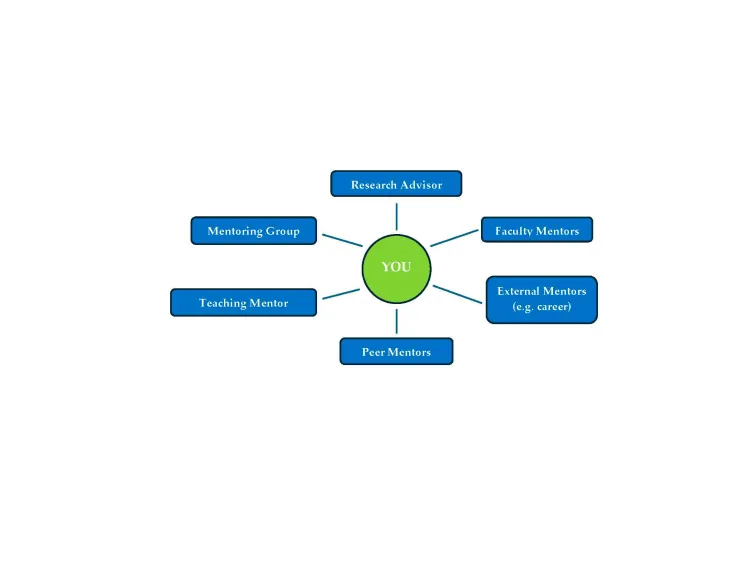
However, no single person can provide all the guidance and support that you may need. You can view a mentor as a guide who helps you see the path towards your goals. The more mentors you have, the clearer and more supported the path becomes. That’s why at UVM, we think of mentoring as a network of connections that support your academic, career, and personal growth. We call this a “mentoring network”. A broad mentoring network gives you access to broad perspectives, reduces over-reliance on a single person, and can better support you during challenging times.
There can be many kinds of mentors. For example:
- Secondary or topical research mentor: A professor or researcher who contributes specialized expertise.
- Career mentor: Faculty, alumni, or professional contacts who provide insight into academic and nonacademic career paths.
- Teaching mentor: A faculty member or teaching staff who supports your teaching skills.
- Peer mentor: A more advanced student or postdoc who offers practical advice on navigating graduate school, research logistics, or departmental culture.
- Life mentor: A trusted person (e.g., faculty, staff, or community member) who provides perspective beyond academics (e.g., resilience, motivation, boundaries).
- Identity-based or cultural mentor: Someone who shares or understands the mentee’s identity, background, or lived experiences and can provide perspective in this area
_________________
1 The content of this document has been adapted from resources developed by CIMER, the University of Michigan’s MORE program, NRMN, and the science of effective mentorship in STEMM. Document initially prepared by Dr. Hamid Ossareh, Associate Professor in Electrical Engineering and Provost’s Faculty Fellow for Graduate Education, 2025.
2 Throughout this document “you” refers to you as the Ph.D. student mentee in a UVM doctoral program.
Understanding Faculty Roles
Faculty members in the Graduate College at UVM may serve you in various capacities, such as:
- Research advisor or co-advisors: Guide(s) your research and dissertation. They are your primary mentor(s) and are closely involved in your day-to-day and long-term intellectual development. This role often entails more frequent contact, keeping track of your progress towards your dissertation, and detailed research discussions.
- Lab supervisor: Oversees lab; you may be a member of the lab’s research group; may or may not be your research advisor.
- Member of the dissertation defense committee: Provides critical feedback on your research and monitors your progress toward graduation.
- Dissertation committee chair: Ensures university processes are followed correctly; must be from outside your and your advisor’s department.
- Course instructors: support your intellectual and professional development by delivering lectures, leading discussions, and holding office hours.
- Mentor: Provides support in various areas, e.g., research, teaching, career and professional advice, emotional encouragement, and skill development. May or may not be your research advisor.
- Sponsor: Advocates for you (e.g., recommending you for opportunities or connecting you with their network). Sponsors trust you and believe you are ready, and have influence and connections.
These roles often overlap. For example, your research advisor may also be your lab supervisor, member of your dissertation committee, mentor, and even sponsor. However, many students mistakenly assume that their research advisor should be their sole mentor. This mindset can limit your growth. We strongly encourage you to seek mentors beyond your advisor (see Section 3 on how to find mentors). Students also often assume that their mentors will promote their careers like sponsors do when, in fact, mentors don’t or can’t always act as sponsors (see Section 5 on how to turn a mentor into a sponsor). Recognizing these distinctions helps you understand who to go to for each kind of support.
Finding and Approaching Mentors
To find and approach mentors (other than your research advisor), you should first self-reflect on your needs, then identify prospects, and finally approach them, as discussed below.
Step 1 - Self-reflect: Think about why you are pursuing a Ph.D. Ask yourself:
- What are my academic and career goals?
- What kind of support do I need (e.g., career advice, emotional support, guidance on research, feedback on papers, knowledge in the field, pedagogy help, technical skills, help with organization and time management skills)?
Step 2 – Identify prospects: Once you have identified your mentoring needs, the next step is to find individuals who can support those needs. Ask yourself: “who has the expertise or experience (besides my research advisor) to support my needs?” Potential mentors might include faculty within or outside your department who have the knowledge or skills in areas that you want to explore, conduct research aligned with your interests, or use tools and methods you would like to learn about. Other examples are postdocs, university staff, other Ph.D. students (i.e., peer mentors), alumni, community members, and/or professionals in your career paths of interest. Note that a mentor need not be in your department.
To find mentors, begin by building connections with people around you. Start with faculty, Ph.D. students, and staff in your department. Talk to them, learn about their work, and see if there are areas where they might be able to offer support. Taking courses with faculty whose work interests you can be a great way to get to know them and establish a relationship. Peer mentors (e.g., other Ph.D. students) can be especially valuable. They can share firsthand experiences and often understand challenges from a student perspective. They may also introduce you to their own mentors or others in their network who can help guide you (see Section 8). Leverage your research advisor as a resource. Ask them to connect you with potential mentors who align with your interests or growth areas.
We recommend you regularly attend talks and seminars and ask questions from the presenters. Sometimes, the presenter can become your professional mentor. In the later stages of your Ph.D. in particular, you will attend conferences and professional meetings where you can network and find mentors outside of UVM. Another great way to connect to external mentors is through MentorNet, which is an online tool that matches mentors and mentees globally: https://greatmindsinstem.org/mentornet/
Finally, you can volunteer to serve on administrative committees or attend graduate school events, where you can meet people and identify potential mentors.
Step 3 – Approach and formalize: To approach a mentor, you have several options. If you are confident someone could be your mentor (perhaps they have expressed a passion for mentorship, seem culturally aware, or are especially approachable), you can ask directly. For example, you can say:
“I’m looking to build a mentoring team and would value your advice on [topic of interest]. Would you be willing to mentor me?”
And if you are unsure, start with a low-stakes conversation. You can say:
“I admire your work on [topic of interest] and would love to hear your advice on how to develop my skills. Would you be willing to speak with me for 15-20 minutes”?
In your conversation, introduce yourself, tell them about your goals, and ask questions. After a few such positive meetings/interactions, ask if they’d be willing to be a part of your mentoring network.
Many faculty view mentoring as part of their professional responsibility and often find it rewarding. So, if they have the time, they will likely say “yes”. If not, they will decline politely and may refer you to someone else. There is little downside to asking.
If the candidate mentor agrees to mentor you, schedule a meeting with them to discuss expectations and goals. A “Mentoring Plan” (next section) can be helpful for this purpose.
Setting Expectations
Effective mentoring requires clear goals and expectations. Early in the mentoring relationship, we strongly recommend having an explicit conversation with your mentor about your short-term and long-term goals and key topics, such as:
- Areas where you need support and areas where the mentor can provide support.
- Preferred communication method and expected response time.
- Frequency and duration for recurring meetings (we recommend once a week for junior Ph.D. students and their research advisors and less frequently for other relationships).
- Form and frequency of feedback, especially if the mentor agrees to provide feedback on your papers or presentations. How much lead time will they need?
- Authorship policies and expectations (if you will co-author papers, or they’ve agreed to provide you with feedback on your work/papers).
- Planned time away (e.g., faculty sabbatical, or medical or parental leave).
We recommend mentors and mentees consider developing a “mentoring plan” to set, and frequently update, clear goals, mutual expectations and boundaries. The plan should ideally cover the topics mentioned above, along with details on how and when your mentoring needs will be addressed. Once someone has agreed to be your mentor, consider sending them a draft mentoring plan before your first meeting so they have time to review it and discuss it with you. You can then refine and complete it together during that initial meeting.
It may feel somewhat awkward when initiating such formal conversations, e.g. a written Mentoring Plan, with a new mentor. However, such plans are widely recognized tools that help clarify expectations and improve communication, so many mentors will appreciate the initiative. To ease into the conversation, you might say: “Mentoring Plans are a commonly used tool to help mentors and mentees clarify goals and mutual expectations. Would you be open to developing and reviewing one together?”
Maintaining and Nurturing Your Mentoring Relationships
After you have defined the goals and expectations of your mentoring relationship, you will need to nurture the relationship to support your growth.
Keep Regular Contact: Schedule regular check-ins to meet with your mentor and keep them updated about your progress. We recommend that you take on the responsibility of scheduling these regular meetings. The frequency and length of these meetings should be decided jointly. Make sure to come prepared for these meetings: come with an agenda and a list of questions or concerns.
In the meetings: Ask your questions and share your concerns, but also listen carefully (i.e., practice active listening). Be open to feedback, even if it is critical. Remember, your growth is the goal here. If the feedback seems confusing, biased, or misaligned, say so respectfully (or think about it and discuss it at a future meeting). Discuss the feedback/advice that you received at prior meetings to show that you are taking their advice seriously. You could say
“Thanks for your advice last month. I applied it and it made a huge difference!”
After each meeting, send a note to thank them for their time and summarize the next steps.
Building a two-way relationship: It’s best if the relationship is two-way so that both parties benefit. While most mentors draw satisfaction simply from helping mentees, you should reciprocate when you can. Reciprocity can be as simple as expressing your appreciation. You can also share relevant resources that pertain to their research or other interests, if appropriate. You may also offer support in areas where you think you can contribute.
Take initiative for your development: Since the ultimate goal of the relationship is your growth, it is important that you take initiative and actively drive the relationship. Regularly reflect on your goals, progress, and mentoring needs, (e.g., publishing, skill development, career exploration). If your current mentoring network does not fully meet your needs, seek additional mentors who can provide guidance. Also, remember that you should pursue training, networking, and professional development opportunities (e.g., conference presentations, internships, teaching experiences) throughout your Ph.D., not just towards the end. Ask your mentors for advice on how to identify and pursue such opportunities.
From a mentor to a sponsor: As your mentoring relationship develops, a mentor may transform into a sponsor. As noted in Section 2, a sponsor actively advocates for you and helps open doors to new opportunities. For a mentor to become a sponsor, they must trust you and believe you are ready, but they must also have influence and access to opportunities. When you believe the time is right, you can ask your mentor to be your sponsor. You could ask:
“Would you be open to recommending me for opportunities when they arise?”
Ending the relationship: Finally, it is important to recognize when a mentoring relationship should end. Typically, this happens when the initial goals of the relationship have been achieved (unless the two parties agree to continue the relationship with a new set of goals, or transform the relationship into collaboration or friendship). A mentoring relationship may also end if it no longer provides value to one or both parties. This can occur, for example, if one person becomes too busy to engage in the relationship, or if the two parties realize there is a significant difference in their values and goals.
Handling Conflicts, Power Dynamics, and Bias
Dealing with conflict: Not all mentoring relationships are healthy. You can help create healthy relationships and prevent conflicts and friction by:
- Always maintaining open and honest communication.
- Clarifying your understanding rather than assuming intentions.
- Setting clear expectations early. A Mentoring Plan can help.
Despite your best efforts, conflicts and tensions may still arise. In such situations, first assess the situation: Is this a one-time issue or a recurring pattern? Could it be rooted in miscommunication, mismatched expectations, or something deeper?
If the issue is ongoing and appears to reflect a deeper problem, consider having a respectful and honest conversation with your mentor. For example, you could say:
“I’d like to share some concerns I’ve had about our meetings. I value your mentorship and want to find a way to work together effectively.”
Some conflicts arise due to circumstances outside of your and your mentor’s control. For example, other demands on the faculty may prevent them from meeting with you regularly or providing feedback on your work, leading to poor mentorship. If this becomes a pattern, address it promptly through an honest conversation.
If you cannot resolve the issue, lean on your mentoring network for support. This is one of the reasons why a mentoring network is more helpful than a single mentor. You can say to another of your mentors:
“I’m having some difficulty managing [XYZ] with my research advisor/another mentor. Do you have any suggestions on how I might navigate this situation?”
You can also consult the Graduate Student Ombudsperson, your Graduate Program Director (GPD), department chair, or the Graduate College. If the issue is related to misconduct or harassment, you can contact the Office of Equal Opportunity.
As a last resort, you may consider ending the mentoring relationship. If the mentor is your thesis advisor, ending the relationship should be done only after careful consideration and in consultation with trusted mentors and your graduate program director, the department chair, your associate dean for graduate education, and/or the Graduate College.
Dealing with conflict can be stressful. If at any point you feel that the situation is impacting your mental health, reach out for support to the Center for Health and Wellbeing.
Dealing with power dynamics: power dynamics (i.e., hierarchy in the relationship) can complicate mentoring, especially when the mentor is your thesis advisor or a committee member. The imbalance of power can make it hard to speak up, particularly if you feel your voice is not being fully heard.
One way to mitigate this imbalance might be to use structured tools like a Mentoring Plan to clarify expectations, boundaries, and communication norms early in the relationship. Revise the plan as appropriate as your relationship evolves. It also helps to build a mentoring network, so you are not overly reliant on a single mentor. If you cannot navigate a situation on your own, you can consult with the Graduate Student Ombudsperson and/or leverage your mentoring network.
Dealing with bias: bias can also complicate mentoring. Everyone has biases, including mentors who are well-intentioned and committed to fairness (i.e., implicit bias). Start by learning to recognize signs of bias or uneven treatment, such as being talked over or having assumptions made about your background or abilities that are not made about other mentees. Document problematic interactions (e.g., date, what was said, impact on your work and well-being) to see if patterns emerge. Depending on your comfort level, you can raise the issue indirectly by asking for clarification or feedback, or more directly by discussing the behavior in a respectful, nonconfrontational way. Tools like a Mentoring Plan can be useful for revisiting expectations. If the bias persists and affects your opportunities or well-being, consider consulting the Graduate Student Ombudsperson and/or escalating the issue to your graduate program director or the Graduate College.
Inclusive and Culturally aware mentoring
Mentees and mentors bring a diverse range of identities and worldviews to the mentoring relationship. Some are related to factors such as race, gender, ability, age, socioeconomic class, and country of origin; others may be related to educational background.
Mentees can benefit from having mentors who share identity characteristics, especially in terms of psychosocial support. However, while mentees may prefer mentors with similar identities, what is ultimately important is the mentor’s ability to recognize these identities and their role in their career development. Thus, do not limit yourself to mentors with similar identity or lived experiences.
Before choosing a mentor, reflect on your needs and values. Think about the support you need from a culturally-aware mentor (e.g., cultural understanding, flexibility). If you feel safe doing so, initiate an open conversation to help your mentor understand how your background shapes your experience and goals in academia. For example, you can say:
“As a [first-gen, international, BIPOC, LGBTQ+] student, I sometimes feel that I am not on equal footing with my peers. I’d appreciate your perspective on navigating this.”
Such conversations can help your mentor become more responsive. At the same time, it is important to protect your boundaries. You are not obligated to educate others.
Some mentors may not be able to provide the culturally aware mentorship that you need. In this case, actively seek additional mentors who can fill this role.
Finally, inclusive mentoring relationships are two-way streets. You should also do your part to create a climate of inclusion and trust in your mentoring relationships
Value of Peer Mentoring
Peer mentoring is one of the most valuable forms of support in graduate school. Unlike other forms of mentorship, peer mentoring is based on mutuality rather than hierarchy. A peer mentor may be a more advanced Ph.D. student who has already walked the same path and can provide advice and feedback. It could also be someone at the same stage of their doctoral journey and you can support each other’s growth. In general, peers can:
- Offer insights into department norms and the unwritten rules of Ph.D.
- Suggest resources and mentorship opportunities.
- Provide feedback on your research, writing, and presentations.
- Provide emotional and social support.
Remember that your current peers will become your future colleagues, so these networks are valuable for your career beyond your Ph.D. studies.
One way to cultivate peer mentoring relationships is by forming a study or writing group. In particular, you can invite peers from your lab or department to meet regularly to discuss your research or writing. You could say, for example: “I’ve been struggling to write up my research. Would you be open to weekly check-ins to support each other’s progress?” If you form such a group, agree on the rules and expectations early on (e.g., confidentiality, form and frequency of feedback, etc.). Be attentive to diverse backgrounds and experiences in your groups.
Another way to leverage peer mentors is through less formal check-ins. You could say for example: “Do you have time to chat about your experience with the qualifying exam? I’d really appreciate any insights.”
Peer support can make the Ph.D. experience less isolating.
Mentoring Map
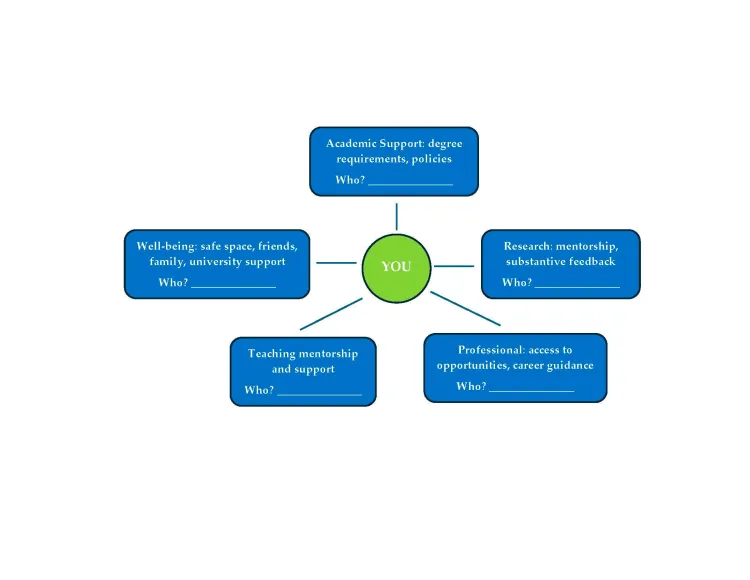
As you build and grow your team of mentors and identify people and resources that can support your growth throughout your Ph.D., creating a mentor map can help you visualize who to reach out to for different types of support. Using the mentor map below and for each category, write the name or support service for the who.
Final Word
As a final word, remember that strong mentoring relationships help you thrive. As you grow in your Ph.D. journey, you yourself will eventually become a mentor. Reflect on what worked well for you and pay it forward to others.