College of Nursing and Health Sciences

Type of Degree

M.S.

School or College

College of Nursing and Health Sciences

Area of Study

Health and medicine

Program Format

On-campus, Full-time, Part-time

Credit hours to graduate

30 non-thesis, 36 thesis

Program Overview

The Exercise Science M.S. at the University of Vermont prepares future exercise professionals to apply evidence‑based science to improve health, prevent injury, manage chronic disease, and optimize human performance.

This in‑person program is designed to integrate advanced scientific coursework, experiential learning, and close faculty mentorship. Graduates are prepared to work across healthcare, performance, wellness, and research settings, or to pursue advanced doctoral and professional education.

Program highlights

  • Vermont’s only M.S. in Exercise Science
  • 100% in‑person, cohort‑based learning
  • Small cohorts (6–10 students per year)
  • Flexible thesis and non‑thesis pathways
  • Strong integration of research, clinical, and community engagement

Why Exercise Science at UVM?

Exercise science connects human health, physical performance, and well‑being through rigorous scientific inquiry. UVM’s program is designed to meet growing workforce and societal needs in:

  • Public health and healthy aging
  • Injury prevention and rehabilitation
  • Chronic disease prevention and management
  • Athletic and human performance optimization

Graduates develop advanced competencies in exercise prescription, movement analysis, research translation, and professional communication, skills increasingly sought across healthcare and performance sectors.


Nancy Gell

Spotlight: Department of Rehabilitation and Movement Science receives CDC-funded grant for 9/11 responders 

For Nancy Gell, promoting healthy behaviors is all about prevention. With more than 25 years of clinical experience as a physical therapist, the director of the Exercise Science M.S. program focuses on preventing functional decline in folks aging with chronic diseases and increased fall risk.  

In 2025, Gell received a grant from the Centers for Disease Control and Prevention to pilot a tele-exercise program for World Trade Center responders, a population experiencing higher rates of an aggressive form of prostate cancer. 

The two-year project will evaluate the impact of responders’ participation in a group-based exercise program focused on aerobic capacity, strength, and balance, which are key components in mitigating the effects of cancer and aging. Read more about this research collaboration

Concentrations

Program Structure

Delivery: 100% in person
Time to completion:

  • Non‑Thesis Track: 30 credits (approximately 1.5 years)
  • Thesis Track: 36 credits (approximately 2 years)

Two Pathways, One Strong Foundation

  • Non‑Thesis Track
    • Advanced coursework in exercise science
    • Internship‑based capstone experience
    • Ideal for professional practice, certification, or professional school preparation
  • Thesis Track
    • Original research conducted under faculty mentorship
    • Thesis proposal, research project, and public defense
    • Ideal for students pursuing PhD or research‑focused careers

Curriculum

Curriculum Highlights

Our curriculum combines a strong scientific core with flexibility to tailor the degree to individual academic and professional goals.

Core Exercise Science Courses

Students complete advanced coursework that builds deep theoretical understanding while emphasizing real‑world application across health, performance, and rehabilitation contexts.

  • EXSC 6045: Advanced Exercise Physiology (3 credits)

    An in‑depth examination of physiological responses to acute exercise and chronic training. Students explore the regulation and integration of metabolic, cardiovascular, and respiratory systems, with applications to health, performance, and clinical populations.

  • EXSC 6018: Advanced Biomechanics (3 credits)

    Students connect advanced biomechanical theory with principles of 2D and 3D motion analysis. The course emphasizes data collection, modeling, and analytical techniques used to quantify human movement across performance, injury prevention, and rehabilitation settings.

  • EXSC 6024: Sports Medicine and Performance (3 credits)

    A combined lecture and laboratory course exploring the physiology and pathology of injury, acute and chronic injury prevention and management, and movement assessment for athlete health and performance. Students also examine current and emerging trends in sports medicine and performance science.

  • EXSC 6032: Motor Learning and Performance (3 credits)

    An advanced study of the structure and function of the central and peripheral nervous systems underlying human motor control. Students examine how movement is acquired, refined, and optimized across skill levels and populations, with applications to rehabilitation, sport, and performance.

Research, Inquiry, and Professional Skills

All students complete coursework in:

  • Biostatistics
  • Critical inquiry and evidence‑based practice
  • Research methods in exercise science
Culminating experience
  • Non‑thesis: Internship‑based capstone applying exercise science knowledge in real‑world settings
  • Thesis: Original research project culminating in a thesis and defense

Customizable Elective Pathways

Students may tailor their program through electives aligned with career goals, including:

  • Strength and conditioning
  • Rehabilitation and injury prevention
  • Physical activity and public health
  • Metabolism and chronic disease
  • Motor control and neurorehabilitation

Students may also complete coursework toward an Integrative Health and Wellness Coaching certificate, with eligibility to sit for national board certification, as part of the MS degree.

Deadlines

Applications are accepted on a rolling basis.

Admissions

Admission Requirements

Applicants must have:

  • A bachelor’s degree from an accredited institution
  • Minimum cumulative GPA of 3.0
  • Prerequisite coursework in:
    • Human Anatomy (1 semester)
    • Exercise Physiology

Application Materials

  • UVM Graduate Application
  • Statement of career interests
  • Two letters of recommendation (at least one academic)
  • TOEFL (international applicants; minimum score of 90)

Take the Next Step

Ready to advance your career in exercise science?

Faculty Expertise

Students learn from nationally recognized faculty across exercise physiology, biomechanics, motor control, sports medicine, and public health.

Program Director
Nancy Gell, PhD, MPH
Associate Professor, Exercise and Movement Science
Expertise: Physical activity, chronic disease prevention, public health

Participating Faculty Include:

  • Connie Tompkins, PhD – Pediatric exercise science and chronic disease prevention
  • Timothy Tourville, PhD, ATC – Sports medicine and injury prevention
  • Theodore Angelopoulos, PhD, MPH – Exercise physiology, metabolism, weight management
  • Boyi Dai, PhD – Biomechanics and injury prevention
  • Jasmine Mirdamadi, PhD – Motor control and learning
  • Kit Vreeland, EdD, MBA, ATC – Sports medicine and performance

Nancy Gell

Associate Professor

Connie Tompkins

Associate Professor of Exercise Science Undergraduate Program Director of Exercise Science Secondary appointment: Associate Professor in the Department of Pediatrics at The Robert Larner, MD College of Medicine

Timothy Tourville

Associate Professor

Boyi Dai

Professor Department Chair

Jasmine Mirdamadi

Assistant Professor

Kathryn Vreeland

Clinical Professor

Outcomes

Career Outcomes

You'll graduate prepared for careers across healthcare, performance, wellness, and research, including:

  • Exercise Physiologist
  • Strength and Conditioning Coach
  • Health and Wellness Coach
  • Clinical or Applied Researcher
  • Corporate or Community Wellness Manager

The program also provides strong preparation for:

  • Doctoral programs (PhD, DPT, OTD)
  • Medical, nursing, and allied health professional programs

National labor data project continued growth in exercise physiology, fitness, and wellness leadership roles over the next decade.

Costs and Funding

Tuition & Financial Support

  • In‑state tuition: $692 per credit
  • Out-state tuition: $1,200 per credit

Merit‑based scholarships are available through the Graduate College. Additional opportunities may include graduate assistantships, teaching roles, and faculty‑funded research support.

More

Experiential Learning & Community Engagement 
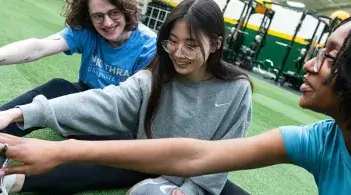
Experiential learning is central to the MS in Exercise Science. Students engage in applied learning through: 

  • Community based health and wellness initiatives
  • UVM Athletics and performance settings
  • Adaptive and inclusive fitness programs
  • Research laboratories and field based projects 

Students contribute to programs serving the local and regional community, including Unified Fitness, Special Olympics partnerships, youth physical activity initiatives, older adult strength and balance programs, and disease specific wellness programs.

Experiential Learning & Community Engagement

three people stretching

Community-based health and wellness initiatives

Students contribute to programs serving the local and regional community, including Unified Fitness, Special Olympics partnerships, youth physical activity initiatives, older adult strength and balance programs, and disease specific wellness programs.
woman checking and man with shorts on

Experiential learning

Experiential learning is central to the M.S. in Exercise Science. Students engage in applied learning through:

- Community-based health and wellness initiatives
- UVM Athletics and performance settings
- Adaptive and inclusive fitness programs
- Research laboratories and field-based projects
group of people doing exercise

Research laboratories and field-based projects

Undergraduate research can also provide invaluable experience in preparation for graduate school or other advanced degree programs
Loading...