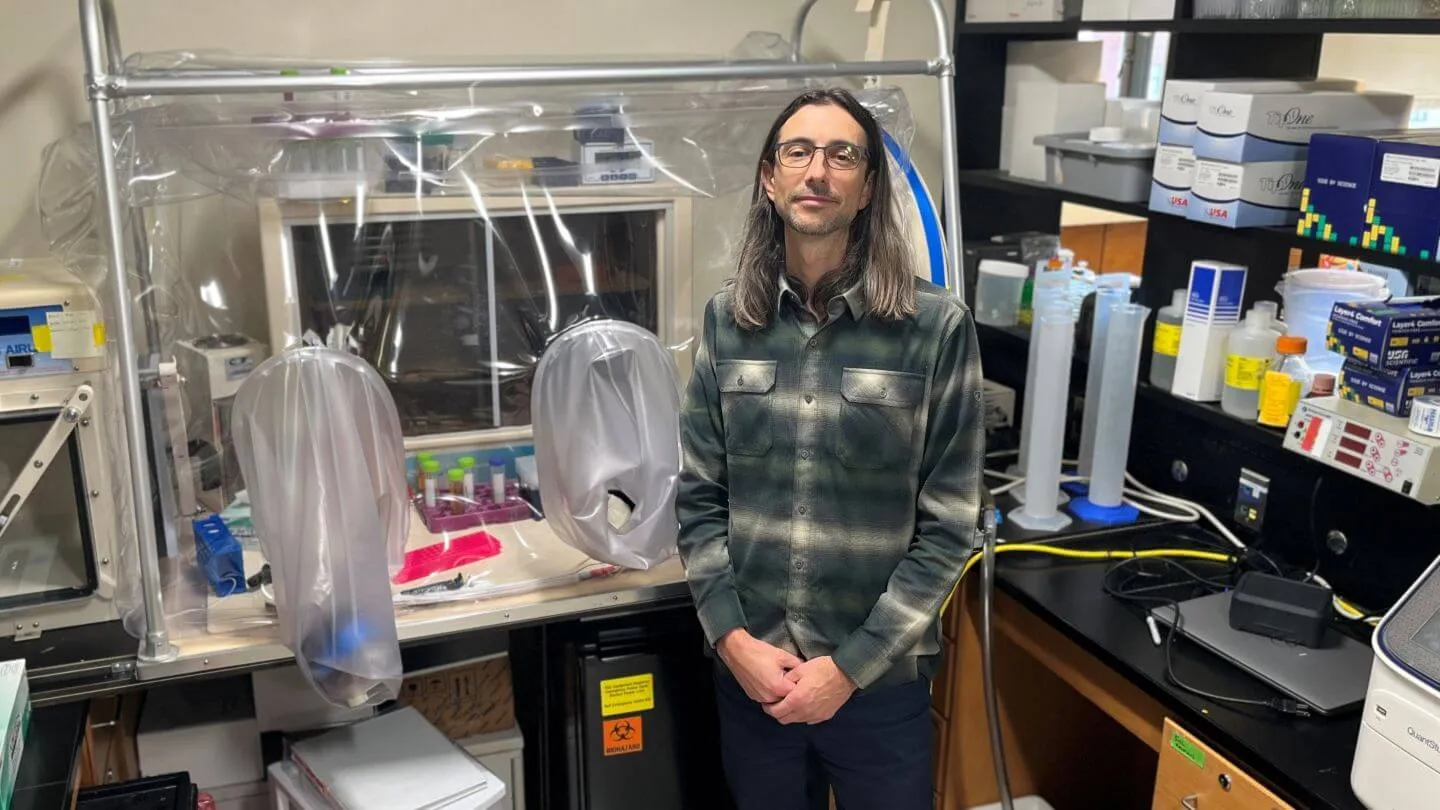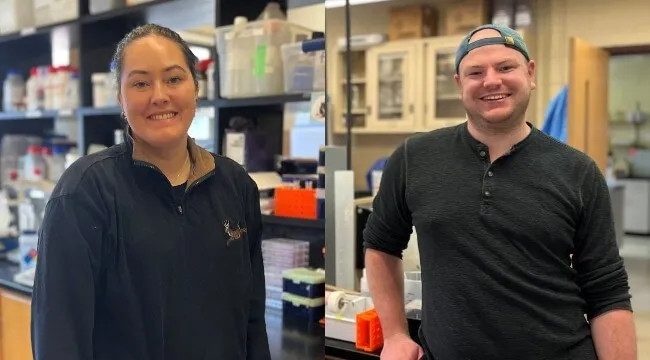
Graduate students Courtney Waytashek and Tyler Hogan are tackling important questions about how the immune system responds to infectious disease in the Krementsov Lab. We caught up with both students to learn more about their research, what sparked their interest in immunology, and what excites them most about their work.
Courtney Waytashek: Investigating Viral Drivers of Immune-Mediated Disease
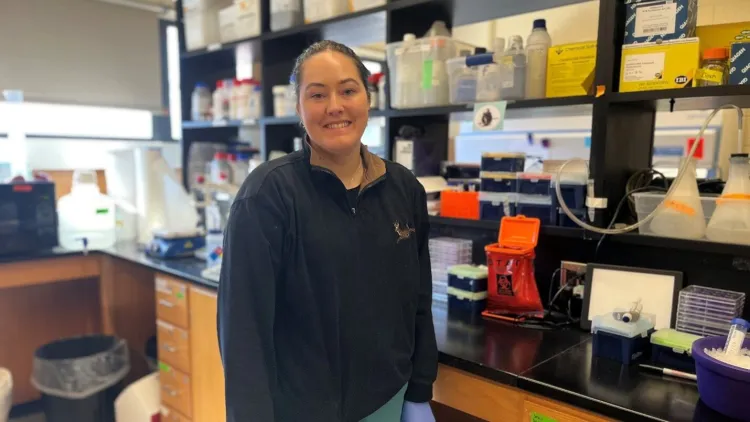
Fifth-year Ph.D. student Courtney Waytashek, a trainee in UVM's Cellular, Molecular and Biomedical Sciences (CMB) program, studies host genetic and immunologic factors that regulate gammaherpesvirus infection. Gammaherpesviruses (EBV and KSHV) have been strongly linked to cancer and autoimmune disease, including MS. Her training in immunology and host-microbe interactions complement the lab's broader efforts to understand immune-mediated disease. Courtney’s work was previously supported by the Vermont Immunology and Infectious Disease NIH T32 training grant, and more recently, an NIH individual F31 fellowship award. Here’s a look into her research experience:
Q. What drew you to join the Krementsov Lab?
Waytashek: I initially earned a bachelor’s degree in biology, but I was especially interested in infectious disease and microbiology. After graduating, I worked as a laboratory technician for two years at Oregon Health & Science University’s Primate Center, where I conducted HIV cure research from 2020 to 2022. At the time, there were two patients who had been functionally cured of HIV through stem cell transplantation, a procedure intended to eliminate the viral reservoir. However, there had also been many unsuccessful attempts. Stem cell transplantation carries significant risks because patients become severely immunocompromised for a period of time, and they can also develop graft-versus-host disease, where the new immune system attacks the body and causes serious autoimmune complications. Our team was investigating why the treatment worked in some cases but not others. Using non-human primate models, we studied the mechanisms underlying successful stem cell transplantation in hopes of better understanding those differences. When I came to UVM for my Ph.D., I wanted to continue studying viral immunology, specifically how the immune system influences viral infections and disease outcomes. I was also interested in the role genetics plays, since we all have distinct genetic backgrounds. Not necessarily through mutations, but through natural genetic variation that can influence how the immune system functions and, ultimately, how effectively someone controls a virus. That was exactly the focus of one of the projects in the lab, which is what drew me to join.
What is your current research focus?
Our most recent publication, which is currently under revision, focuses on Epstein-Barr virus (EBV), a gammaherpesvirus carried by more than 95 percent of adults. While most people never know they have it, EBV is associated with an increased risk of certain cancers and autoimmune diseases, including multiple sclerosis. Using a mouse model of the virus, MHV-68, we study why some mice are naturally resistant and do not develop a mono-like illness while others do. By identifying the genetic and immune differences between those groups, we're trying to understand what protects against disease. There are currently no treatments, cures, or ways to prevent EBV infection. By better understanding how the body controls the virus, we hope to uncover insights that could eventually improve prevention and treatment strategies.
How has working in this lab shaped your development as a scientist?
One of the biggest ways this lab has shaped me is by expanding my understanding of host genetics. Before coming to UVM, my work focused primarily on how viruses interact with immune cells, particularly T cells. What I wasn't really studying was how underlying genetic variation influences those outcomes. This lab has given me a much deeper appreciation for the role genetics plays in immune system function. It also introduced me to a completely new model system, moving from non-human primates to mice. Learning how genetic and immune differences shape disease has changed how I approach scientific questions and given me a broader perspective on both infectious disease and immunology.
Working in the lab has also given me a lot of experience designing experiments, especially animal studies. As a technician, you're usually told when things are happening and what to do. Here, you're doing all the planning yourself, which requires thinking on a very different time scale. I've also gained a lot of virology experience that I didn't have before. In my previous HIV research, we focused more on detecting the virus through DNA and RNA. Here, I've learned a lot of cell culture-based techniques to look at how the virus is actively replicating and how to get it to reactivate from cells, which is pretty cool.
“Dimitry is really big on professional development. I've become more confident presenting in front of large groups, and my writing has improved through iterative drafting and feedback. What he's really big on is helping us develop as scientists.” - Courtney Waytashek
What are your career goals, and how has the Krementsov Lab helped prepare you for them?
My main goal is to eventually run a lab, either at an academic institution or in a government-run research lab. A big part of that is learning how to become an independent researcher. That includes writing effectively, conducting research, mentoring students, and understanding how a university lab operates, from finances to administration. I've had opportunities to mentor undergraduate students, which has been a really valuable part of that process.
Dimitry has been very helpful in showing me the behind-the-scenes aspects of running a lab. He's also been a great mentor when it comes to grant writing and making sure I'm developing the skills I'll need for the next stage of my career. Right now, I'm looking for a postdoctoral position, which is the typical next step before applying for faculty positions. Dimitry has been helping me identify opportunities and prepare applications. As a lab, we also do a lot of practice talks before interviews, which has been really helpful.
Was there a moment when you knew this was your career path?
As an undergraduate, I took a special-topics seminar on vector-borne disease. I originally signed up because I liked the professor and thought the topic would be interesting. Over the course of the semester, I spent a lot of time reading the literature and learning about dengue virus, and that's really what did it for me: I found the science incredibly interesting, and we also had to write a practice grant proposal, which I actually really enjoyed. Around the same time, I became involved in research as an undergraduate and realized I really enjoyed working in the lab. All of those experiences happened within a fairly short period, and together they helped me realize that this was what I wanted to do.
Tyler Hogan: Uncovering New Regulators of Inflammation and Sepsis
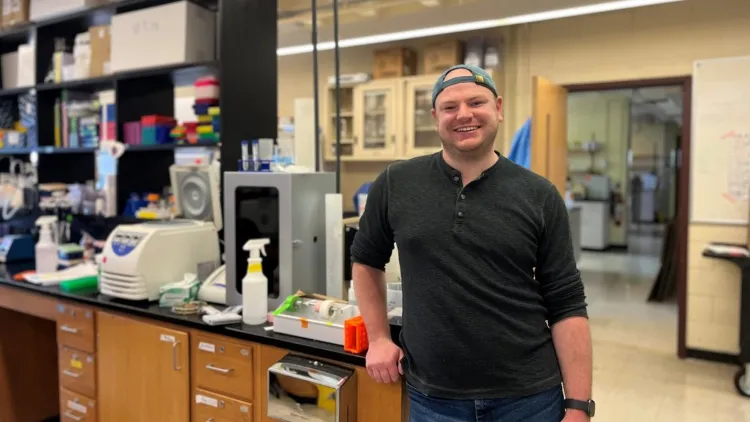
Fourth-year CMB Ph.D. student Tyler Hogan investigates the biology of a newly identified secreted protein involved in the regulation of sepsis and inflammatory responses. His work contributes to the Krementsov Lab's expanding portfolio of research focused on the genetic and molecular mechanisms that shape immune function and disease outcomes. Tyler’s work was previously supported by a Graduate Assistance in Areas of National Need (GAANN) training grant from the U.S. Department of Education, and more recently, an NIH individual F31 fellowship award.
Q. How did you get involved with the Krementsov lab?
Hogan: I've been at UVM since 2014, when I started as an undergraduate. I began doing research in 2017 with Paula Deming, whose lab was just down the hall. After that, I worked as a lab technician for her and with Eyal Amiel for five or six years. Later, Dimitry reached out because he had a senior lab technician position available and offered it to me. I said, "Yeah." It was a perfect fit. I was in that role for about 11 months before starting the CMB program.
Could you describe your most recent publication and its key findings?
I'm just about to submit a publication that investigates the biology of a newly identified secreted protein involved in regulating sepsis and inflammatory responses. My research focuses on inflammation, particularly sepsis, which is a major health problem worldwide. Our findings suggest that this protein may play a protective role during sepsis. My work is focused on understanding why it's protective in mice and uncovering the biological mechanisms behind its effects.
How has your experience conducting research influenced your scientific interests and career aspirations?
I originally came to UVM planning to go to medical school. At the time, I didn't really know what career options existed beyond medicine. I was interested in biology, so I thought, "Doctor, that's what I want to do." It wasn't until my junior year that I got involved in research. I had friends who were already doing research, and I also needed a project for my Honors College thesis. Initially, research was a way to build my résumé, and it was also necessary because the Honors College requires a thesis project to graduate. I had a couple of friends in Paula's lab, and the research sounded interesting to me. It ended up being a really fruitful experience. That experience shifted my career goals and set me on the path toward a career in research.
What has surprised you most about the research process?
What has surprised me most isn't necessarily about the research itself, but the satisfaction that comes from mentoring students. Seeing a student follow the same logical path and begin making independent decisions on a project is incredibly rewarding.
The satisfaction of watching students grow is one of the most surprising things I've discovered that I enjoy. I didn't expect mentoring and teaching to become such an important part of my experience, but it's something I've really come to value. There's also a sense of pride. When students first join the lab, they're often not very confident because everything is new and can feel intimidating. They're learning new techniques, working with cells, and trying not to contaminate them, which is very easy to do. Over time, though, there's usually a moment when something clicks. They begin to understand the theory behind what they're doing and can connect all the pieces. It's really satisfying to watch them reach that point and confidently explain their work.
Looking ahead, what do you hope to accomplish during the remainder of your Ph.D. program, and what are your career aspirations?
So far, much of my Ph.D. research has focused on in vitro studies, working directly with cells and conducting small-scale characterization of this new protein. For the remainder of my Ph.D., I'd like to explore its broader role in living organisms by returning to mouse studies. Working with cells provides a very controlled and simplified system, but animals are far more complex, with many biological processes happening simultaneously. I want to better understand the protein's larger role and its broader implications for health and disease. As for my career goals, I think I want to stay in academia. I enjoy the academic environment and really value teaching and mentoring students. My next step will likely be a postdoctoral position to gain additional training before eventually applying for faculty positions.