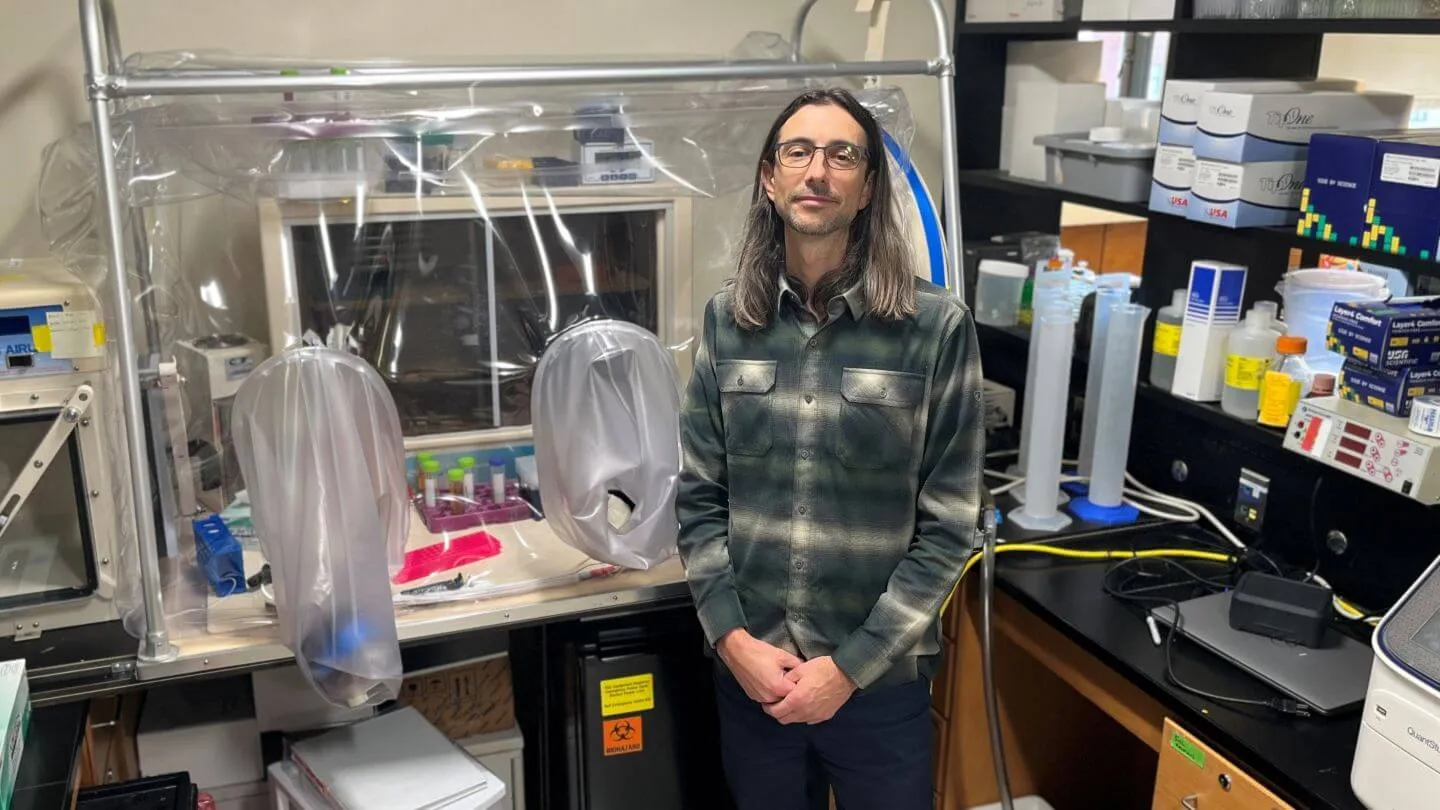
The Krementsov Lab at the University of Vermont has secured more than $880,000 in new National Institutes of Health (NIH) funding to advance research on one of the biggest challenges in multiple sclerosis (MS): understanding why disease progression varies so dramatically from person to person. The two awards will support studies led by Dimitry Krementsov that explore how gut bacteria, genetics, and the immune system interact to influence disease progression, treatment response, and the body's ability to repair neurological damage. The projects build on the lab's longstanding expertise in immunology, microbiology, genetics, and autoimmune disease. Together, the awards will examine how interactions among gut bacteria, diet, and the immune system contribute to differences in MS progression and treatment outcomes. A third, 3-year award from the National MS Society will probe the genetics of myelin repair in MS.
Investigating Vitamin K Production by Gut Bacteria
The first award, an NIH/NIAID R21 grant titled "Modulation of CNS Autoimmunity by Akkermansia muciniphila Vitamin K Metabolism," will provide $422,125 over two years. The project focuses on Akkermansia, a common and potentially beneficial gut bacterium that has emerged as an important player in microbiome research. The team previously found that MS progression is associated with lower levels of Akkermansia and bacterial vitamin K. Researchers will now investigate genetic differences among Akkermansia strains that influence vitamin K production and determine how dietary vitamin K and bacteria-derived vitamin K affect disease progression in experimental models of MS.
Using Multiomic Approaches to Predict Disease Progression
A second NIH/NIAID R21 award, "Regulation of Disease Progression and Therapeutic Response in Multiple Sclerosis by the Gut Microbiota," was awarded to Krementsov and collaborator Yang Mao-Draayer of the Oklahoma Medical Research Foundation as co-principal investigators. The project will receive $461,074 in total funding, including approximately $230,000 to support research at UVM. The study will integrate blood biomarkers and gut microbiome data to predict disease progression and treatment response in MS.
A Chance Collaboration
The work grew from an unexpected discovery made through a collaboration with physician-scientist Dr. Yang Mao-Draayer, a former UVM faculty member now at the University of Michigan. After reconnecting with Krementsov while serving on a grant review panel, Mao-Draayer shared data from an MS biomarker study that included fecal samples collected for microbiome analysis. Her team lacked the tools to analyze the microbiome data, while Krementsov Lab postdoctoral fellow Theresa Montgomery was eager to expand her bioinformatics expertise. For a lab that primarily works with mouse models, the human data presented a unique opportunity. The collaboration proved transformative. After months of analysis, Montgomery identified patterns that led to a publication and launched a new line of research focused on vitamin K and Akkermansia, a gut microbe linked to MS progression. The findings address a major challenge in MS research: understanding and predicting disease progression.
“From person to person, when a person is diagnosed with MS, somebody could essentially have an acute episode of clinical signs and then recover and then be fine for a long time,” explains Krementsov. “Maybe they relapse again, but then they recover and that can continue for many years. People on the other end of the extreme will progress rapidly. What the Krementsov Lab is interested in, and I think the field as a whole is very interested in, is trying to individually predict disease progression so you can tailor the treatment plan.”
The lab is also investigating whether the gut microbiome helps drive disease progression. Using samples collected at diagnosis and paired with five years of clinical follow-up, researchers identified several factors associated with disease progression, including reduced levels of Akkermansia.
“If we can identify biomarkers that predict disease progression, clinicians could potentially use that information to tailor treatment plans earlier and more effectively,” says Krementsov. “If the gut microbiome contributes to progression, that would be really significant, because the gut microbiome is easily accessible and we have methods now to quantify it and analyze it cheaply and we could potentially change the composition of the microbiome through things like diet. That's really interesting to us because we're thinking about microbial metabolism and it's kind of like you are what you eat, but it's what the microbes might take from what you eat and convert into something that ends up in your body.”
Mentoring Future Scientists and Looking Ahead: Genetics of Myelin Repair
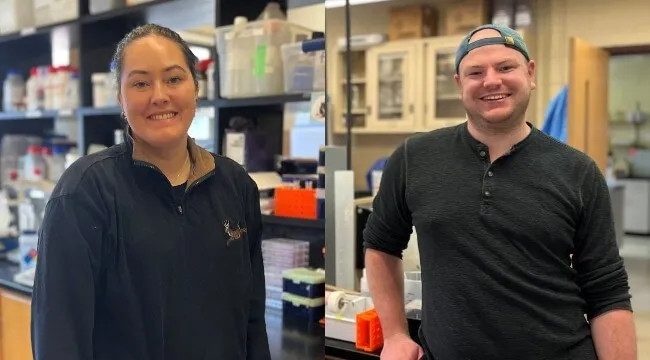
Beyond its scientific findings, the project has provided valuable training opportunities, like those for Montgomery and fifth-year Ph.D. student Courtney Waytashek. Looking ahead, Krementsov plans to expand the lab's research on the genetic factors that influence MS progression.
“Where I see us going is to try to model the genetic causes of disease progression in MS,” says Krementsov. That effort is being advanced through another, recently funded 3-year grant from the National MS Society that brings together Krementsov, Dr. Steven Crocker at the University of Connecticut, and Dr. Peter Calabresi, who recently joined UVM as chair of the Department of Neurological Sciences. The project uses an experimental model developed by Calabresi at John Hopkins University to study myelin loss and repair and the research builds on evidence that the brain can partially repair damage caused by MS. While some patients naturally regrow small amounts of myelin, the process is typically inefficient.
“We want to essentially identify genes that can predict recovery of myelin,” says Krementsov. “We use our mouse models as our tools because we can do much more mechanistic work, and we're working with a different model that other people have used to specifically look at myelin loss and then myelin recovery in a very controlled fashion. We can look at the timing and see if there are different mouse strains that can recover particularly well, which might eventually tell us which genes and which mechanisms are important for that.”
By identifying the genes and biological pathways involved in myelin repair, the team hopes to uncover new therapeutic targets that could help restore function and slow disability progression in people living with MS.
“Microbiome may be one part of the puzzle why somebody progresses or not, but we think that genetics are actually a very big part of that as well,” says Krementsov. “And if we can understand what some of those genes are, we can maybe predict progression, but maybe more importantly, if we understand what the genes are, we can figure out how they work to drive progression and maybe that gives us a new pathway to intervene.”